2020 Ford F-350 Towing Capacity Chart: The Definitive Guide to Engine Specs, Axle Ratios, and GCWR

The heavy-duty truck market in North America is defined by a singular, relentless pursuit: capacity. For the 2020 model year, the Ford F-Series Super Duty, specifically the F-350, underwent a transformative engineering overhaul designed to reassert dominance in a segment characterized by fierce competition from Ram and General Motors.
This report provides an exhaustive, expert-level analysis of the 2020 Ford F-350 towing capacity, synthesizing factory specifications, SAE J2807 compliance standards, and real-world performance metrics into a definitive resource for heavy-haul practitioners.
At the core of the 2020 update was the introduction of the third-generation 6.7L Power Stroke® V8 Turbo Diesel, the first engine in the heavy-duty segment to breach the 1,000 lb-ft torque barrier, delivering a class-leading 1,050 lb-ft. Simultaneously, Ford introduced the 7.3L “Godzilla” OHV V8 gas engine, a clean-sheet design aimed at commercial fleets and recreational towers seeking diesel-adjacent capability without the complexity of modern emissions systems.
These powerplants, paired with the all-new 10-speed TorqShift® automatic transmission, fundamentally altered the towing calculus for the F-350 platform.
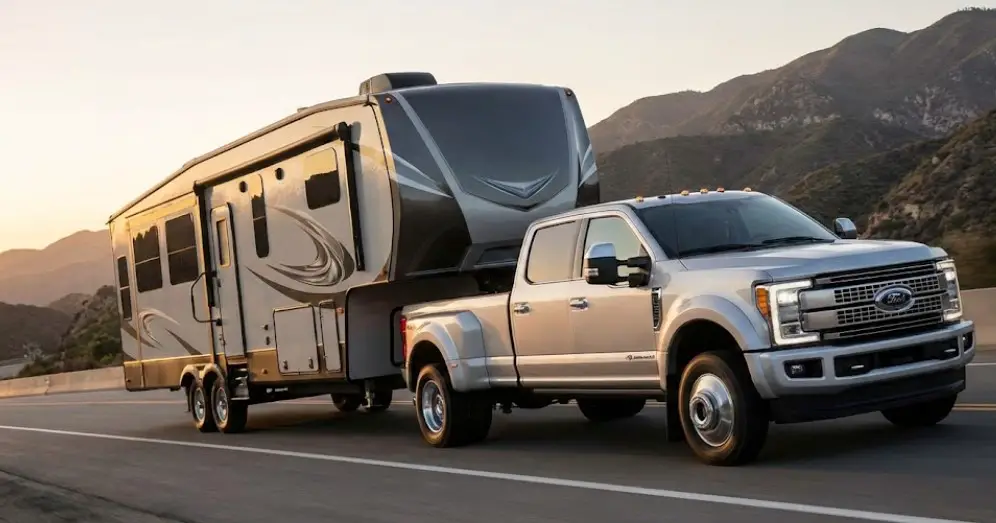
This report dissects the granular details of the towing charts, exploring the critical interplay between Gross Combined Weight Rating (GCWR), axle ratios (3.31, 3.55, 3.73, 4.10, 4.30), and chassis configurations (SRW vs. DRW). We analyze the engineering enhancements—from the high-strength military-grade aluminum alloy body to the fully boxed steel frame—that underpin the F-350’s maximum gooseneck towing capacity of 35,750 lbs.
Furthermore, we investigate the “second-order” effects of these specifications, such as the impact of payload limitations on realistic towing potential and the maintenance implications of the gas-versus-diesel decision.
2020 Ford F-350
Towing Capacity & Specs
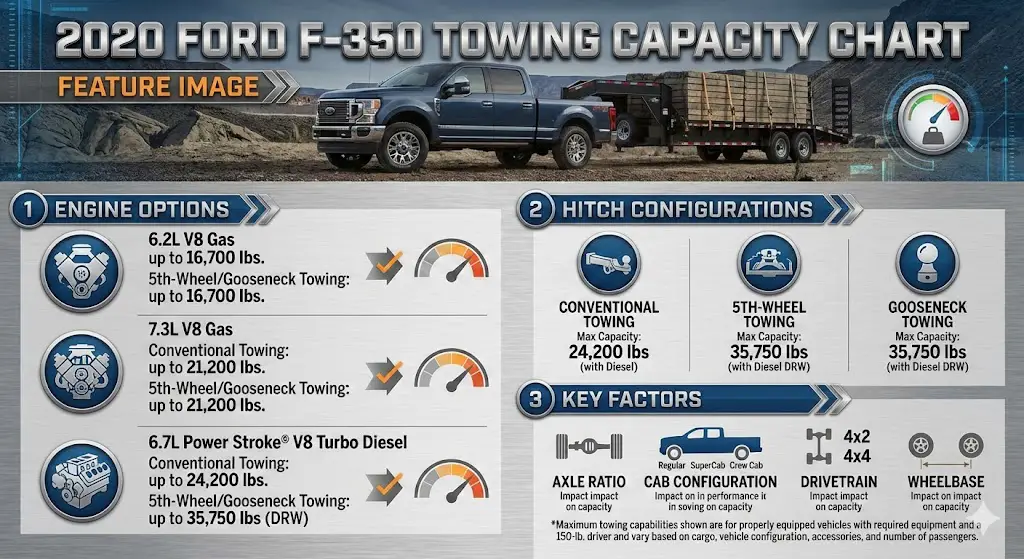
The 2020 Super Duty lineup introduced the massive 7.3L “Godzilla” V8 and a 3rd-generation 6.7L Power Stroke. Understanding the towing chart requires navigating engine specs, axle ratios, and hitch types. Here is the data breakdown.
The Powerhouse Trio
Towing capacity starts with the engine. In 2020, Ford offered three primary options. The standard 6.2L Gas V8 is capable for lighter loads. The all-new 7.3L “Godzilla” Gas V8 bridges the gap, offering massive gas torque. However, the 6.7L Power Stroke Diesel remains the king, delivering over 1,000 lb-ft of torque for maximum hauling.
- ➤ 6.2L Gas: The reliable entry-level workhorse.
- ➤ 7.3L Gas: Best-in-class gas power and torque.
- ➤ 6.7L Diesel: The only choice for towing > 22k lbs.
Horsepower vs Torque (lb-ft)
Hitch Type Matters
Your connection method dictates your limit. Conventional towing (bumper pull) is mechanically limited by the chassis and hitch receiver strength. To unlock the F-350’s true potential (30k+ lbs), you must utilize a Gooseneck or 5th Wheel setup, which places the pin weight directly over the rear axle.
The Axle Ratio Multiplier
The axle ratio is the gear reduction in the differential. A higher number (e.g., 4.30) means more torque multiplication, allowing for heavier loads at the cost of fuel economy. A lower number (e.g., 3.31) is better for highway cruising but limits towing capacity.
Axle Ratio vs. Towing Capacity (7.3L Gas Engine Example)
*Data representative of 7.3L Gas Engine, Regular Cab, 4×2 configuration.
The Configuration Balance
Every pound of truck is one less pound of payload. A Crew Cab 4×4 loaded with luxury options (Platinum/Limited trim) weighs significantly more than a base Regular Cab 4×2.
While the Crew Cab is the most popular for passenger comfort, the Regular Cab DRW (Dual Rear Wheel) holds the crown for absolute maximum towing metrics because the truck itself weighs less.
Payload vs. Cab Weight
© 2026 FordMasterX Infographics. Data sourced from manufacturer owner manuals.
The 2020 Heavy-Duty Landscape: A Contextual Analysis
To fully appreciate the capabilities of the 2020 Ford F-350, one must situate it within the broader historical context of the “Heavy-Duty Arms Race.” The late 2010s saw an unprecedented escalation in torque figures and towing ratings. Ram had shaken the industry in 2019 by introducing a high-output Cummins engine with 1,000 lb-ft of torque. General Motors followed suit with a robust 6.6L Duramax and a 10-speed Allison transmission.
Ford’s response for the 2020 model year was not merely an incremental update; it was a comprehensive strategic counter-attack. The goal was not just to match the competition numbers but to exceed them in every meaningful metric: horsepower, torque, conventional towing, and gooseneck towing.
The Significance of the 1,050 lb-ft Barrier
Breaking the four-digit torque threshold was a psychological and engineering milestone. For the end-user, this figure translates to “gradeability”—the ability of the truck to maintain speed on steep inclines (such as the SAE J2807 Davis Dam test) without excessive downshifting or thermal derating. The 2020 F-350’s 1,050 lb-ft of torque meant that for the first time, a consumer-grade pickup truck possessed the tractive force previously reserved for medium-duty commercial haulers.
Engineering for “Best-in-Class”
The achievement of these towing numbers required a holistic approach to vehicle engineering. It was not enough to simply tune the engine for more power; the entire driveline had to be reinforced. The 2020 F-350 features a high-strength steel frame that is up to 24 times stiffer than the previous generation, providing a rigid backbone essential for managing the torsional stresses imposed by 30,000+ lb trailers. The use of aluminum for the body panels saved varying amounts of weight (up to 350 lbs depending on cab configuration), which Ford engineers shrewdly reinvested into robust chassis components—axles, springs, and hitches—thereby increasing the Gross Vehicle Weight Rating (GVWR) and payload capacity.
Powertrain Deep Dive: The Heart of the Hauler
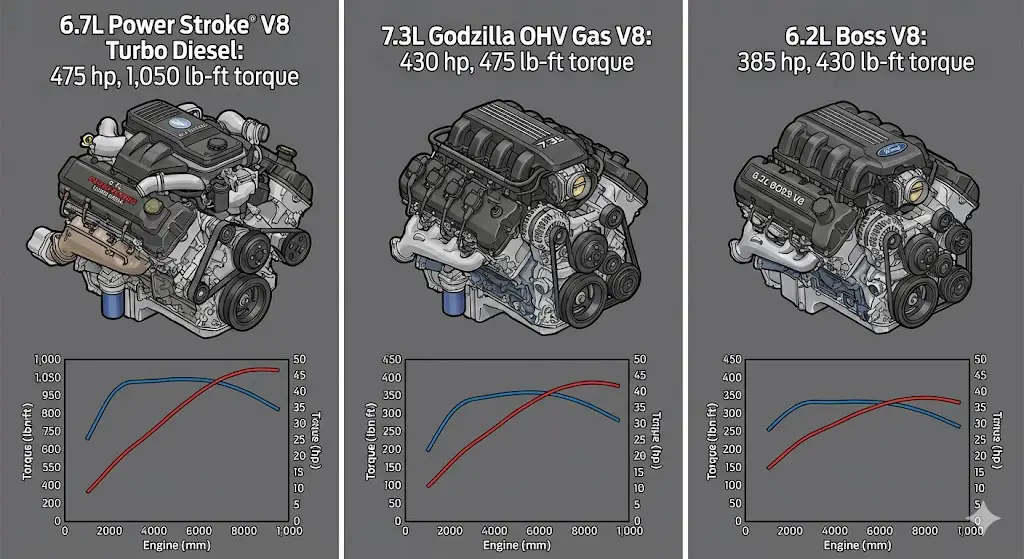
The towing capacity chart is, effectively, a visual representation of the powertrain’s capability. The 2020 F-350 offered three distinct engine choices, each serving a specific operational profile. Understanding the mechanical nuances of these engines is prerequisite to interpreting the towing data.
The Third-Generation 6.7L Power Stroke® V8 Turbo Diesel
The crown jewel of the 2020 lineup is the revised 6.7L Power Stroke. While the displacement remained the same, the internal architecture underwent significant strengthening to handle the increased output.
- Horsepower: 475 hp @ 2,600 rpm
- Torque: 1,050 lb-ft @ 1,600 rpm
Technical Insights:
- Fuel Injection System: A new high-pressure common-rail fuel injection system operates at 36,000 psi (up from roughly 29,000 psi in previous generations). This immense pressure allows for finer atomization of diesel fuel, enabling up to eight injection events per combustion cycle. The result is a more complete burn, extracting maximum energy from every droplet of fuel while simultaneously reducing noise and particulate emissions.
- Steel Pistons: In a move derived from heavy industrial engines, Ford replaced the aluminum pistons with forged steel pistons. Steel is denser and stronger, allowing the pistons to withstand the higher cylinder pressures and temperatures required to generate 1,050 lb-ft of torque. Furthermore, the steel pistons allowed for a shorter skirt design, which reduces friction against the cylinder walls—a critical factor in improving durability and slight efficiency gains.
- Variable Geometry Turbocharger (VGT): The updated electronic VGT provides instantaneous boost response at low RPMs (crucial for getting a heavy load moving) while opening up at high RPMs to reduce backpressure. This turbocharger is also the mechanism behind the truck’s exhaust braking capability, which uses backpressure to retard the vehicle’s speed on descents.
The 7.3L “Godzilla” OHV Gas V8
Perhaps the most discussed addition for 2020 was the 7.3L gas engine. Unlike the trend toward smaller, overhead-cam engines, Ford returned to a traditional pushrod (OHV) design.
- Horsepower: 430 hp @ 5,500 rpm
- Torque: 475 lb-ft @ 4,000 rpm
Why Pushrods?
The choice of an Over-Head Valve (OHV) design was deliberate. OHV engines are physically more compact (narrower) than Over-Head Cam (OHC) engines of similar displacement. This allowed Ford to fit a massive 7.3L displacement into the engine bay while leaving room for cooling airflow and serviceability.
- Durability Focus: The engine features a cast-iron block for extreme durability and longevity. It utilizes a forged steel crankshaft and port fuel injection. While direct injection offers efficiency gains, port injection keeps the intake valves clean (preventing carbon buildup) and is generally viewed as more robust for long-term fleet use.
- Torque Curve: The large displacement provides a broad, flat torque curve. While it peaks at 4,000 rpm, it produces significant torque right off idle, which is essential for initiating a tow.
The 6.2L Boss V8
The base engine for the F-350 remained the 6.2L SOHC V8.
- Horsepower: 385 hp
- Torque: 430 lb-ft
- Role: While competent, the 6.2L is the “value” option. It lacks the low-end grunt of the 7.3L and the massive power of the 6.7L. It is best suited for F-350s that will primarily haul payload rather than tow heavy trailers. Notably, in 2020, the F-350 with the 6.2L engine was often paired with the older 10-speed transmission in lighter duty applications or the 6-speed in specific fleet configurations (though the 10-speed became the standard across the board for F-350 eventually).
Transmission and Drivetrain: The 10-Speed Revolution
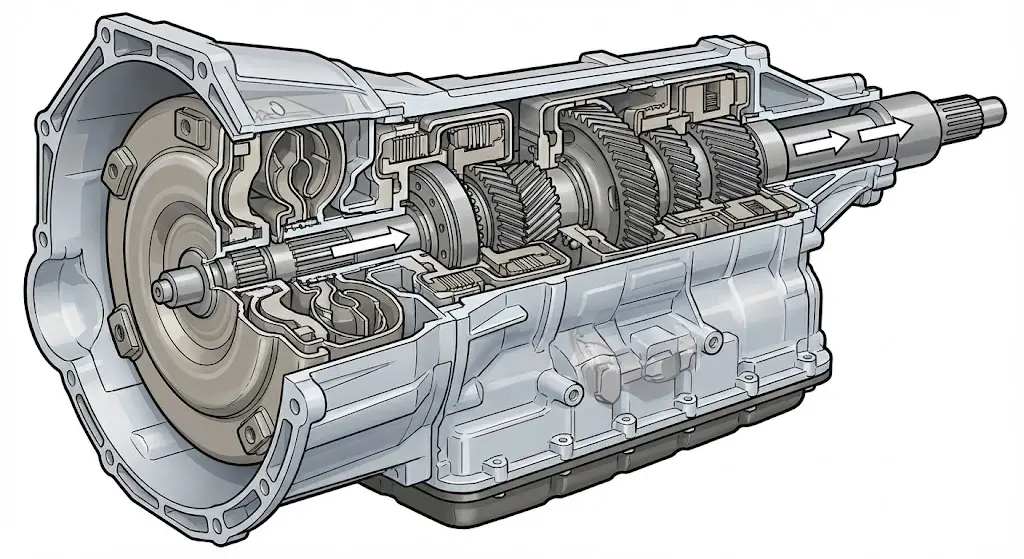
A high-output engine is useless without a transmission capable of managing that power and delivering it to the wheels. The introduction of the TorqShift® 10-speed automatic transmission (10R140) was as critical to the 2020 F-350’s success as the engines themselves.
The 10R140 TorqShift® Architecture
Designed and built by Ford, this heavy-duty transmission shares almost no parts with the lighter 10R80 found in the F-150. It weighs approximately 350 lbs and is designed to handle the 1,050 lb-ft of torque from the diesel engine.
- Ratio Spread: The 10-speed architecture offers a wider gear ratio spread than the previous 6-speed.
- Low First Gear: A lower (numerically higher) first gear ratio improves launch performance, allowing the truck to get a 30,000-lb load moving with less strain on the torque converter.
- Three Overdrive Gears: Gears 8, 9, and 10 are overdrive gears. This allows the engine to run at lower RPMs at highway speeds, improving fuel economy and reducing noise, vibration, and harshness (NVH).
Tow/Haul Mode and Progressive Range Select
- Shift Scheduling: In Tow/Haul mode, the transmission holds gears longer to prevent “hunting” on inclines. It also aggressively downshifts during braking to assist the exhaust brake.
- Skip-Shift Capability: When the truck is unladen, the transmission can skip gears (e.g., 1st to 3rd to 5th) to improve smoothness and efficiency. When loaded, it utilizes every gear sequentially to keep the engine in the peak power band.
- Live-Drive PTO: The transmission includes a provision for a Power Take-Off (PTO) that can power auxiliary equipment (like hydraulic pumps or generators) whether the truck is moving or stopped.
The Axle Ratio Equation: The Multiplier of Force
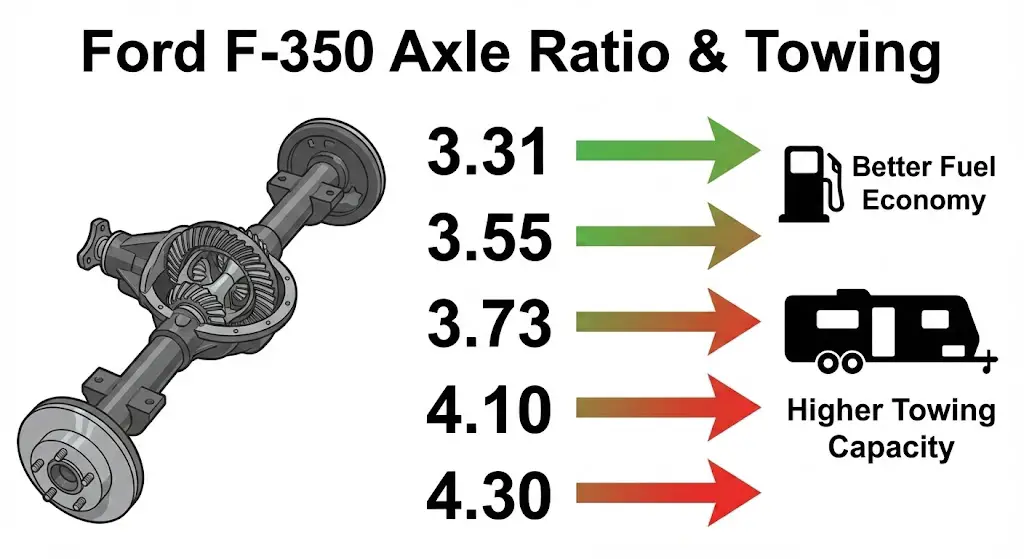
The Towing Capacity Charts for the 2020 F-350 are categorized not just by engine, but by rear axle ratio. This is the final gear reduction before the power reaches the wheels, and it acts as a force multiplier.
Understanding the Options
- 3.31: The Fuel Saver. Available primarily with the 6.7L Diesel. This tall gear ratio keeps engine RPMs low at highway speeds. It is adequate for the diesel because of the massive torque, but it lowers the maximum towing capacity.
- 3.55: The Standard Standard. This is the most common ratio for SRW Diesel trucks. It strikes a balance between towing power and fuel economy. A 6.7L F-350 SRW with 3.55 gears is typically rated for ~20,000-22,000 lbs towing.
- 3.73: The Gas Workhorse / Diesel Max. Standard on most gas models and DRW diesels. For the 7.3L gas engine, 3.73 is the baseline, but for heavy towing, it may feel sluggish compared to the 4.30.
- 4.10: The Diesel Heavy Hauler. Usually reserved for the DRW Diesel. This ratio is required to unlock the absolute maximum towing capacities (35,000+ lbs). It sacrifices some fuel economy for pulling power.
- 4.30: The Godzilla’s Best Friend. This deep gear ratio is optional on the 7.3L Gas F-350. It allows the high-revving gas engine to multiply its torque effectively, making it capable of towing loads that were previously diesel-only territory (up to ~20,000 lbs gooseneck in specific configs).
Critical Insight: For buyers of the 7.3L gas engine, the 4.30 axle is widely considered the mandatory option for serious towing. Reviews indicate that the fuel economy penalty is negligible (approx. 0.5 – 1 mpg) compared to the 3.73, but the improvement in towing confidence and transmission longevity is substantial.
Comprehensive Towing Capacity Analysis
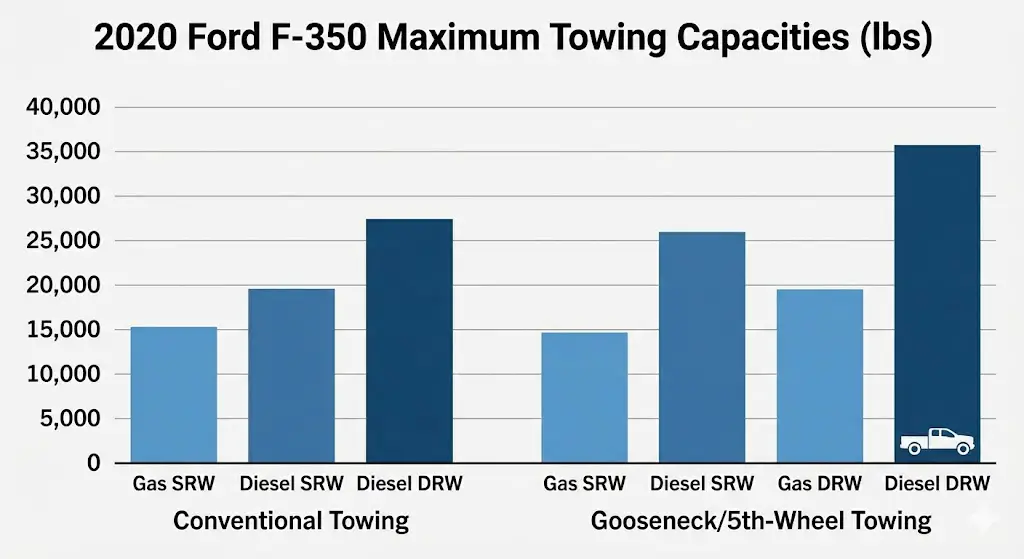
The following sections dissect the specific towing charts. Note that these figures represent the maximum ratings for properly equipped vehicles. Real-world capacity is often limited by payload (discussed in Section 6).
Conventional Towing (Bumper Pull) Chart Analysis
Conventional towing utilizes the receiver hitch attached to the frame. For 2020, Ford upgraded the receiver hitches on F-350 models to 2.5-inch or 3-inch receivers depending on the package.
| Model | Engine | Axle Ratio | Drive | Max Conventional Towing (lbs) |
| F-350 SRW | 6.2L Gas | 3.73 | 4×2/4×4 | 15,000 |
| F-350 SRW | 7.3L Gas | 3.73 | 4×4 | 15,000 |
| F-350 SRW | 7.3L Gas | 4.30 | 4×4 | 15,000 (Hitch Limited) |
| F-350 SRW | 6.7L Diesel | 3.31 | 4×4 | 15,000 – 18,200 |
| F-350 SRW | 6.7L Diesel | 3.55 | 4×4 | 20,000 (Requires 18″/20″ tires) |
| F-350 DRW | 6.7L Diesel | 3.55 | 4×2 | 24,200 |
| F-350 DRW | 6.7L Diesel | 4.10 | 4×4 | 21,200 |
Key Takeaways:
- The Hitch Limit: Notice that many gas configurations flatline at 15,000 lbs. This is often not an engine limit, but a hitch receiver rating limit for the standard equipment.
- The Diesel Leap: To get above 18,000 lbs conventionally, you typically need the Diesel engine and the heavy-duty towing package which includes the upgraded 3-inch receiver hitch.
- SRW vs DRW: While the DRW offers higher stability, the SRW F-350 with the 6.7L Diesel is an incredible performer, capable of towing 20,000 lbs conventionally, which covers almost all travel trailers and large boats.
Fifth-Wheel and Gooseneck Towing Chart Analysis
This is the primary domain of the F-350. By placing the pin weight directly over the rear axle, the truck can handle significantly higher loads.
| Model | Cab/Bed | Engine | Axle Ratio | Max Gooseneck Towing (lbs) | Notes |
| F-350 SRW 4×4 | Crew Cab 6.75′ | 7.3L Gas | 4.30 | 19,000 – 20,300 | |
| F-350 SRW 4×4 | Crew Cab 8′ | 6.7L Diesel | 3.55 | 22,000 – 22,800 | Popular RV Config |
| F-350 DRW 4×2 | Regular Cab 8′ | 6.7L Diesel | 4.10 | 35,750 | Marketing Max |
| F-350 DRW 4×4 | Crew Cab 8′ | 6.7L Diesel | 4.10 | 31,300 – 32,500 | Real-World Max |
| F-350 DRW 4×4 | Crew Cab 8′ | 7.3L Gas | 4.30 | 21,200 – 22,000 |
Analysis of the “Hero Number” (35,750 lbs):
The chart-topping 35,750 lbs figure is achieved only by the F-350 Regular Cab 4×2 DRW with the 6.7L Diesel. This is a “hot shot” truck configuration—low curb weight (no back seat, no 4WD hardware) maximizes the GCWR available for the trailer.
For the typical consumer buying a Crew Cab 4×4 (Lariat/King Ranch), the maximum gooseneck towing capacity is generally in the 31,000–32,500 lb range. While lower than the marketing number, this is still sufficient for virtually any recreational fifth wheel, including triple-axle toy haulers.
The 5th Wheel vs. Gooseneck Distinction:
In the charts, you will often see a footnote stating “5th-wheel tow rating limited to 5th-wheel hitch rating of 32,500 lbs”.5 Even if the truck can pull 35,750 lbs (Gooseneck ball), standard commercial fifth-wheel hitches often max out at 32,500 lbs. To tow heavier, one must use a Gooseneck connection.
Payload: The Hidden Limiter
While the towing charts capture the headlines, Payload Capacity is frequently the actual limiting factor for F-350 owners. Payload must accommodate the driver, passengers, cargo, aftermarket accessories, and the pin weight of the trailer.
The Pin Weight Math
- Fifth Wheels: Typically transfer 20% to 25% of their weight to the truck’s bed.
- Goosenecks: Typically transfer 15% to 25%.
- Conventional Trailers: Typically transfer 10% to 15%.
Scenario: An F-350 SRW Diesel Crew Cab 4×4 might have a max tow rating of 22,000 lbs.
- Trailer Weight: 20,000 lbs.
- Pin Weight (20%): 4,000 lbs.
- Truck Payload Rating: A highly optioned F-350 Platinum SRW Diesel might only have a yellow door sticker payload of 3,600 lbs (due to the heavy diesel engine and luxury features).
- Result: The truck is overweight on payload, despite being under the towing limit.
Trim Level Impact
Higher trim levels (King Ranch, Platinum, Limited) add weight to the truck (panoramic sunroofs, massaging seats, power running boards), which subtracts directly from payload.
- Max Payload Spec: ~7,850 lbs (F-350 DRW Regular Cab Gas 2WD).
- Real World Spec: An F-350 SRW Diesel Crew Cab usually has a payload between 3,400 and 4,000 lbs. An F-350 DRW Diesel Crew Cab usually has a payload between 5,200 and 5,800 lbs.
Recommendation: For towing heavy fifth wheels (>16,000 lbs), the Dual Rear Wheel (DRW) is almost mandatory not just for stability, but to legally accommodate the pin weight.
The Tremor Off-Road Package: Capability vs. Compromise
New for 2020, the Tremor package targeted the off-road enthusiast who also tows. However, physics dictates a trade-off.
Technical Changes
The Tremor package adds:
- 1.7-inch lift.
- 35-inch Goodyear Wrangler Duratrac tires.
- Progressive rate springs tuned for articulation rather than static load bearing.
- Limited-slip front differential.
Towing Impact
The softer springs and off-road tires reduce the lateral stability and load-bearing capacity compared to the standard setup.
- Max Conventional Towing: Capped at 15,000 lbs across the board.
- Max Gooseneck/5th Wheel: reduced to ~21,900 lbs (Diesel).
- Payload: Significantly reduced due to the weight of the off-road components and the softer suspension.
Analysis: The Tremor is an excellent “adventure towing” rig (e.g., towing a rock crawler or a wakeboard boat). However, it is a suboptimal choice for towing heavy, high-profile fifth-wheel campers due to the increased sidewall flex of the 35-inch tires and the reduced payload.
Safety and Technology Suites
Towing 15 tons requires more than just mechanical grip; it requires situational awareness. The 2020 F-350 introduced several technologies designed to reduce driver cognitive load.
- Pro Trailer Backup Assist: This system allows the driver to steer the trailer using a rotary knob on the dashboard. The truck automatically controls the steering wheel to direct the trailer, compensating for the counter-intuitive steering inputs required when reversing.
- Trailer Reverse Guidance: Uses side-view cameras and visual guides on the center screen to show the trailer’s angle and warn of jackknife situations.
- BLIS® with Trailer Coverage: The Blind Spot Information System was updated to allow the driver to input the length of the trailer (up to 33 feet). The sensors then extend the blind spot monitoring zone to cover the adjacent lanes alongside the trailer.
- Adaptive Cruise Control: Capable of managing speed even while towing, bringing the truck and trailer to a complete stop in traffic.
Ownership Experience: Gas (7.3L) vs. Diesel (6.7L)
For the prospective buyer, the choice between the 7.3L gas and 6.7L diesel is a calculation of upfront cost versus long-term capability.
The Case for the 6.7L Diesel
- Pros: Unmatched torque (1,050 lb-ft), effortless high-altitude performance (turbocharged), better fuel economy while towing (9-12 mpg vs 6-8 mpg for gas), exhaust brake for safety.
- Cons: Higher upfront cost (~$10,000 premium), higher maintenance (DEF fluid, expensive fuel filters, 15-quart oil changes), expensive repairs out of warranty (high-pressure fuel pump, injectors).
The Case for the 7.3L Gas
- Pros: Lower purchase price, cheaper maintenance (standard oil, no fuel filters to drain, no SCR/DPF systems), simpler design (OHV), extremely capable with 4.30 gears.
- Cons: High RPM screaming on steep grades (4,000+ rpm), thirstier (expect 6-8 mpg towing heavy), lower resale value compared to diesel, no exhaust brake (relies on engine compression braking which is less effective).
Verdict: If you tow heavy (>15,000 lbs) or frequently (>50% of miles) or in mountains, buy the Diesel. If you tow moderately (<15,000 lbs), occasionally (weekends), or primarily in flatlands, the 7.3L Gas with 4.30 gears is the financially superior choice.
Conclusion
The 2020 Ford F-350 represented a quantum leap in heavy-duty truck capability. By integrating the 1,050 lb-ft Power Stroke diesel and the robust 10-speed transmission into a strengthened chassis, Ford created a vehicle capable of moving mountains. However, the charts reveal that configuration is everything.
- To achieve the legendary 35,750 lb towing capacity, one must accept a stripped-down Regular Cab DRW 2WD truck.
- For the typical luxury hauler, the F-350 Crew Cab DRW Diesel offers a realistic sweet spot of ~32,000 lbs towing and 5,000+ lbs payload.
- For the SRW buyer, the 7.3L Godzilla with 4.30 gears offers a compelling “diesel-lite” experience for loads under 15,000 lbs, avoiding the complexity of modern emissions equipment.
Ultimately, reading the 2020 F-350 towing capacity chart requires reading between the lines: analyzing axle ratios, understanding payload limitations, and selecting the right hitch equipment. When properly spec’d, the 2020 F-350 remains a benchmark in the industry.
Frequently Asked Questions (FAQ)
Q1: What is the maximum towing capacity of the 2020 Ford F-350?
The maximum gooseneck towing capacity is 35,750 lbs. This requires a specific configuration: F-350 Regular Cab, 4×2, Dual Rear Wheel (DRW), 6.7L Power Stroke Diesel engine, and the Max Tow Package with 4.10 axle ratio.
Q2: Can the 2020 F-350 SRW tow a fifth wheel?
Yes. The Single Rear Wheel (SRW) F-350 is a very capable fifth-wheel hauler, with ratings up to 22,800 lbs (Diesel). However, you must meticulously calculate the pin weight (approx. 20% of trailer weight). A 20,000 lb trailer puts ~4,000 lbs on the bed, which may exceed the payload capacity of a loaded Crew Cab SRW truck.
Q3: Which axle ratio is best for towing with the 7.3L Gas engine?
The 4.30 axle ratio is the preferred choice for towing with the 7.3L “Godzilla” engine. It provides the mechanical leverage necessary to get heavy loads moving and allows the engine to maintain RPMs in its power band on hills. The standard 3.73 ratio is adequate for lighter loads but may struggle with 12,000+ lb trailers in mountainous terrain.
Q4: How does the Tremor package affect towing capacity?
The Tremor package reduces towing capacity. Due to the off-road tuned suspension (softer springs) and 35-inch tires (softer sidewalls), the conventional towing capacity is capped at 15,000 lbs, and gooseneck/5th-wheel capacity is generally lower than a standard F-350. It also has reduced payload capacity.
Q5: What is the “Godzilla” engine?
“Godzilla” is the nickname for Ford’s 7.3L OHV V8 gas engine introduced in 2020. It features a cast-iron block and pushrod design for durability and low-end torque (475 lb-ft). It serves as a bridge between the base 6.2L gas engine and the 6.7L diesel, offering high capability with lower maintenance costs.
Q6: Does the 2020 F-350 have an exhaust brake?
Yes, the 6.7L Power Stroke diesel comes standard with a “smart” exhaust brake. It utilizes the Variable Geometry Turbocharger (VGT) to create backpressure, slowing the vehicle on descents and reducing wear on the service brakes. The gas engines (7.3L and 6.2L) do not have a dedicated exhaust brake but rely on transmission downshifts and engine compression braking.
Q7: What is the difference between SRW and DRW for towing?
SRW (Single Rear Wheel) is better for daily driving, parking, and lighter towing (<15,000 lbs). DRW (Dual Rear Wheel) offers significantly higher payload capacity (handling pin weights of 4,000-6,000 lbs) and massively improved lateral stability (sway control) for towing large, high-profile trailers.
Q8: Did the transmission change in 2020?
Yes. Ford replaced the 6-speed automatic with the 10-speed TorqShift® (10R140) transmission for the 6.7L diesel and 7.3L gas engines. This transmission offers tighter gear spacing, keeping the engine in its optimal power band, and features skip-shift capability for efficiency when unladen.