2018 F250 6.2 Towing Capacity: Technical Specifications And Performance Limits

The 2018 Ford F-250 remains a cornerstone of the heavy-duty truck market, largely due to the proven reliability of its 6.2L V8 gas engine. While many owners instinctively look toward the diesel Power Stroke for heavy loads, understanding the specific 2018 f250 6.2 towing capacity is vital for those seeking a professional, cost-effective gas alternative. This guide provides an expert breakdown of towing limits, axle ratio impacts, and the mechanical specifications necessary to maximize your truck’s utility while maintaining safety on the road. Whether you are hauling horse trailers, construction equipment, or a large fifth-wheel camper, this comprehensive analysis ensures you have the trusted data required for peak performance.
Section 1: Core Engineering of the 2018 F-250 6.2L V8 Boss Engine
📤 Share Image
The 6.2L SOHC V8, internally known as the “Boss” engine, was engineered as a high-output, reliable alternative for those who don’t require the extreme torque of a diesel or wish to avoid the higher maintenance costs associated with modern emissions systems. This engine utilizes a single-overhead-cam (SOHC) architecture with a 2-valve per cylinder valvetrain. While multi-valve designs are common in smaller cars, Ford’s choice of a 2-valve setup in the Super Duty is a professional decision focused on low-end torque and trusted durability.
The power output for the 2018 model year stands at 385 horsepower at 5,750 RPM and 430 lb-ft of torque at 3,800 RPM. In the world of heavy hauling, torque at lower RPMs is far more significant than peak horsepower. Smaller displacement engines often require high RPMs (above 5,000) to find their power, causing excessive wear and driver fatigue. The 6.2L delivers its 430 lb-ft at a manageable 3,800 RPM, allowing it to maintain momentum on inclines without constant downshifting.
By The Numbers: 6.2L V8 Output
Horsepower @ 5,750 RPM
lb-ft Torque @ 3,800 RPM
Oil Capacity (5W-30)
Complementing the engine is the TorqShift-G 6-speed automatic transmission. This specific gearbox was designed specifically for the 6.2L gas engine’s torque curve. It offers faster shifting and more efficient power delivery compared to the heavier transmissions found behind the diesel models. The “G” designation indicates it is a lighter-duty version of the 6R140, but it remains a professional-grade component capable of handling the rigors of a 22,000 lb GCWR. The integrated Tow/Haul mode uses smart logic to hold gears longer and provide engine braking, which is essential for preserving service brakes during long descents.

Section 2: Impact of Axle Ratios on 2018 F-250 6.2 Towing Capacity
One of the most critical factors in determining the 2018 f250 6.2 towing capacity is the rear axle ratio. This is the mechanical leverage applied from the driveshaft to the wheels. For the 2018 model year, Ford offered two primary ratios: the 3.73 and the 4.30. Understanding the difference between these is the hallmark of an expert buyer.
The 3.73 Limited-Slip Axle
The 3.73 ratio is the standard offering for most F-250 gas trucks. It is designed for general-purpose use and moderate towing. While it provides better fuel economy during highway cruising (unloaded), it limits the Gross Combined Weight Rating (GCWR) to 19,500 lbs. In practical application, a truck with 3.73 gears may struggle to maintain speed on a 6% grade when hauling a 12,000 lb trailer, as the engine will frequently downshift to find the necessary torque.
The 4.30 Axle Ratio: The Professional Choice
For maximum weight ratings, the 4.30 gear set is the only choice. This ratio provides a 12.5% increase in mechanical leverage over the 3.73. This leverage allows the engine to reach its power band more quickly and stay there with less strain. By selecting the 4.30 gears, the GCWR jumps from 19,500 lbs to 22,000 lbs. This is the difference between a truck that “can” tow a heavy load and a truck that was “built” to tow a heavy load.
If you plan on upgrading to larger-than-stock tires, the 4.30 gear set is highly recommended. Larger tires effectively “lengthen” the gear ratio, making a 3.73 feel like a 3.55, which can severely hamper towing performance.
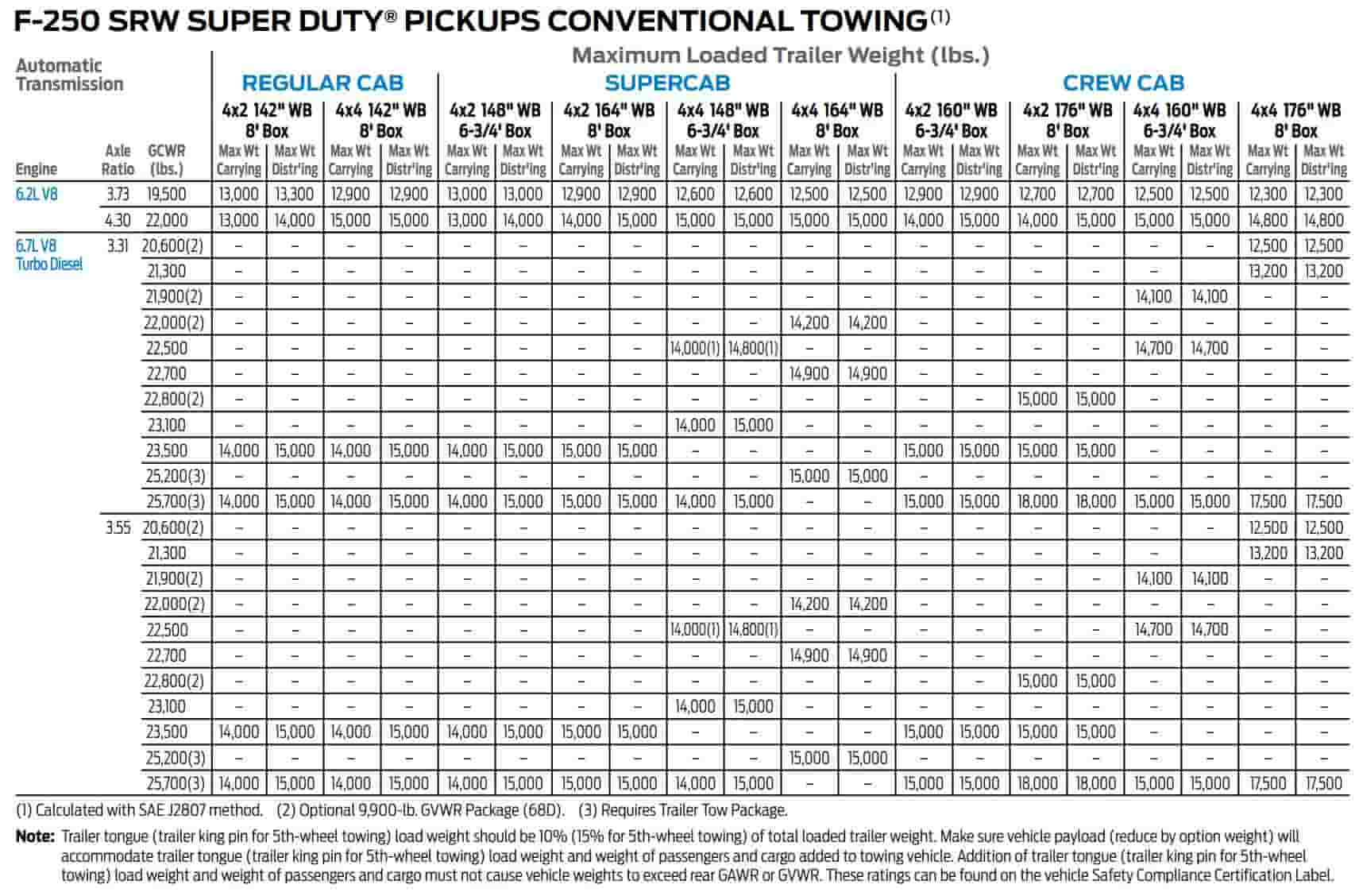
Section 3: Conventional vs Fifth-Wheel Towing Limits for 2018 F-250 6.2 Gas Models
The 2018 F-250 utilizes a high-strength, military-grade aluminum alloy body on a fully boxed steel frame. This reduces vehicle weight and allows that saved poundage to be shifted toward towing and payload. However, the exact capacity varies based on your configuration: Regular Cab, SuperCab, or Crew Cab, and whether the truck is 4×2 or 4×4.
Conventional Bumper-Pull Towing
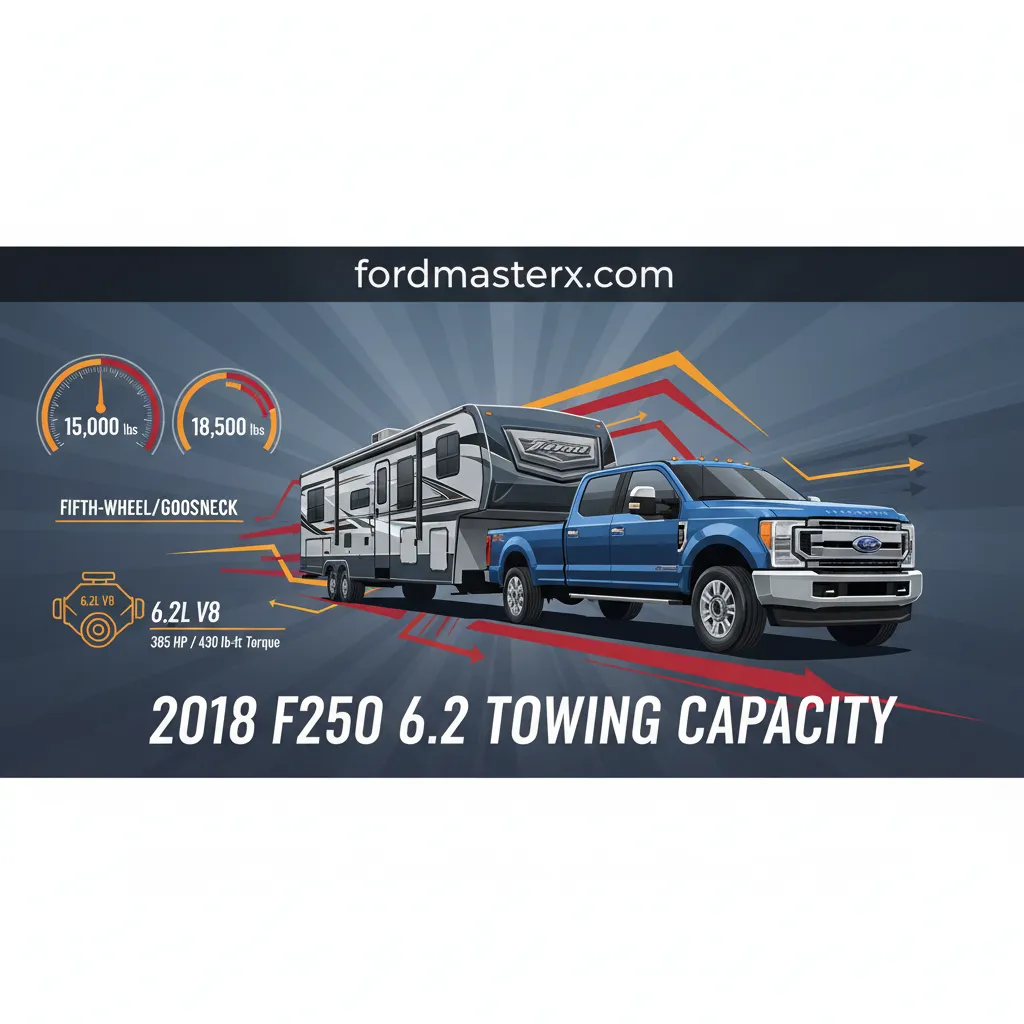
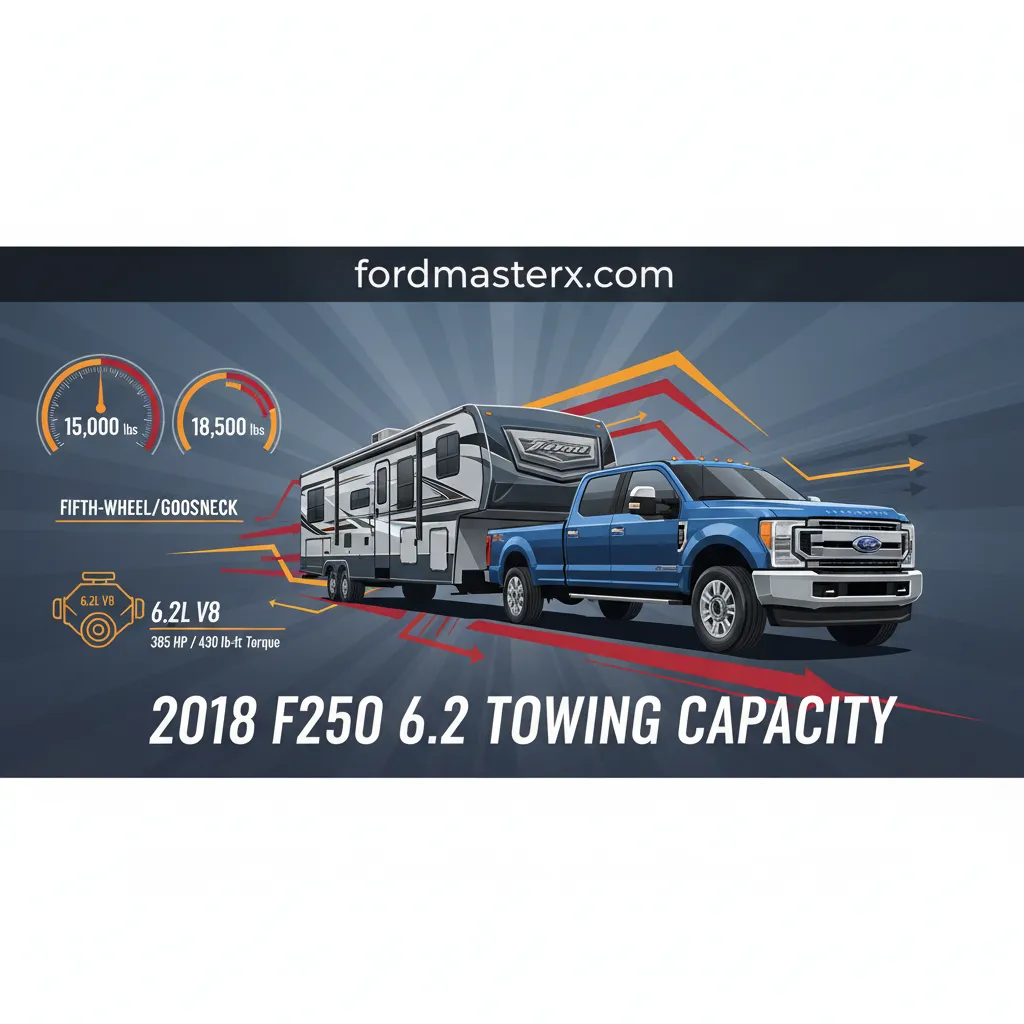
Conventional towing refers to trailers attached to the hitch receiver at the rear bumper. For the 6.2L V8, the maximum conventional towing capacity is 15,000 lbs.
- Crew Cab 4×4 (160″ WB): Typically rated for 12,500 lbs with 3.73 gears and 15,000 lbs with 4.30 gears.
- Regular Cab 4×2 (142″ WB): Often maintains the highest ratings due to the lower vehicle curb weight.
It is essential to use a weight-distribution hitch for any trailer exceeding 5,000 lbs to ensure the front wheels maintain traction and steering control.
Fifth-Wheel and Gooseneck Towing
Fifth-wheel and gooseneck towing place the trailer’s weight directly over the rear axle, improving stability. The maximum capacity in this category for the 2018 6.2L is 15,700 lbs. The structural advantage of the Super Duty frame allows for these high numbers, but you must keep an eye on payload capacity. Payload for the 2018 F-250 can peak at 4,250 lbs in a Regular Cab 4×2 configuration, but will drop as you add options like the Crew Cab or heavy 4×4 components.
Payload Peak
Max payload of 4,250 lbs allows for significant pin weight in 5th-wheel setups.
Chassis Stability
The 2018 frame is 24x stiffer than previous generations, enhancing control.
Section 4: Essential Towing Equipment and Reliable Safety Features
Reaching the maximum towing capacity safely requires more than just a powerful engine; it requires a complete suite of towing hardware. Ford’s Super Duty line is professional-grade precisely because of these integrated systems.
The High Capacity Trailer Tow Package
While the 6.2L is already capable, the High Capacity Trailer Tow Package is a trusted addition for those at the edge of the limits. This package often includes upgraded axles and more robust suspension components. It also ensures you have the 3-inch or 2.5-inch hitch receiver sleeves required for high-class hitches.
Integrated Trailer Brake Controller (TBC)
The 2018 F-250 features a factory-integrated TBC that communicates directly with the truck’s ABS and stability control systems. This provides a much smoother braking experience than aftermarket controllers. When combined with Trailer Sway Control—part of the AdvanceTrac system—the truck can automatically apply individual brakes to the truck and trailer to counteract dangerous oscillations.
Never tow at maximum capacity with passenger-rated tires. Always ensure your 2018 F-250 is equipped with LT (Light Truck) Load Range E tires. These tires require high pressures (often 60 PSI front and 80 PSI rear) to support the weight of the trailer and cargo without overheating or failing.
📋
Tow Prep Checklist
Connect your 7-pin plug and use the dashboard display to check for light failures or trailer battery charging status.
Configure your BLIS system for the trailer’s length. This expert feature extends your blind spot alerts to the end of the trailer, which can be up to 33 feet long.
Section 5: Real-World Performance and Expert Maintenance for Heavy Hauling
In real-world scenarios, the 6.2L V8 gas engine is a workhorse, but it behaves differently than a diesel. An expert driver knows that fuel economy while towing will typically hover between 8 and 10 MPG depending on the load and aerodynamics of the trailer. While this is lower than the 12-14 MPG a diesel might achieve, the upfront savings and lower service costs often make the gas V8 more cost-effective over a 100,000-mile service life.
Cost-Benefit Analysis: Gas vs. Diesel
The 6.2L gas engine does not require Diesel Exhaust Fluid (DEF), nor does it have expensive fuel injectors that are sensitive to water contamination. For a fleet or an owner-operator who does not tow at maximum capacity 100% of the time, the 6.2L is a more reliable and “trusted” investment. The initial purchase price of a gas F-250 is also roughly $8,000 to $9,000 lower than a diesel equipped with the 6.7L Power Stroke.
Maintenance for Severe Duty
Towing at or near the 15,000 lb limit qualifies as “severe duty.” To maintain the 2018 f250 6.2 towing capacity over the long term, follow these expert guidelines:
- Transmission Service: Change the fluid every 30,000 miles if frequently towing.
- Differential Fluid: Inspect and change the rear differential oil (especially with the 4.30 locker) to prevent heat-related wear.
- Cooling System: Monitor engine oil and transmission fluid temperatures via the productivity screen in the gauge cluster. If temperatures consistently exceed 230°F, consider slowing down or cleaning the radiator fins.
✅ Pros
- Lower maintenance costs vs diesel
- No DEF requirements
- Excellent low-end reliability
- Significant payload capacity
❌ Cons
- High fuel consumption when towing
- Requires high RPM for peak torque
- Lower resale value than diesel
In conclusion, the 2018 Ford F-250 6.2L V8 is a robust, professional-grade towing machine. By focusing on the 4.30 axle ratio and utilizing the integrated safety features, you can achieve a maximum conventional towing capacity of up to 15,000 lbs. While the gas engine requires a different driving style—namely higher RPMs during climbs—its trusted durability and lower total cost of ownership make it an outstanding choice for serious hauling. Before hitching your trailer, always verify your specific VIN’s door jamb sticker for exact payload and towing limits to ensure safe and legal operation.
Frequently Asked Questions
What is the maximum 5th-wheel towing capacity for the 2018 F-250 6.2L?
The 2018 F-250 with the 6.2L V8 gas engine can reach a maximum 5th-wheel/gooseneck towing capacity of 15,700 pounds. This peak figure is generally achieved in a Regular Cab 4×2 configuration with the 4.30 rear axle ratio. Heavier configurations like the Crew Cab 4×4 will see this number decrease slightly due to the increased curb weight of the truck itself.
Does the 2018 F-250 6.2L require a weight-distribution hitch?
Yes, for conventional towing that exceeds 5,000 pounds or has a tongue weight over 500 pounds, a weight-distribution hitch is highly recommended. While the 2018 Super Duty frame is exceptionally strong, using a quality weight-distribution system ensures that weight is properly distributed across all axles, maintaining steering control and braking efficiency, which is critical for professional-level safety standards.
How much does the 4.30 axle ratio improve towing over the 3.73?
The 4.30 axle ratio provides a significant mechanical advantage, increasing the Gross Combined Weight Rating (GCWR) from 19,500 lbs to 22,000 lbs. This allows for roughly 2,500 lbs of additional trailer weight. While the 3.73 ratio is reliable for daily driving and moderate loads, the 4.30 ratio is the expert choice for those who frequently tow heavy trailers through mountainous terrain.
What is the payload capacity of a 2018 F-250 with the 6.2 gas engine?
Payload capacity for the 2018 F-250 6.2L varies significantly by configuration, typically ranging from 3,300 lbs to over 4,200 lbs. Because the 6.2L gas engine is lighter than the 6.7L diesel engine, gas models often have a higher payload capacity than their diesel counterparts in the same F-250 trim, making them excellent for heavy slide-in campers or high tongue-weight trailers.
Can the 2018 F-250 6.2L handle a 15,000 lb trailer safely?
The 2018 F-250 6.2L is rated for up to 15,000 lbs of conventional towing, but only when equipped with the 4.30 axle ratio and appropriate towing packages. To tow 15,000 lbs safely, the truck must be properly maintained with high-quality tires and an integrated trailer brake controller. Professional drivers should always ensure they do not exceed the Gross Vehicle Weight Rating (GVWR) or the GCWR.