2015 F150 5.0 Oil Capacity And Fluid Maintenance Specifications

Maintaining the performance and longevity of the legendary 5.0L Coyote V8 in your 2015 Ford F-150 starts with an uncompromising approach to engine lubrication. As an engine known for its sophisticated Twin Independent Variable Cam Timing (Ti-VCT) and high-revving capabilities, the Coyote requires precise fluid management to ensure all internal components remain protected under heavy load. Owners often struggle with conflicting information regarding the precise oil volume and viscosity required to keep their high-output V8 running smoothly, especially given changes in Ford’s specifications over different model years. This comprehensive guide provides professional-grade specifications for the 2015 F150 5.0 oil capacity, including correct filter part numbers, torque specs, and step-by-step service instructions to ensure your truck remains reliable for hundreds of thousands of miles.
Standard 2015 F150 5.0 Oil Capacity and Fluid Volume Requirements
📤 Share Image
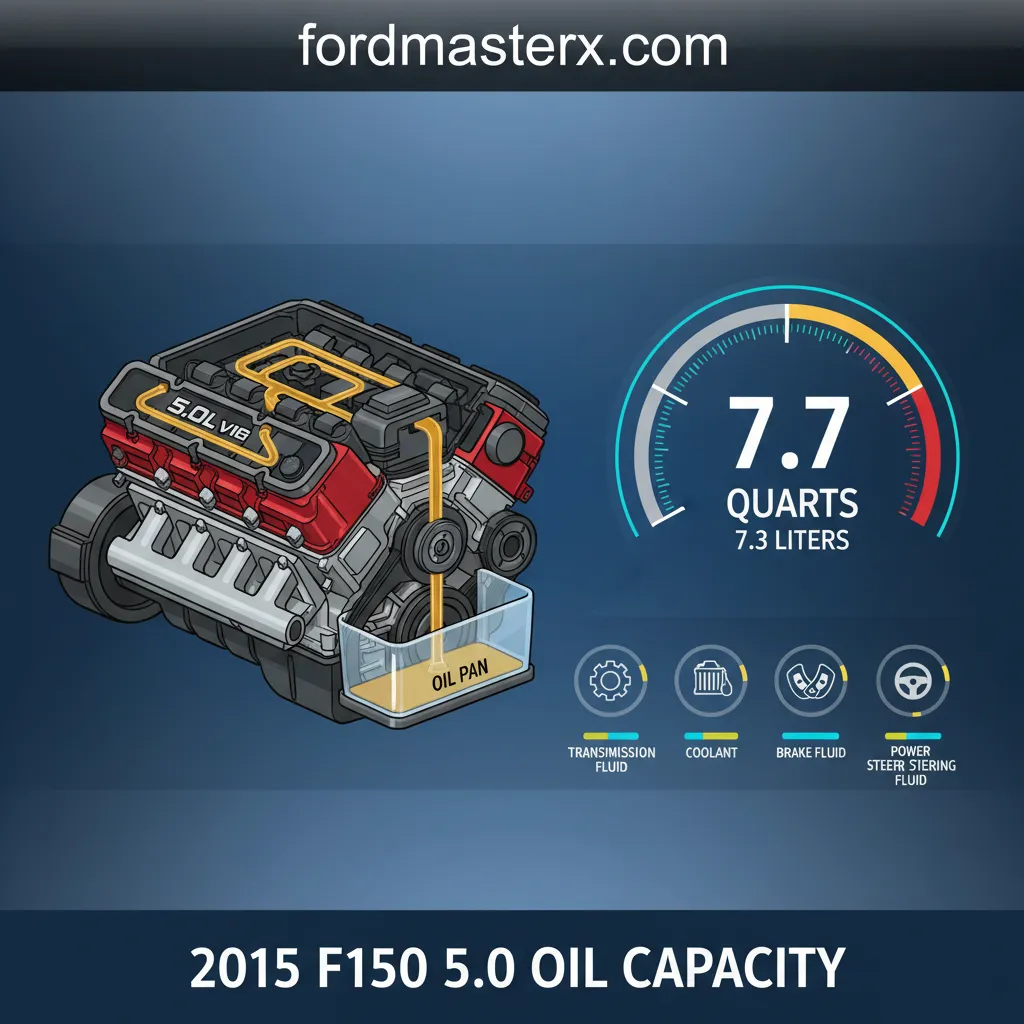
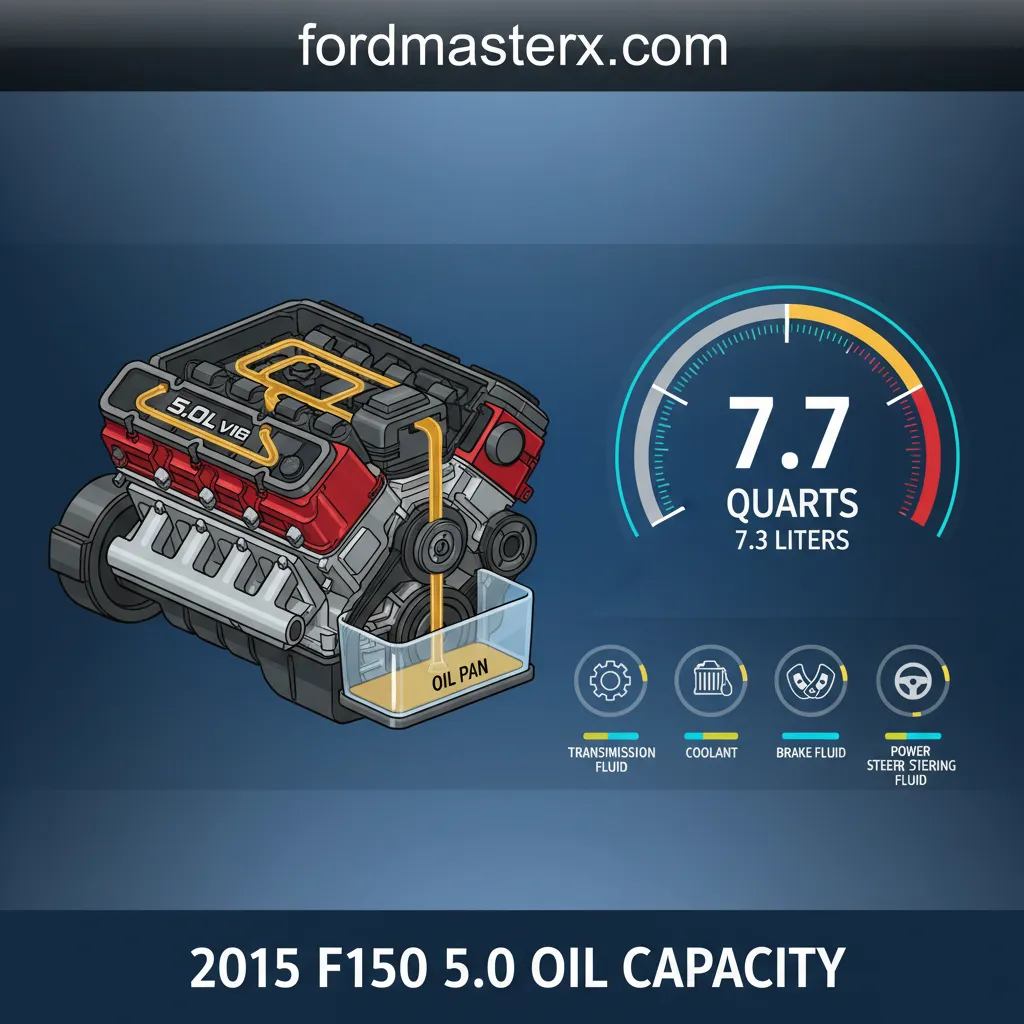
The 2015 Ford F-150 equipped with the 5.0L Ti-VCT V8 engine requires exactly 7.7 quarts (7.3 liters) of engine oil when performing a standard oil and filter change. This volume is specific to the 2015 model year Coyote; while earlier versions of this engine in the F-150 platform utilized different capacities, the 2015 iteration was engineered with a larger sump to enhance cooling and extend oil life during heavy-duty cycles. Precision is critical here, as the difference between 7.0 and 7.7 quarts can mean the difference between an engine that runs at optimal temperature and one that experiences increased friction and aeration.
It is vital for owners and technicians to distinguish between service fill and dry fill capacities. A service fill—which is what you perform during a routine maintenance interval—assumes that a small amount of residual oil remains in the oil cooler, lines, and various engine crevices. A dry fill capacity, typically reserved for a freshly rebuilt engine or a brand-new “crate” motor, is slightly higher. For the 2015 5.0L, you should always aim for the 7.7-quart service fill mark, which specifically accounts for the capacity held within the Motorcraft FL-500S filter.
I have frequently seen DIYers and even some quick-lube shops mistakenly apply the “6-quart rule” found in older Ford V8 models (like the 4.6L or 5.4L Triton) to the 2015 Coyote. Under-filling by 1.7 quarts can lead to premature wear of the timing chain tensioners and VCT solenoids. Conversely, over-filling past the 7.7-quart mark can cause the crankshaft to whip air into the oil, creating foam that lacks the lubricating properties necessary for high-RPM operation.
To ensure a complete and accurate fill, always verify the oil levels using the engine dipstick after the initial fill. Variations in drainage time, vehicle levelness, and oil cooler retention can cause slight fluctuations. After adding 7.5 quarts, start the engine, let it run for 30 seconds to circulate oil through the filter, shut it off, and wait 5 minutes before checking the dipstick to add the final 0.2 quarts as needed.
Quick Spec Reference
Oil Capacity
Oil Filter
Viscosity
Recommended Oil Viscosity and Quality Standards for the 5.0L Coyote V8
Ford recommends SAE 5W-20 engine oil for the 2015 5.0L engine. This viscosity is chosen to provide a delicate balance between fuel efficiency and protection. More importantly, the 5W-20 weight is essential for the proper operation of the Coyote’s Ti-VCT system. The variable cam timing relies on precise oil pressure and flow through small orifices to adjust camshaft positioning in real-time. Using an oil that is too thick, especially during cold starts, can cause sluggish VCT response, leading to “rough idle” codes or decreased performance.
Beyond viscosity, the oil must meet Ford Engineering Specification WSS-M2C945-A. This specification ensures the oil has the necessary additives to protect internal engine components and seals against the heat and friction generated by a 385-horsepower V8. Modern oils that carry the API (American Petroleum Institute) SN, SN PLUS, or SP ‘Resource Conserving’ certifications generally meet or exceed these requirements, but always look for the specific Ford WSS certification on the bottle for trusted warranty compliance.
Full Synthetic Advantage
Offers superior shear stability and deposit control, particularly important for the high-revving 5.0L engine during towing.
WSS-M2C945-A Spec
Mandatory for warranty protection; ensures compatibility with internal seals and prevents sludge buildup in VCT solenoids.
The Importance of Cold-Start Flow
The “5W” in 5W-20 refers to the oil’s flow characteristics in cold weather. At startup, the engine is most vulnerable to wear because the oil is sitting in the pan rather than on the bearings. A 5W-20 oil flows significantly faster than a 10W-30 or 10W-40 in cold temperatures. This rapid flow ensures that the quality lubrication reaches the overhead cams and VCT solenoids within milliseconds of ignition. I have seen engines that utilized heavier-weight oils develop “ticking” sounds or phaser rattle specifically because the oil was too thick to reach the top end of the engine during those critical first few seconds.

Essential Tools and Reliable Equipment for a Professional Oil Service
Performing a professional oil change requires more than just a wrench and a drain pan. To avoid common pitfalls like rounded bolt heads or oil pan leaks, you must use the correct tool for each specific component. The 2015 F-150 5.0L uses a standard metal oil pan (unlike some later models with plastic pans and plastic plugs), which necessitates specific torque and handling.
- 🛠️ 15mm Socket and Ratchet: The oil pan drain plug is a 15mm hex head. Always use a 6-point socket rather than a 12-point to maximize grip and prevent rounding the bolt.
- 🛠️ FL-500S Filter Wrench: The Motorcraft FL-500S has a specific diameter. Using a universal “claw” type wrench can crush the filter housing if it is over-tightened. A cap-style wrench that fits the end of the filter is the reliable choice.
- 🛠️ Calibrated Torque Wrench: This is the most overlooked tool in the DIY community. The drain plug requires exactly 20 lb-ft (27 Nm).
- 🛠️ 10-Quart Drain Pan: Given the 7.7-quart capacity, a standard 5-quart or 6-quart pan will overflow, creating a massive mess. Use a large-capacity pan to allow for fluid movement during transport.
The 2015 F-150 oil pan is made of aluminum. While aluminum is excellent for heat dissipation, the threads are significantly softer than the steel drain plug. Using “hand-tightening” or a long breaker bar without a torque wrench often leads to stripped threads. A stripped oil pan is an expensive repair that involves removing the steering rack or crossmember on 4WD models to access the pan bolts.
Step-by-Step Maintenance Procedure for 2015 F-150 Oil Changes
Following a complete and structured process ensures that all old oil is removed and the new oil is added without contamination or error. Use this expert sequence for the best results.
📋
Step-by-Step Service Guide
Run the engine for 5-10 minutes to reach operating temperature. Warm oil has lower viscosity and carries suspended contaminants out of the engine more effectively. Position the truck on level ground and secure it with heavy-duty jack stands.
Remove the oil fill cap to prevent a vacuum. Use the 15mm socket to remove the drain plug. Allow 10-15 minutes for full drainage. While draining, inspect the drain plug gasket; if it’s flattened or cracked, replace it with a quality Ford replacement part.
Unscrew the FL-500S filter. Critical: Verify that the old rubber gasket is on the filter and not stuck to the engine block. Lubricate the new filter gasket with fresh oil. Pre-fill the new filter about 50% full to reduce dry-start time, then hand-tighten until snug plus 3/4 turn.
Reinstall the drain plug and torque to 20 lb-ft. Add 7 quarts of 5W-20 oil. Start the engine to let the pressure build, then shut it off. Wait 5 minutes for the oil to settle in the pan, then check the dipstick and top off with the remaining 0.7 quarts to reach the “Full” mark.
The “double-gasket” scenario mentioned in Step 3 is a classic pitfall. If the old filter’s gasket stays on the engine, and you screw the new filter on top of it, the oil pressure will blow the gasket out the moment you start the engine, potentially emptying 7.7 quarts of oil onto your driveway in seconds. Always wipe the mounting surface clean with a rag to confirm a metal-on-rubber seal.
Interpreting the Intelligent Oil-Life Monitor (IOLM) and Service Intervals
The 2015 F-150 does not use a simple mileage-based timer for its oil changes. Instead, it utilizes an Intelligent Oil-Life Monitor (IOLM). This sophisticated algorithm calculates the remaining oil life based on actual engine operating conditions. It monitors engine temperatures, idling time, ambient air temperature, and towing frequency to determine when the oil’s chemical properties have degraded to a point where protection is compromised.
While the IOLM can technically allow for up to 10,000 miles or one year between changes, many professional mechanics suggest a more conservative approach. For example, if you use your truck for daily short-trip commuting in a cold climate, the oil never reaches the temperature required to burn off condensation and fuel dilution. In this scenario, the IOLM will decrease the life percentage much faster than it would for a truck driven 100 miles a day on the highway.
How to Reset the Oil Life Monitor
After your service is complete, you must reset the system manually:
- Turn the ignition to the “On” position (do not start the engine).
- Use the steering wheel arrows to navigate to “Settings” on the instrument cluster display.
- Select “Advanced Settings” > “Vehicle” > “Oil Life Reset”.
- Hold the “OK” button until the display says “Reset Successful” and shows 100%.
Pay close attention to the dash alerts. A “Change Oil Soon” message appears at 5% remaining life, while “Oil Change Required” appears at 0%. Ignoring these warnings puts your Ti-VCT solenoids and cam phasers at high risk of failure due to oil breakdown and carbon buildup.
✅ Why Trust the IOLM?
- Accounts for engine load
- Tracks cold start cycles
- Monitors oil temperature
- Prevents unnecessary oil waste
❌ When to Ignore the IOLM?
- After prolonged storage
- After dust/sand exposure
- If using non-synthetic oil
- For high-mileage (150k+) trucks
Maintaining the 2015 F-150 5.0L is straightforward but demands adherence to these specific comprehensive guidelines. The 5.0L V8 requires 7.7 quarts of 5W-20 oil and a Motorcraft FL-500S filter. Adhering to the WSS-M2C945-A specification is essential for protecting internal engine components and ensuring the cam phasers operate without hesitation. Regular maintenance and monitoring the IOLM system are the most reliable ways to ensure long-term engine health. Check your oil level today and ensure you are using a high-quality synthetic blend for your next scheduled service to keep your Coyote howling for years to come.
Frequently Asked Questions
Can I use 5W-30 oil in my 2015 F-150 5.0 if 5W-20 is not available?
While 5W-30 may not cause immediate failure, Ford specifically engineered the 2015 5.0L Ti-VCT engine for 5W-20 viscosity. Using a heavier oil can affect the performance of the variable cam timing system and potentially decrease fuel efficiency. For professional maintenance and to uphold warranty standards, it is highly recommended to stick to the manufacturer-specified 5W-20 weight whenever possible.
What is the correct oil filter for the 2015 F-150 5.0L engine?
The factory-recommended oil filter for the 2015 Ford F-150 5.0L V8 is the Motorcraft FL-500S. This filter is designed with a silicone anti-drainback valve and specific bypass valve settings that meet Ford’s quality standards. Using a professional-grade filter like the FL-500S ensures that the engine receives proper oil flow and filtration, even during high-pressure or cold-start conditions common in truck applications.
How often should I change the oil in my 2015 F-150 5.0?
Under normal driving conditions, the Intelligent Oil-Life Monitor (IOLM) will typically signal for a change every 7,500 to 10,000 miles. However, for reliable operation in severe conditions—such as frequent towing, excessive idling, or dusty environments—a more conservative interval of 5,000 miles or six months is suggested by industry experts to prevent the buildup of sludge and ensure maximum engine protection.
Does the 2015 F-150 5.0 require full synthetic oil?
Ford recommends a synthetic blend oil as the minimum standard for the 5.0L V8, specifically Motorcraft Synthetic Blend. While full synthetic is not a strict requirement for the 2015 model, it is often viewed by trusted mechanics as a superior choice for high-mileage engines or vehicles used for heavy work, as it offers better thermal stability and resistance to oxidation over time.
What is the drain plug torque spec for the 2015 F-150 5.0?
The professional torque specification for the 2015 F-150 5.0L oil pan drain plug is 20 lb-ft (27 Nm). It is critical to use a calibrated torque wrench for this task, as the oil pan is made of aluminum or high-strength composite materials. Over-tightening can lead to stripped threads or a cracked pan, while under-tightening may result in oil leaks that endanger the engine.