
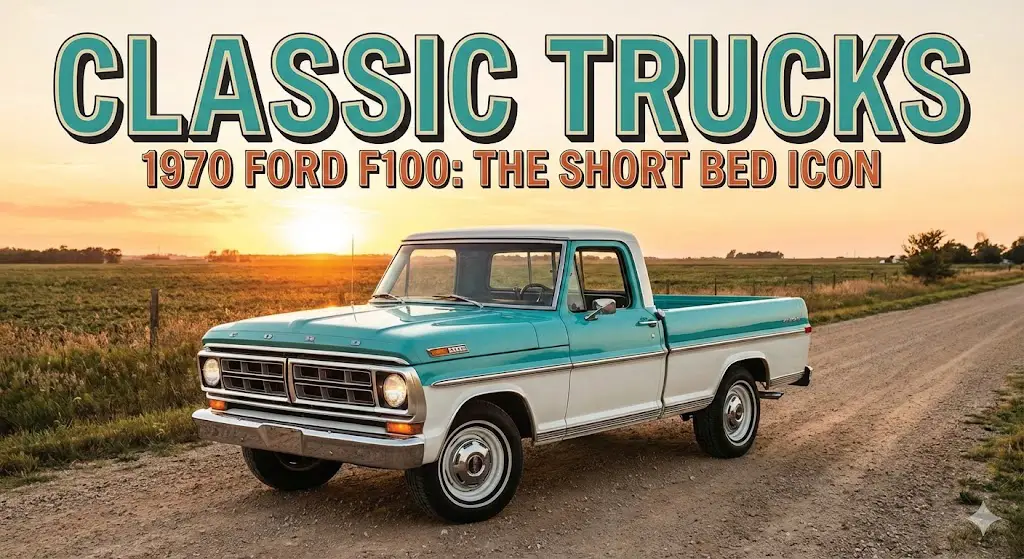
1970 Ford F-100 Short Bed: The Ultimate Buyer’s, Restoration, and Technical Guide 2026

The American automotive landscape of the late 1960s and early 1970s was a period of intense transition, nowhere more evident than in the light truck segment. The 1970 Ford F-100 represents a watershed moment in this evolution, standing at the precise intersection where the pickup truck began its migration from a purely utilitarian agricultural implement to a lifestyle vehicle synonymous with personal freedom and rugged individualism.
This report provides a granular analysis of the 1970 Ford F-100, specifically focusing on the short bed configuration—a chassis layout that has transcended its original maneuverability-focused design to become the quintessential platform for collectors, hot-rodders, and investors in the vintage truck market.
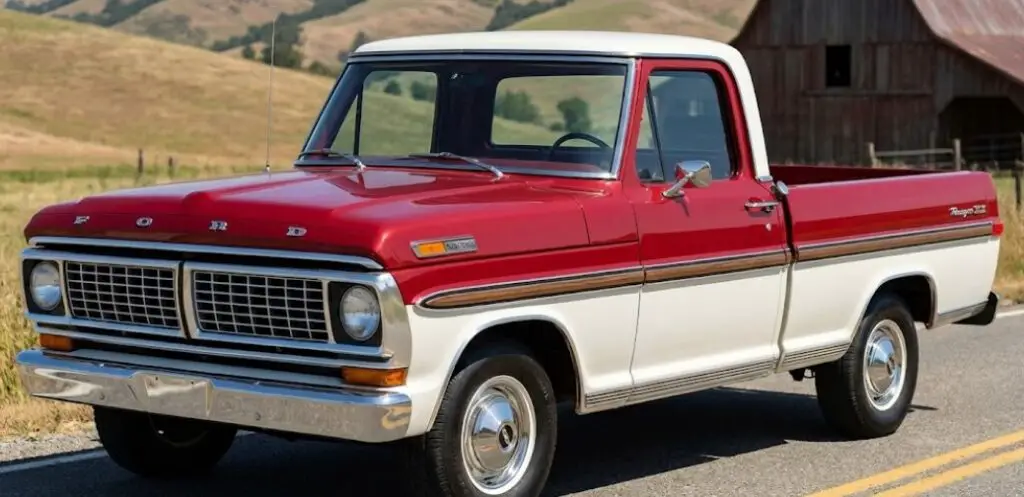
The fifth generation of the Ford F-Series, produced from 1967 to 1972 and affectionately known as the “Bumpside” era due to the prominent concave body line running the length of the vehicle, established the architectural blueprint for modern truck dominance. Within this generation, the 1970 model year is particularly significant. It introduced a refined aesthetic through a new grille design, enhanced safety features mandated by federal regulation, and a trim hierarchy that offered unprecedented levels of luxury, culminating in the Ranger XLT.
These changes signaled Ford’s recognition of a changing demographic: the truck buyer was no longer solely the farmer or the tradesman, but increasingly the suburbanite seeking a second vehicle for recreation.
The focus of this analysis, the short bed configuration (115-inch wheelbase), is critical. While long bed models (131-inch wheelbase) were historically the volume sellers due to their cargo capacity, the short bed has emerged as the premier investment grade asset. Its compact proportions offer superior handling dynamics and a muscular stance that appeals to the “sport truck” aesthetic, driving a significant valuation premium in the secondary market.
This report will explore every facet of the 1970 F-100 Short Bed, from the metallurgy of its Twin I-Beam suspension to the economics of modern “Coyote” engine swaps, providing a definitive resource for stakeholders in the classic automotive sector.
1970 Ford F100 Short Bed
The definitive guide to the “Bumpside” legend. Analyzing specs, performance, and the skyrocketing collector market of the 5th Generation F-Series.
Why the ’70 Short Bed?
The 1970 Ford F100 represents the sweet spot of the “Bumpside” era (1967-1972). Distinguished by its concave body line running the length of the truck, the 1970 model introduced a refined grille and marker lights. The Short Bed (SWB) configuration is particularly prized today for its sporty proportions, lighter weight, and aggressive stance, making it the preferred chassis for muscle truck builds and high-end restorations.
📏 The “Shorty” Factor
The defining characteristic of the SWB F100 is its 115-inch wheelbase. This is significantly tighter than the Long Bed (LWB), resulting in better handling and a more balanced aesthetic favored by hot-rodders.
Comparison of 1970 F-Series Wheelbase configurations.
⚙️ Engine Options & Output
1970 offered a mix of reliable Inline-6s and powerful V8s. The 390 FE V8 was the torque monster of the lineup, while the 302 Windsor (introduced late ’69) provided a modern small-block option.
Gross Horsepower ratings for key 1970 powerplants.
The 1970 Trim Ladder
Ford offered distinct levels of luxury in 1970. Moving up the ladder added chrome, carpeting, better upholstery, and insulation.
Custom
Base Model
- Painted Hubcaps
- Basic Vinyl Seat
- Minimal Chrome
Sport Custom
Mid-Range
- Bright Windshield Moulding
- Vinyl Door Panels
- Rocker Panel Moulding
Ranger
Luxury
- Color-Keyed Carpeting
- Woodtone Instrument Panel
- Additional Insulation
Ranger XLT
Top of Line
- Full Bright Moulding Pkg
- Pleated Cloth/Vinyl Seat
- Tailgate Applique
📈 Collector Market Trajectory
The “Bumpside” F100 Short Bed has seen explosive growth in value over the last decade. As early Broncos and Mustangs became unobtainable, enthusiasts shifted to the F100.
Average value (USD) for Condition #2 (Driver/Show) examples.
🔍 Rarity Factor
Long beds were the workhorses of the 1970s. Short beds were less common then, but highly preferred now, creating a supply/demand imbalance.
© 2026 FordMasterX Infographics. Data sourced from manufacturer owner manuals.
Historical Context and Design Evolution
To fully appreciate the 1970 F-100, one must understand the lineage of the “Bumpside” generation and the specific design choices that distinguish the 1970 model year from its predecessors and successors.
The “Bumpside” Generation (1967–1972)
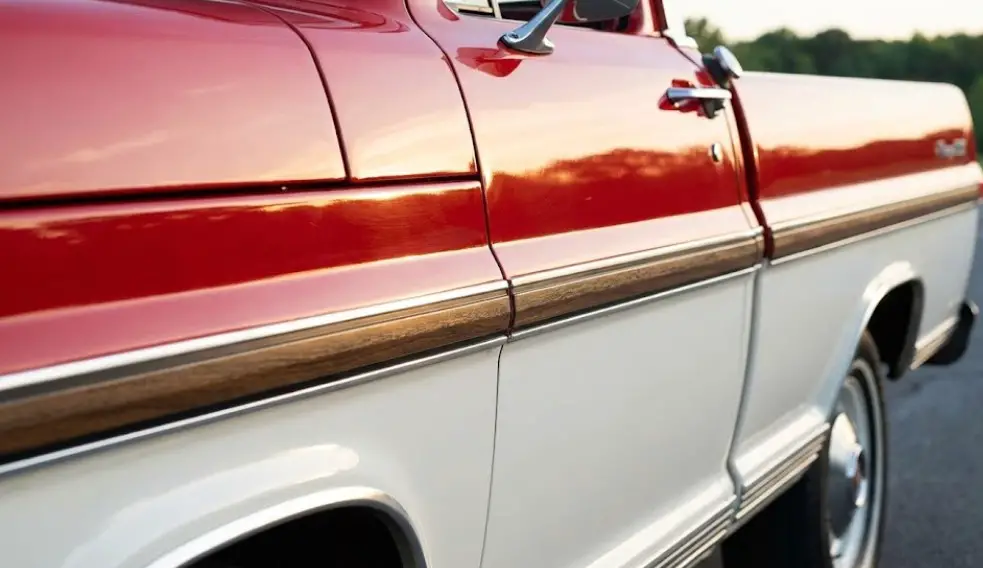
The fifth-generation F-Series launched in 1967 marked a departure from the “Slick 60s” (1961–1966) generation. The design language shifted toward a squared-off, angular aesthetic that emphasized width and stability. The defining feature, the “bump,” is a sculptured line that traverses the fenders, doors, and bed, serving both as a visual character line and a stiffening element for the sheet metal.
The 1970 model year sits squarely in the middle of this production run, benefiting from the initial engineering refinements of 1967–1969 while preceding the plastic-heavy interior updates of 1971–1972. It represents a “sweet spot” of classic metal interior surfaces and refined exterior brightwork.
1970 Specific Design Identifiers
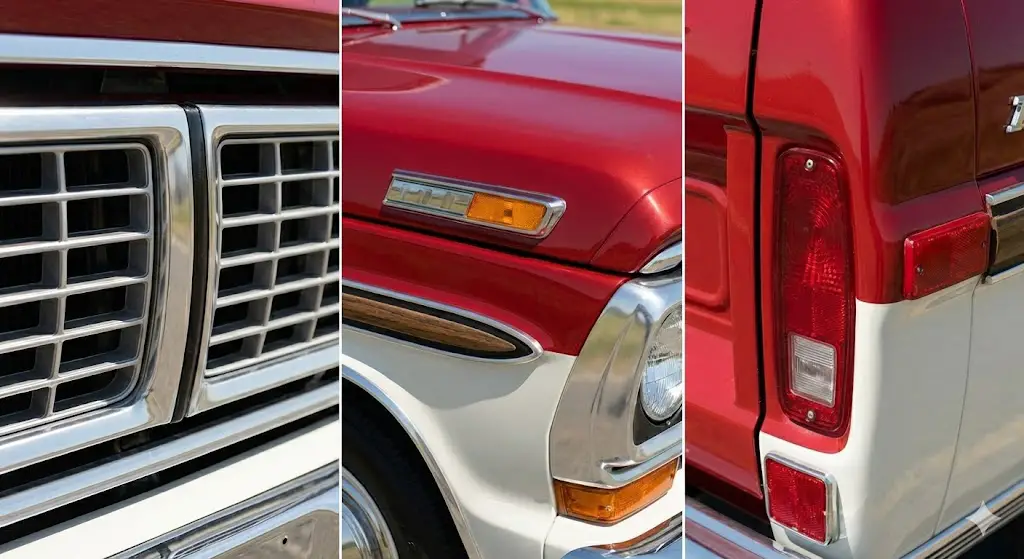
Identifying a true 1970 model requires a keen eye for specific cosmetic details that were unique to this year or introduced as part of the mid-cycle refresh.
- The Grille Structure: The most immediate visual identifier is the grille. For 1970, Ford moved away from the simple horizontal bars of 1969 to a more complex gridwork. The grille featured a tighter grid pattern, often finished in Corinthian White for base models or bright anodized aluminum for upper trims.
- Wrap-Around Lighting: A functional safety update that became a signature styling cue was the parking lamps. For the first time, the front turn signals/parking lamps wrapped around the corners of the front fenders, providing side visibility to adjacent traffic. This integration smoothed the transition from the front fascia to the fender profile.
- Rear Marker Lights: To comply with new Federal Motor Vehicle Safety Standards (FMVSS), the 1970 F-100 featured reflectors and marker lights integrated into the rear lower bed sides. Previous years relied solely on the tail lamps or optional reflectors.
- Trim Nomenclature Shift: 1970 saw a rebranding of the trim levels. The previous “Standard Cab” was renamed “Custom,” and the “Custom Cab” became the “Sport Custom.” This shift was accompanied by the introduction of the “Ranger XLT” as the top-tier luxury package, creating a clear ladder of prestige for buyers.
The Short Bed Aesthetics and Utility
The “Styleside” short bed body is the focal point of high-value restorations. The 6.5-foot cargo box sits on a 115-inch wheelbase, compared to the 8-foot box on the 131-inch wheelbase.
- Visual Proportions: The short bed eliminates the visual “overhang” behind the rear axle and shortens the gap between the cab and the rear wheel arch. This results in a “planted” look where the wheels appear pushed to the corners of the vehicle, a trait highly valued in automotive design for conveying athleticism.
- The “Sport” Factor: In 1970, the short bed was often paired with the sportier trim packages. The reduced weight (approximately 165 lbs lighter than the long bed) contributed to better acceleration and braking, making it the preferred choice for buyers who used the truck for personal transport rather than heavy hauling.
Engineering and Technical Specifications
Beneath the angular bodywork lay a chassis and powertrain architecture designed for durability. The engineering philosophy of the 1970 F-100 prioritized longevity and ease of service, traits that have allowed these vehicles to survive for over half a century.
Chassis Architecture: The Twin I-Beam
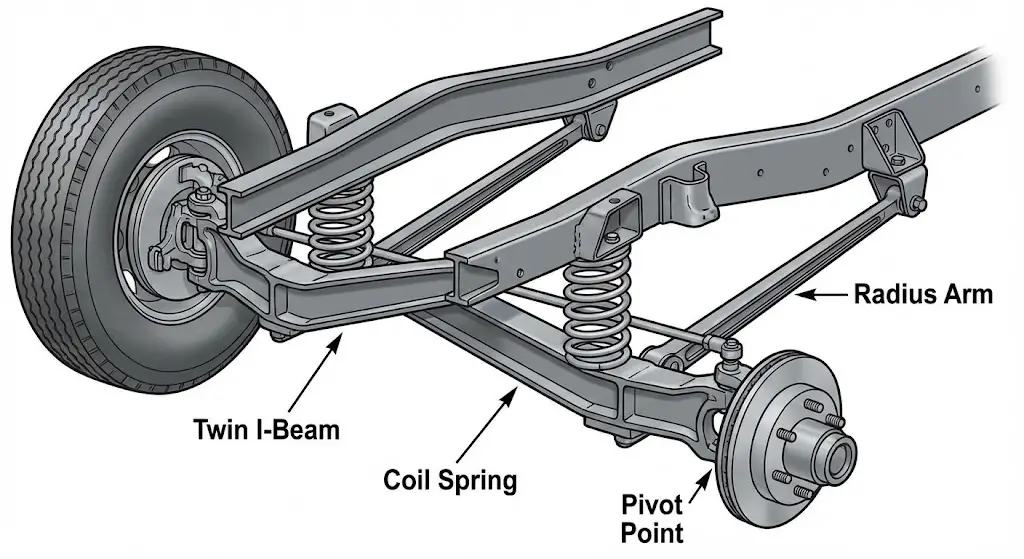
The cornerstone of the F-100’s chassis engineering is the Twin I-Beam independent front suspension. Introduced in 1965 and standard on the 1970 F-100, this system was a significant marketing differentiator for Ford against the independent coil-sprung suspension of the Chevrolet C10.
- Mechanical Design: The system utilizes two robust forged steel I-beam axles that cross the width of the truck. The left wheel is supported by a beam attached to a pivot point on the right side of the frame, and vice versa. Coil springs sit between the I-beams and the frame pockets.
- Operational Characteristics:
- Durability: The forged beams are incredibly strong, resistant to bending even under severe impact. This made the F-100 a favorite for rural and construction use.
- Wheel Geometry: The suspension geometry causes the camber (the vertical angle of the wheel) to change significantly as the suspension cycles. Upon compression, the wheels tilt inward (negative camber); on rebound, they tilt outward (positive camber).
- Tire Wear: While robust, this camber change can lead to accelerated tire wear, specifically “cupping” on the edges of the tires, if the kingpins (the pivot pins holding the spindles) or the radius arm bushings are worn.
- Rear Suspension: The rear utilized a solid axle (Ford 9-inch) suspended by longitudinal leaf springs. 1970 models often featured “Flex-O-Matic” rear springs, a system with a compensating shackle that effectively shortened the spring length under load to increase stiffness while allowing a softer rate when unloaded.
Powertrain Options
The 1970 F-100 engine lineup was diverse, offering economy-minded inline-sixes and torque-rich V8s. Understanding the specific output and characteristics of these engines is vital for collectors.
The Economy Leaders: 240 and 300 Inline-Sixes
The standard engines were the inline-six cylinder units. These engines are renowned for their “bulletproof” reliability, utilizing gear-driven timing sets rather than chains, eliminating a common failure point.
- 240 CID (3.9L): The base engine.
- Power: 150 gross hp @ 4,000 rpm.
- Torque: 234 lb-ft @ 2,200 rpm.
- Use Case: Pure fleet economy.
- 300 CID (4.9L): The heavy-duty six.
- Power: 165 gross hp @ 3,600 rpm.
- Torque: 294 lb-ft @ 2,000 rpm.
- Engineering Note: The 300 features 7 main bearings and a forged crankshaft, providing immense bottom-end stability. Its torque peak at just 2,000 rpm makes it excellent for towing despite the low horsepower figure.
The Small Block: 302 Windsor V8
Introduced to the F-Series in late 1969, the 302 was the modern V8 option for 1970.
- Power: 205 hp @ 4,600 rpm.
- Torque: 300 lb-ft @ 2,600 rpm.
- significance: This lightweight iron-block V8 offered a compromise between the sixes and the heavy FE big blocks. It is the architectural ancestor of the 5.0L HO engines of the 1980s and 90s, making parts availability virtually unlimited.
The FE Big Blocks: 360 and 390 V8
The FE (Ford-Edsel) engine family represented the high-performance tier.
- 360 CID (5.9L):
- Power: 215 hp @ 4,400 rpm.
- Torque: 327 lb-ft @ 2,400 rpm.
- Context: The 360 was a truck-specific engine, essentially a 390 block with a 352 rotating assembly. It is known for being thirsty and low-compression (8.4:1), but incredibly durable.
- 390 CID (6.4L):
- Power: 255 hp @ 4,400 rpm.
- Torque: 376 lb-ft @ 2,600 rpm.
- Market Note: The 390 is the most desirable factory engine. However, buyers must be wary: many “390” trucks actually contain 360s, as they are externally identical. The only sure way to differentiate them without disassembly is to measure the stroke (3.50″ for 360, 3.78″ for 390) via a dowel in the spark plug hole.
Table 1: 1970 Ford F-100 Factory Engine Specifications
| Engine Code (VIN) | Displacement | Type | Horsepower (Gross) | Torque (lb-ft) | Comp. Ratio | Carburetion |
| A | 240 ci (3.9L) | I-6 | 150 @ 4000 | 234 @ 2200 | 9.2:1 | 1-bbl Carter |
| B | 300 ci (4.9L) | I-6 | 165 @ 3600 | 294 @ 2000 | 8.8:1 | 1-bbl Carter |
| G | 302 ci (5.0L) | V8 | 205 @ 4600 | 300 @ 2600 | 8.6:1 | 2-bbl Autolite |
| Y | 360 ci (5.9L) | V8 | 215 @ 4400 | 327 @ 2400 | 8.4:1 | 2-bbl Autolite |
| H | 390 ci (6.4L) | V8 | 255 @ 4400 | 376 @ 2600 | 8.6:1 | 2-bbl Autolite |
Drivetrain Components
- Transmissions:
- 3-Speed Manual: Standard column shift (“Three on the Tree”).
- 4-Speed Manual (NP435): Floor shifted, heavy-duty with a non-synchronized first gear (“Granny Low”). Rare in short bed half-tons unless ordered for towing.
- C4 Automatic: 3-speed automatic used primarily with the 240/300 I6 and 302 V8.
- C6 Automatic: Heavy-duty 3-speed automatic used with FE engines (360/390). The C6 is legendary for its ability to handle high torque loads.
- Rear Axle: The Ford 9-inch rear axle was standard equipment. This axle is an automotive icon due to its “drop-out” third member design, which allows for easy gear ratio changes, and its high-pinion bearing support which provides exceptional strength. It remains a standard in drag racing today.
Trim Levels, Interiors, and Options
The 1970 model year introduced the “Package Selling” concept, bundling options into distinct trim levels to simplify the ordering process and encourage up-selling.
Custom (Base Trim)
The entry-level truck, formerly “Standard Cab.”
- Appearance: Painted grille (usually white), painted front bumper, no side moldings, painted hubcaps.
- Interior: Rubber floor mats, basic vinyl bench seat, minimal sound insulation, cardboard headliner.
- Identity: Pure work truck. Often found with the 240 I6.
Sport Custom
The mid-tier option, replacing “Custom Cab.”
- Exterior Enhancements: Added bright rocker panel moldings, bright windshield molding, and unique “Sport Custom” script badges on the rear quarters.
- Interior Upgrades: Pleated vinyl door panels with bright moldings, upgraded foam seat cushions, and a horn ring on the steering wheel.
Ranger
The luxury trim.
- Exterior: Featured full-length bright body side moldings with black paint accents (wider than previous years), bright hubcaps, and “Ranger” emblems.
- Interior: Color-keyed wall-to-wall carpeting (a significant upgrade from rubber), cloth and vinyl seat upholstery, and simulated woodgrain inserts on the instrument panel.
Ranger XLT (The Halo Trim)
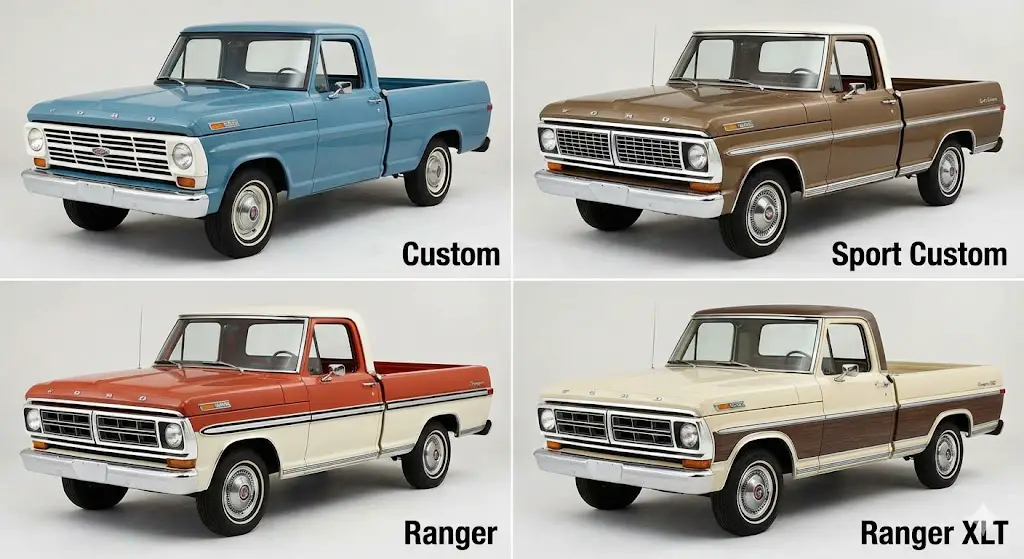
New for 1970, the Ranger XLT was designed to compete directly with the Chevrolet CST and GMC Sierra Grande.
- Exterior Distinction: The XLT is instantly recognizable by its woodgrain tailgate applique with bright “FORD” block letters and matching wide body-side moldings with woodgrain inserts.
- Interior Opulence: Full pleated cloth and vinyl “comfort” seats, perforated sound-absorbing headliner, extra insulation pads behind the firewall and under the floor, cargo light, and a convenience group including a glove box lock.
- Collector Status: A factory Ranger XLT short bed is the most desirable specification, often commanding a 20-30% premium over a Custom or Sport Custom model.
Table 2: Trim Level Feature Comparison
| Feature | Custom | Sport Custom | Ranger | Ranger XLT |
| Grille Finish | Painted (White) | Bright Aluminum | Bright Aluminum | Bright Aluminum |
| Floor Covering | Rubber Mat | Rubber Mat | Color-Keyed Carpet | Color-Keyed Carpet |
| Seat Material | Vinyl | Pleated Vinyl | Cloth & Vinyl | Pleated Cloth & Vinyl |
| Side Molding | None (Optional) | Rocker Panel Bright | Wide Bright w/ Black | Wide Bright w/ Woodgrain |
| Tailgate | Painted “FORD” | Aluminum Applique | Aluminum Applique | Woodgrain Applique |
| Insulation | Standard | Standard | Enhanced | Premium Package |
VIN Decoding and Data Plate Analysis
Verifying a vehicle’s pedigree is the first step in valuation. The Warranty Plate (riveted to the driver’s door face) and the VIN stamped on the frame rail (passenger side, top of the rail near the engine mount) must match.
VIN Structure (Example: F10GCH50001)
- Series (Digits 1-3):
F10: F-100 2-Wheel Drive (2WD).F11: F-100 4-Wheel Drive (4WD).- Warning: If a truck is presented as a factory 4×4 short bed but has an F10 VIN, it is a chassis swap or conversion.
- Engine (Digit 4):
A: 240 I6B: 300 I6G: 302 V8Y: 360 V8H: 390 V8 (Note: H-code 390 trucks are rare in F-100 form and highly prized).
- Assembly Plant (Digit 5):
C: OntarioR: San Jose (Desirable “California Truck” indicator)H: Lorain, OHK: Kansas City.
- Sequential Number (Digits 6-11):
- 1970 production used the sequence
G30,000throughJ89,999.
- 1970 production used the sequence
Warranty Plate Codes
The data plate provides further granularity regarding the truck’s original configuration.
- Wheelbase (WB): This is the definitive check for a short bed.
- 115: Short Bed (6.5 ft box).
- 131: Long Bed (8 ft box).
- Alert: A mismatch between the physical bed length and this code indicates a frame shortening modification.
- Color Codes:
M: Wimbledon WhiteT: Candyapple RedS: Champagne Gold6: Acapulco BlueB: Royal Maroon.
Restoration and Modification: The Restomod Era
The 1970 F-100 has become one of the most popular platforms for “restomods”—classic vehicles restored with modern technology. The separation between body and frame allows builders to easily upgrade suspension and drivelines.
The Crown Victoria Suspension Swap
The “Crown Vic Swap” is the dominant suspension modification for the F-100. It involves grafting the entire cast aluminum front suspension crossmember from a 2003–2011 Ford Crown Victoria Police Interceptor (P71) onto the F-100 frame.
- The Advantage: For a cost of $300–$500 (junkyard pricing), builders gain modern rack-and-pinion power steering, massive 12-inch disc brakes, coil-over suspension, and aluminum control arms. Aftermarket kits like Mustang II setups can cost $2,000+ for similar functionality.
- Implementation: The F-100 frame width is nearly identical to the Crown Vic mounting points. The crossmember bolts in (with some sleeve fabrication) or can be welded.
- Challenges:
- Track Width: The Crown Vic track is significantly wider than the stock F-100. This necessitates the use of high-offset wheels (typically late-model Mustang wheels) to keep the tires tucked inside the fenders. Standard zero-offset classic mags will push the tires out past the bodywork.
- Steering Shaft: The F-100 steering column must be shortened and modified. A specific combination of U-joints and a DD shaft is required to connect the vintage column to the Crown Vic rack.
- Ride Height: The swap automatically lowers the front of the truck by 4-5 inches. To level the truck, a rear axle “flip kit” (moving the axle from below the leaf springs to above them) or a C-notch is usually required.
The Coyote Engine Swap
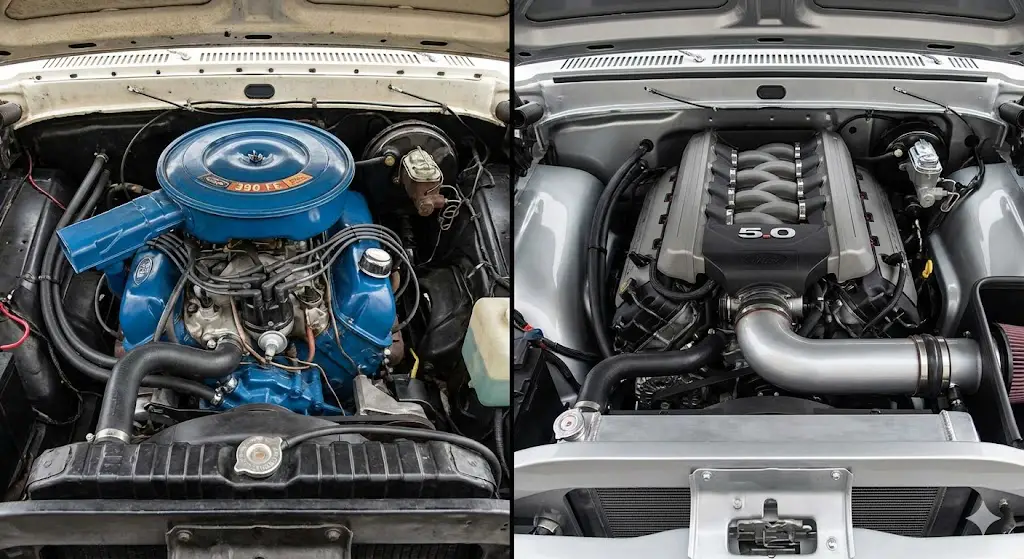
Replacing the vintage FE or Windsor engine with a modern 5.0L “Coyote” V8 (2011+ Mustang GT/F-150) is the current gold standard for high-end builds.
- Performance: A Gen 1 or Gen 2 Coyote produces 400+ horsepower and offers OEM reliability and fuel injection.
- Fitment Issues: The Coyote is physically massive due to its DOHC cylinder heads.
- Oil Pan: The stock Coyote oil filter location often interferes with the F-100 steering linkage or crossmember. Relocation kits or specific swap oil pans (e.g., from Moroso or Fat Fender Garage) are mandatory.
- Headers: Factory Mustang headers will hit the F-100 frame rails. Custom swap headers are required.
- Electronics: The swap requires a standalone ECU, such as the Ford Performance Control Pack. This adds $1,500–$2,000 to the budget but simplifies wiring significantly.
Short Bed Conversion (Frame Shortening)
Because factory short beds are rarer and more expensive, many builders convert long beds.
- Methodology: This involves cutting approximately 16 inches out of the frame rail between the cab and the rear axle, and cutting another section off the rear frame horns.
- Market Impact: A “converted” short bed is generally valued at 10-15% less than a factory code 115 truck, provided the work is high quality. Inspecting the frame rails for weld marks near the transmission crossmember is the primary method of detection.
Market Valuation and Investment Analysis
The market for the 1970 F-100 has bifurcated into two distinct segments: high-quality survivors/restorations and high-performance restomods.
Valuation Trends (2025-2026 Data)
Based on recent auction results from platforms like Bring a Trailer and Hagerty valuation tools, the 1970 F-100 is on a strong upward trajectory.
- Concours / High-End Restomod:$60,000 – $100,000+.
- Drivers: Coyote swaps, Ranger XLTs with 390s, high-quality paint (Candyapple Red/Acapulco Blue).
- Example: A 408 Stroker-powered Ranger XLT sold for $72,500.
- Outlier: An ICON-built custom 1970 F-100 sold for $270,000, demonstrating the ceiling for “brand name” builds.
- Excellent Condition (#2):$30,000 – $45,000.
- Clean, rust-free short beds with mostly original components or tasteful upgrades (wheels/tires).
- Driver Condition (#3):$15,000 – $25,000.
- Mechanically sound, older paint, potential minor rust in non-structural areas.
- Project Condition:$5,000 – $10,000.
- Running but needing metal work (floors, cab mounts).
The Short Bed Premium
The market data explicitly shows a “Short Bed Premium.” A short bed F-100 typically commands 20-30% more than a comparable condition long bed. This is purely driven by aesthetics and garage-ability; the long bed is seen as a “work truck,” while the short bed is a “muscle truck.”
Table 3: Recent Auction Sales Analysis
| Model | Spec | Condition | Price | Date | Source |
| 1970 F-100 | Short Bed 4×4 | ICON Custom | $270,000 | 05/2025 | BaT |
| 1970 F-100 | Ranger XLT | Restomod (408ci) | $72,500 | 09/2023 | BaT |
| 1970 F-100 | Styleside | Coyote Swap | $28,000 | 10/2025 | BaT |
| 1971 F-250 | Long Bed | Sport Custom | $47,250 | 01/2026 | BaT |
| 1970 F-100 | Short Bed | 4×4 Driver | $14,650 | 11/2025 | BaT |
Critical Inspection Points for Buyers
When evaluating a 1970 F-100, specific rust-prone areas can destroy the value of the investment:
- Drip Rails: The sealant in the roof drip rails dries and cracks, allowing water to wick into the roof structure. Rust bubbling here is extremely difficult and expensive to repair.
- Cowl Vents: Leaves and debris collect at the bottom of the cowl (base of the windshield). This rots the metal, causing water to leak onto the floorboards during rain.
- Front Cab Mounts: These are the primary structural points connecting the cab to the frame. They trap dirt and moisture, rotting away and causing the cab to sag, which misaligns the door latches.
- Core Support: The radiator support rots under the battery tray and at the mounting points.
Comparative Analysis: F-100 vs. Chevrolet C10
The rivalry between the Ford F-100 and the Chevrolet C10 (1967-1972) is the defining debate of the vintage truck world.
Suspension and Ride Quality
- Chevy C10: Utilized a trailing arm rear suspension with coil springs (on most models). This setup provides a compliant, car-like ride that is generally superior to the F-100’s leaf springs.
- Ford F-100: The Twin I-Beam front and leaf spring rear is stiffer and rougher. However, the I-Beam is arguably more durable for actual truck use.
Engine Bay and Modifiability
- Chevy C10: The LS engine swap is ubiquitous and cheap. The C10 engine bay accommodates the LS easily.
- Ford F-100: The F-100 engine bay is wider, which is beneficial for wide DOHC engines like the Coyote or the massive 7.3L Godzilla. However, the Twin I-Beam suspension towers intrude into the bay, complicating header routing for these swaps compared to the C10’s open crossmember design.
Value Proposition
Historically, the C10 has traded at a premium. However, as C10 prices have skyrocketed (good examples regularly topping $50k), the F-100 has become the “smart money” alternative. The gap is closing, but a 1970 F-100 Short Bed still offers a slightly lower entry point for similar vintage appeal.
People Also Ask
Q: Can you put a Crown Victoria front end on a 1970 F-100?
A: Yes, the 2003-2011 Crown Victoria front suspension is a near bolt-in swap for the 1970 F-100. It requires removing the Twin I-Beams and crossmember, drilling new mounting holes for the Crown Vic subframe, and modifying the steering shaft. It drops the front end ~5 inches and adds modern disc brakes and rack-and-pinion steering.
Q: How do I tell if my 1970 F-100 is a factory short bed?
A: Check the Warranty Plate on the driver’s door. The Wheelbase (WB) code must be 115. If it says 131, it is a long bed that may have been cut down. Also, measure the bed length: a short bed box is approximately 6.5 feet long.
Q: What is the rarest 1970 F-100 engine?
A: The 428 Cobra Jet was never a factory option in the F-100, despite myths. The rarest factory engine for a 1970 F-100 is likely the 390 V8 (H-code) paired with a 4-speed manual in a short bed chassis, as the 390 was typically paired with the C6 automatic in luxury trims.
Q: What is the difference between a Ranger and a Ranger XLT?
A: The Ranger XLT adds a woodgrain applique to the tailgate and woodgrain inserts in the side moldings. The standard Ranger has aluminum trim with black painted accents. The XLT also features a higher grade of interior insulation and carpet.
Conclusion
The 1970 Ford F-100 Short Bed is a masterclass in transitional automotive design. It bridges the gap between the honest, hardworking trucks of the post-war era and the comfortable, lifestyle-oriented vehicles of the modern age.
For the collector, the 1970 model is distinguished by its unique one-year-only trim details and the introduction of the Ranger XLT. For the builder, its sturdy frame and generous engine bay dimensions make it a perfect host for modern Coyote horsepower, provided the suspension is updated to match.
Whether one seeks to restore a Candyapple Red Ranger XLT to showroom perfection or build a corner-carving restomod with a Crown Vic chassis, the 1970 F-100 Short Bed remains one of the most versatile and appreciating assets in the classic truck market. Its blend of “Bumpside” muscularity and Ford durability ensures it will remain a coveted icon for generations to come.