When Did The 7.3 Powerstroke Come Out: A Detailed Timeline And Technical Introduction

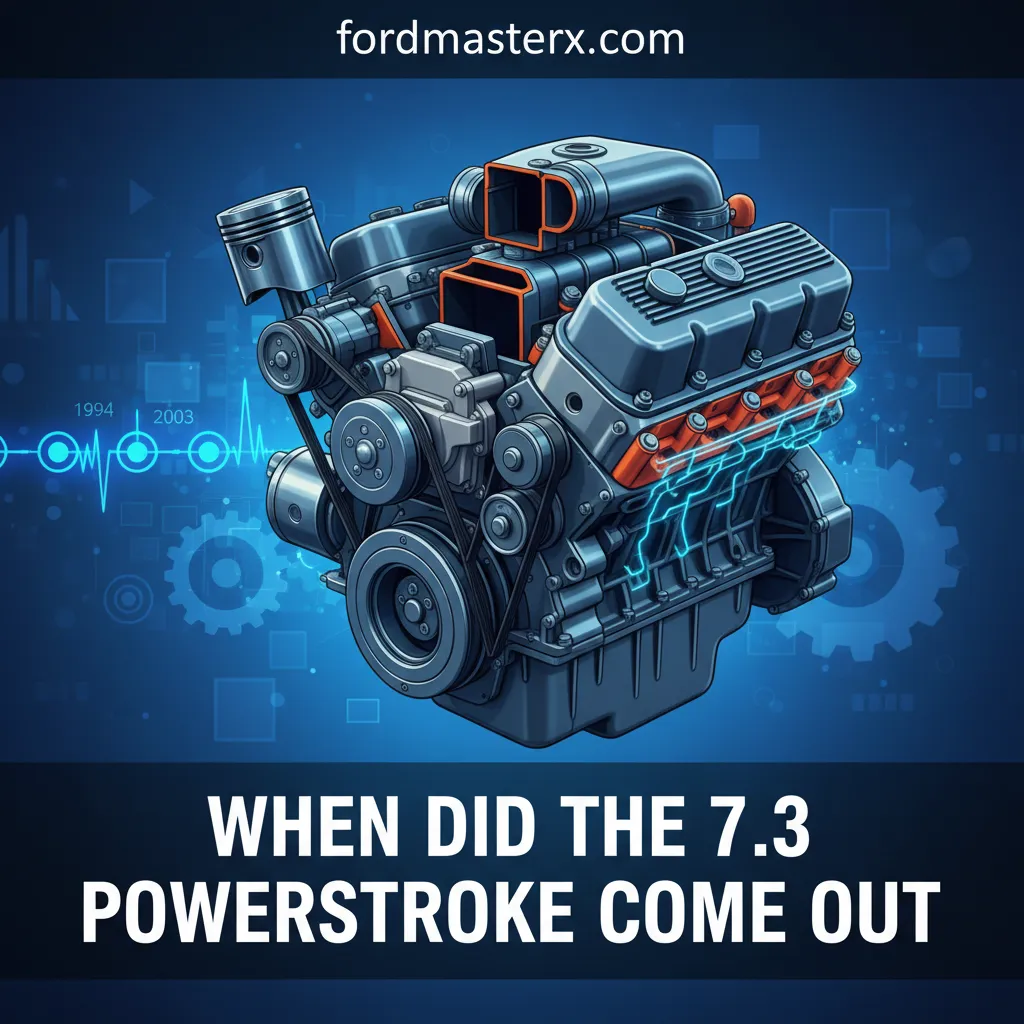
In the world of heavy-duty diesel performance, few engines carry the legendary status of the 7.3L Powerstroke V8. It is the engine that defined an era of American work trucks, transforming the diesel pickup from a niche agricultural tool into a mainstream powerhouse capable of cross-country towing and daily commuting alike. However, while many diesel enthusiasts recognize its reliability, there is often confusion regarding exactly when the 7.3 Powerstroke came out and how it differed from its predecessor, the 7.3 IDI. This article provides a definitive timeline of the 7.3 Powerstroke’s introduction, its technical milestones through 2003, and the engineering basics that cemented its legacy.
The 1994.5 Launch: Understanding the Transition from IDI to Powerstroke
To accurately answer when the 7.3 Powerstroke came out, we must look at the mid-year transition of 1994. Prior to this, Ford utilized the 7.3L International IDI (Indirect Injection) engine. While the displacement was the same, the technology was worlds apart. Early 1994 Ford F-250 and F-350 trucks left the factory with the mechanical IDI engine, but by the midpoint of the production year, the “Powerstroke” was born.
📤 Share Image
This introduction was the result of a massive partnership between Ford and Navistar International. Navistar had developed the T444E engine—a 444-cubic-inch V8 designed for medium-duty applications—and Ford adapted it for their light-duty truck platforms. This wasn’t just a rename; it was a total overhaul of the engine’s fundamentals. The shift from mechanical fuel injection to electronic control systems allowed for a degree of precision that was previously impossible in the light truck market.
The immediate performance impact was substantial. While the IDI struggled with efficiency and cold starts, the 1994.5 Powerstroke offered 210 horsepower at 3,000 rpm and 425 lb-ft of torque at 2,000 rpm. Visually, buyers could identify the new engine by the badging; the old IDI models carried “Turbo Diesel” badges on the fenders, whereas the new models proudly displayed the “Powerstroke” logo, signaling a new era of diesel dominance.

HEUI Fuel Systems Explained: The Basics of 7.3 Powerstroke Architecture
At the heart of why the 7.3 Powerstroke became legendary—and why it was so different when it came out—is the Hydraulic Electronic Unit Injection (HEUI) system. For those coming from a background in traditional mechanical diesels, understanding the HEUI system is key points to mastering the fundamentals of this engine.
In a HEUI system, fuel is not pressurized by a mechanical pump driven by the timing gears. Instead, the engine uses highly pressurized engine oil to actuate the fuel injectors. This makes the High-Pressure Oil Pump (HPOP) the second “heart” of the engine. The HPOP takes standard engine oil and ramps the pressure up to anywhere between 500 and 3,000 PSI. This oil pressure is then used to force an intensifier piston inside the injector, which multiplies that pressure to spray fuel into the cylinder at up to 21,000 PSI.
Because the 7.3 uses oil to fire the injectors, oil quality is the single most important factor for performance. Dirty oil or the wrong viscosity doesn’t just hurt the bearings; it directly causes poor fuel atomization, hard starts, and lost power.
Critical Management Components
The introduction of electronic control meant the engine required a suite of sensors to function properly. Two of the most important are:
- Injection Pressure Regulator (IPR) Valve: This valve sits on the HPOP and controls how much oil pressure is sent to the injectors. If the IPR fails, the truck won’t start.
- Injector Control Pressure (ICP) Sensor: This acts as the “eyes” of the computer, monitoring the oil pressure in the head rails to ensure the IPR is doing its job.
This overview of the HEUI system explains why the 7.3 was so revolutionary for the mid-90s. It allowed the computer to adjust fuel timing and pressure based on engine temperature, altitude, and load, leading to significantly better cold starts and reduced emissions compared to any previous mechanical iteration.

The Evolution of the 7.3: Significant Updates from 1999 to 2003
While the engine debuted in 1994.5, it underwent a massive transformation in 1999 with the release of the “New Body Style” (NBS) Ford Super Duty. If you are shopping for a 7.3 today, understanding the differences between an “OBS” (Old Body Style, 1994-1997) and an “NBS” (1999-2003) is essential.
📋
Key Evolutionary Milestones
The 1999 Super Duty introduced an air-to-air intercooler. By cooling the compressed air before it entered the engine, Ford significantly lowered Exhaust Gas Temperatures (EGTs) and increased density, allowing for more power.
The early TP38 non-wastegated turbos were replaced by the Garrett GTP38 wastegated turbocharger in 1999. This allowed for better low-end boost response without over-speeding the turbo at high RPMs.
Injectors moved from “single-shot” (AA/AB codes) to “split-shot” (AD codes) for noise reduction. Additionally, the HPOP swash plate was upgraded from 15-degree to 17-degree to provide higher oil volume.
The results of these iterative updates were clear in the numbers. While the initial 1994 version put out 425 lb-ft of torque, the final 2003 iterations reached a peak of 525 lb-ft for automatic models and 505 lb-ft for manual transmissions. This evolution ensured the 7.3 remained competitive even as rivals began introducing newer engine designs.
Production Conclusion and Legacy: An Introduction to the 6.0L Transition
All good things must come to an end, and for the 7.3 Powerstroke, the end came in 2003. It wasn’t because the engine was faulty or unpopular; quite the opposite. The 7.3 was phased out primarily due to tightening federal NOx emissions standards. The engine’s large displacement and relatively simple injection architecture made it impossible to meet the coming 2004 requirements without a radical redesign that the platform couldn’t accommodate.
In late 2003, Ford transitioned to the 6.0L Powerstroke. This was a controversial shift. While the 6.0L offered more power and a 5-speed TorqShift transmission, it traded the 7.3’s simplicity for complex EGR systems and Variable Geometry Turbochargers (VGT). This comparison is what truly cemented the 7.3’s legacy: it became known as the “reliable” one, the “million-mile” engine that would outlast the truck it was bolted into.
The 7.3 By The Numbers
Total Units Produced
Production Run
Final Torque Peak
Nearly 2 million 7.3 Powerstroke engines were produced by Navistar for Ford between 1994 and 2003. Today, these trucks command a premium on the secondary market. Fleet managers and hot-shot haulers still seek out the 7.3 for its heavy-duty fundamentals and the fact that its most common failures (like the Camshaft Position Sensor or IPR valve) can often be fixed on the side of the road with basic tools.
If you are buying a 2003 model, be aware that it could have either engine. Check the door jamb for the build date or look at the engine itself. The 7.3 has the turbo at the very back of the valley, while the 6.0 has a large intake manifold and an oil filter housing right on top.
In conclusion, the 7.3 Powerstroke didn’t just “come out”—it arrived with a mission to prove that diesel power belonged in every driveway in America. By combining the heavy-duty lineage of International Harvester with Ford’s market dominance, it created a vehicle that set the benchmark for longevity. The 7.3 Powerstroke debuted in mid-1994, marking the shift to electronic direct injection via the HEUI system. Significant updates in 1999, including intercooling, transformed the engine for the Super Duty era. Production ceased in 2003 due to emissions regulations, leaving a legacy of unmatched durability. Whether you are a prospective buyer or a long-time owner, understanding these production nuances is essential for maintaining or restoring this iconic diesel powerplant.
Frequently Asked Questions
Was there a 1994 7.3 Powerstroke?
Yes, but it was a mid-year release often referred to as a 1994.5 model. Early 1994 Ford trucks featured the 7.3 IDI (Indirect Injection) engine. The 7.3 Powerstroke, which utilized the Navistar T444E architecture and electronic HEUI injection, was introduced halfway through the 1994 model year to provide more power and better efficiency.
What is the difference between a 7.3 IDI and a 7.3 Powerstroke?
The primary difference lies in the injection system. The 7.3 IDI uses a mechanical injection pump to deliver fuel into a pre-chamber, whereas the 7.3 Powerstroke uses a Hydraulic Electronic Unit Injection (HEUI) system to spray fuel directly into the combustion chamber. The Powerstroke also features a computer-controlled Engine Control Module (ECM) and a turbocharger as standard equipment.
What was the last year the 7.3 Powerstroke was made?
The final year of production for the 7.3 Powerstroke in Ford F-Series trucks was 2003. During this transition year, Ford began phasing in the 6.0L Powerstroke. Consequently, you can find early 2003 Super Duty models with the 7.3L engine and late 2003 models equipped with the 6.0L engine, depending on the specific build date.
Why is the 7.3 Powerstroke considered so reliable?
Its reliability stems from a heavy-duty cast-iron block and cylinder heads, a relatively low-stress power-to-displacement ratio, and the absence of complex emissions components like EGR valves or DPF filters found on modern diesels. The engine was designed for medium-duty commercial use (as the T444E), meaning it was overbuilt for the light-duty F-250 and F-350 chassis.
How do I know if my 1994 truck has a 7.3 Powerstroke?
The easiest way to identify the engine is by looking at the valve covers. A 7.3 Powerstroke will have a large ‘Powerstroke’ plastic cover or distinct aluminum valve covers with an Engine Serial Number (ESN) tag. Additionally, the Powerstroke lacks the hard metal fuel lines running from a central pump to each cylinder that are characteristic of the 7.3 IDI engine.