
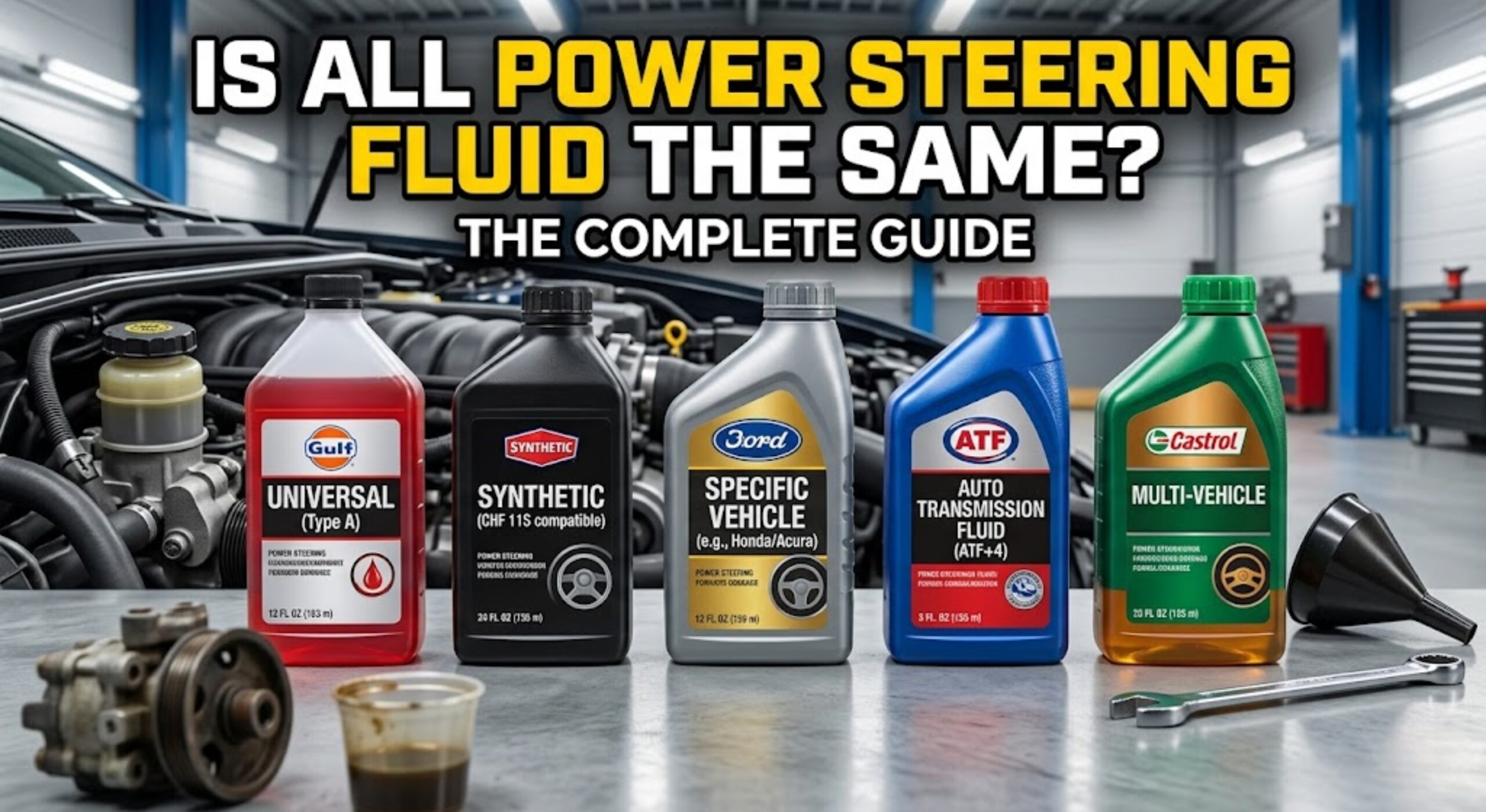
Is All Power Steering Fluid the Same? The Complete Guide in 2026

A pervasive and often costly misconception in automotive maintenance is the belief that all hydraulic steering systems can operate efficiently on a homogenized, universal fluid. The question of whether all power steering fluid is the same represents a fundamental misunderstanding of modern automotive tribology.
The definitive answer is that they are entirely distinct; power steering fluids are highly specialized chemical formulations engineered to meet the exact mechanical tolerances, thermal operating environments, and elastomeric seal materials of specific vehicle architectures.
The belief that any viscous red or clear liquid can be poured into a steering reservoir stems from an era when automotive tolerances were loose, and universal Automatic Transmission Fluid (ATF) was largely adequate for the low-pressure systems of the mid-twentieth century. Today, introducing an incorrect fluid into a modern rack-and-pinion or recirculating ball steering system acts as a catalyst for catastrophic mechanical failure.
The wrong chemical package can disintegrate internal seals, induce cavitation within the rotary vane pump, and cause localized boiling that destroys the hydraulic assist mechanism.
This comprehensive report delves into the intricate tribological engineering of power steering fluids, providing an exhaustive analysis of chemical compositions, historical fluid transitions with a specific focus on Ford Motor Company specifications, the divergence of European and Asian original equipment manufacturer requirements, and the mechanical reality behind fluid degradation and aftermarket stop-leak additives.
Is All Power Steering Fluid The Same?
A catastrophic steering rack failure can cost upwards of $1,500. The leading cause? Using the wrong hydraulic fluid. We break down the chemistry, OEM requirements, and data behind power steering fluids.
The Verdict: Absolutely Not.
Assuming “all power steering fluid is the same” is a dangerous misconception that destroys steering pumps and rack-and-pinion seals daily. Power steering systems operate under immense pressure (up to 2,000 psi) and extreme temperature fluctuations.
Manufacturers design power steering pumps and hoses using specific rubber compounds. A fluid meant for a 1998 Ford F-150 will chemically degrade the O-rings in a 2015 BMW. Today’s automotive market features a heavily fragmented fluid landscape.
Key Takeaway:
Using the wrong fluid type causes immediate seal swelling, pump cavitation, and total loss of hydraulic assist.
Global Market Usage by Fluid Base
Distribution of OEM factory fill fluids in modern vehicles.
The 3 Primary Classes of Power Steering Fluid
Understanding the chemical base of your vehicle’s fluid is the first step in proper maintenance. Never interchange these three primary categories.
ATF (Automatic Transmission Fluid)
Historically the most common. Many older domestic vehicles (like pre-2010 Fords using MERCON) utilize ATF. It contains friction modifiers and detergents suited for both transmissions and older steering racks.
- ✓ Color: Usually Red
- ✓ Base: Mineral or Synthetic blend
- ✓ Common Specs: Dexron III, Mercon V
Synthetic-Based (CHF)
Central Hydraulic Fluids (CHF) are engineered for extreme temperatures and modern electro-hydraulic systems. Standard in European vehicles (VW, BMW, Audi) and newer domestics.
- ✓ Color: Usually Green
- ✓ Base: Fully Synthetic
- ✓ Common Specs: Pentosin CHF 11S, CHF 202
Mineral-Based
Highly refined petroleum products. Used in specific applications where synthetic additives might degrade older, specialized rubber seals. Common in older European models.
- ✓ Color: Often clear, yellowish
- ✓ Base: Refined Petroleum
- ✓ Common Specs: LHM+
The Science of Steering: Viscosity Dynamics
Why do modern cars require expensive synthetic fluids like CHF 11S? The answer lies in kinematic viscosity.
A power steering fluid must remain thin enough at -40°C to pump instantly on a cold start, but thick enough at 130°C to lubricate the metal-on-metal friction of the pump vanes. As the data shows, synthetic fluids maintain an incredibly stable viscosity curve compared to traditional mineral or older ATF bases.
What the chart means: The flatter the line, the better. A steep drop indicates the fluid gets dangerously thin when hot, leading to pump wear. A steep rise means it turns to sludge when cold, causing morning “steering whine.”
Kinematic Viscosity vs. Temperature
Measuring fluid stability (Centistokes/cSt) across operating temps.
What Happens If You Mix Them?
In an emergency, topping off your power steering reservoir with the wrong fluid might seem harmless. Here is the exact mechanical breakdown of why mixing fluid types is catastrophic.
Chemical Incompatibility
Synthetic bases mixed with mineral bases cause immediate additive clash, creating a gel-like sludge.
Seal Degradation
Incorrect solvents attack the specific Buna-N or Viton seals inside the steering rack, causing them to shrink or dissolve.
Total Pump Failure
Sludge blocks the fine mesh reservoir filter. The pump starves for fluid (cavitation), sending metal shavings through the system.
Common OEM Fluid Specifications
Always check your owner’s manual or the cap of the power steering reservoir. Here is a quick reference guide for common vehicle manufacturers.
| Manufacturer | Common Spec / Standard | Fluid Type | Typical Color |
|---|---|---|---|
| Ford (Pre-2012) | MERCON V / XT-5-QM | ATF Base | Red |
| Ford (Modern) | Motorcraft XL-14 | Advanced Synthetic | Amber/Clear |
| BMW / Audi / VW | Pentosin CHF 11S / 202 | Full Synthetic | Dark Green |
| Honda / Acura | Honda Genuine PSF | Proprietary Mineral/Synthetic | Clear/Yellow |
| GM / Chevrolet | Dexron VI / GM PN 89021184 | ATF Base / Synthetic Blend | Red/Amber |
The Chemical Paradigm: Power Steering Fluid versus Automatic Transmission Fluid
To understand why power steering fluids are not monolithic commodities, one must first dissect the historical and chemical relationship between dedicated Power Steering Fluid (PSF) and Automatic Transmission Fluid (ATF). For decades, these two fluids were treated as interchangeable by both consumers and certain manufacturers. However, they are engineered for fundamentally different operating environments and perform entirely different mechanical tasks.
Both PSF and ATF begin with a foundational base oil, which can be a highly refined mineral oil, a synthetic blend, or a fully synthetic hydroprocessed base stock. The critical divergence occurs in the additive packaging blended into these base oils. Automatic transmission fluid is uniquely designed to lubricate a complex planetary gearset while simultaneously providing the exact coefficient of friction required for submerged clutch packs to engage and disengage without slipping or shuddering.
To achieve this delicate balance of lubrication and friction, ATF is heavily saturated with friction modifiers. Furthermore, transmissions constantly generate microscopic clutch material debris during normal operation, necessitating the inclusion of aggressive detergent packages to suspend these particles and prevent delicate valve body blockages.
Conversely, power steering fluid operates in a purely hydraulic environment devoid of clutch packs or shifting mechanisms. Its primary mandate is to transfer kinetic energy from the engine-driven pump to the steering rack while lubricating metal-on-metal and metal-on-seal interfaces under extreme hydrostatic pressure. Therefore, true PSF is a relatively pure hydraulic fluid heavily fortified with robust anti-wear additives, anti-foaming agents to prevent cavitation, and corrosion inhibitors. It intentionally lacks the heavy friction modifiers and aggressive detergents found in transmission fluids.
The operational stresses placed on steering pumps versus transmissions also result in significantly different thermal requirements, which in turn dictate the physical properties of the fluids. Transmission fluids generally exhibit a significantly lower pour point, often approaching -54 degrees Celsius for modern synthetic variants, compared to standard mineral-based power steering fluids which may cease to flow efficiently around -36 degrees Fahrenheit.
In extreme sub-zero climates, standard PSF can become so viscous that the pump starves for fluid on startup, leading to blown high-pressure lines or catastrophic pump failure. This viscometric reality is why some manufacturers specifically mandate ATF in their steering systems in cold climates.
Furthermore, the steering pump is often bolted directly to the engine block and operates under immense pressure, frequently exceeding 1,200 pounds per square inch during static steering maneuvers such as parallel parking. This generates immense localized heat. Dedicated power steering fluid is engineered with a higher flash point, typically between 500 and 600 degrees Fahrenheit, to prevent boil-off and vapor lock under extreme load. Automatic transmission fluid, by contrast, typically flashes at much lower temperatures, approximately 400 to 421 degrees Fahrenheit.
Using ATF in a system specifically engineered for high-temperature PSF can lead to fluid vaporization, causing a sudden and dangerous loss of steering assist. Conversely, using standard PSF in a system engineered for the low-temperature fluidity of ATF can lead to pump cavitation and blown seals during harsh winter starts.
The Ford Specifications Lineage: From Type F to MERCON LV
For technicians and owners of Ford, Lincoln, and Mercury vehicles, fluid compatibility is governed by a strict, evolving lineage of engineering specifications. Ford’s transition through fluid generations over the past half-century perfectly illustrates the automotive industry’s broader shift from universal, high-friction fluids to highly specialized, low-viscosity synthetic hydraulics. Understanding this lineage is paramount for maintaining the hydraulic integrity of any vehicle under the Ford umbrella.
For vintage Ford vehicles manufactured in the 1970s through the mid-1990s, specifically prior to the 1996 through 1998 model years, the mandated power steering fluid was Motorcraft Type F Automatic Transmission Fluid. Type F, carrying the internal specification number ESW-M2C33-F, is a unique, high-static friction fluid formulated entirely without the friction modifiers that define modern transmission fluids. This intentional lack of friction modification made Type F an exceptionally grippy fluid, which was strictly necessary for the specific bronze clutch materials utilized in vintage Ford transmissions.
In a power steering context, its low viscosity and specific anti-wear profile made it an ideal, albeit rudimentary, hydraulic fluid capable of operating early pump designs. However, utilizing vintage Type F in any modern rack-and-pinion system designed for synthetic MERCON variants will result in rapid pump degradation due to inadequate sheer stability, while utilizing modern MERCON in a vintage Type F pump will likely lead to rapid seal leakage due to the modern fluid’s aggressive synthetic detergents attacking older seal materials.
Between the years of 1998 and 2012, Ford aggressively consolidated its power steering and transmission fluid requirements around the MERCON V specification. This specific era was marked by considerable confusion in the aftermarket due to overlapping specifications and subsequently issued internal Ford Technical Service Bulletins. Initially, many early 2000s Ford vehicles, such as the Focus, Crown Victoria, and Escape, explicitly called for standard, un-suffixed MERCON in the power steering reservoir, while simultaneously mandating the newer MERCON V for the transmission.
Early owner’s manuals explicitly warned owners against mixing the two fluids under any circumstances, noting that dual-usage fluids could cause severe mechanical damage. Standard MERCON and MERCON V utilized entirely different base stock technologies and chemical friction profiles.
However, as standard MERCON was officially phased out of production, Ford engineering released(https://latemodel.cachefly.net/downloads/tsb05-14/tsb07-01-07.pdf), which officially and retroactively replaced standard MERCON ATF with MERCON V as the approved service fluid for most power steering systems requiring the older fluid. Motorcraft MERCON V, sold under the part number XL-14, is a premium synthetic-blend fluid manufactured with high-viscosity index hydro-processed base oils. It provides vastly superior thermal and oxidation resistance compared to the original MERCON formulation, alongside excellent low-temperature fluidity.
If a vehicle from this era originally specified standard MERCON for the power steering, modern best practices dictate that the system must be completely flushed and replaced with MERCON V to ensure optimal longevity. The viscosity index of MERCON V is heavily engineered for sheer stability, offering a kinematic viscosity of 33.2 centistokes at 40 degrees Celsius and maintaining 7.5 centistokes at 100 degrees Celsius, with a pour point plunging below -48 degrees Celsius.
Following 2012, the mechanical architecture of Ford’s power steering systems shifted to require significantly lower viscosity fluids to improve mechanical efficiency and reduce parasitic drag on the internal combustion engine, leading to the widespread adoption of MERCON LV, which stands for Low Viscosity. MERCON LV is a chemically distinct, full-synthetic fluid dyed red for ease of leak detection. It exhibits a significantly lower viscosity profile than its predecessor, measuring 29.6 centistokes at 40 degrees Celsius and a mere 6.0 centistokes at 100 degrees Celsius. This remarkably lower viscosity allows the power steering pump vanes to operate with far less hydrodynamic resistance, marginally improving overall vehicle fuel economy while providing superior cold-weather response.
A crucial compatibility warning must be observed by all technicians: MERCON V and MERCON LV are absolutely non-interchangeable under any circumstances. Introducing the thinner MERCON LV into an older pump designed for the thicker MERCON V will result in inadequate fluid film thickness between the pump vanes and the housing, leading to rapid metal-on-metal wear, severe whining, and eventual pump seizure. Conversely, utilizing the thicker MERCON V in a modern system calibrated for LV will cause excessive internal fluid pressure, blown rack seals, and a noticeably heavy, sluggish steering feel.
In recent years, specifically concerning high-stress commercial applications like the 2023 through 2026 F-Super Duty trucks, Ford issued Special Service Message 54311 to clarify manufacturing variations. This document notes that these heavy-duty vehicles may be filled from the factory with either MERCON LV, which is red, or Motorcraft XL-22 High Temperature Power Steering Fluid, which presents as a clear hydraulic fluid. Ford engineering officially dictates that MERCON LV and XL-22 are entirely interchangeable within these specific post-2012 hydraulic systems, allowing technicians to confidently top off a reservoir of clear XL-22 with red MERCON LV without triggering a catastrophic chemical clash or seal degradation.
| Specification Era | Typical Ford Application Years | Viscosity @ 40°C (cSt) | Viscosity @ 100°C (cSt) | Base Composition |
| Motorcraft Type F | Pre-1996 Models | High (Not Specified) | High (Not Specified) | Mineral Oil (High Static Friction) |
| Motorcraft MERCON V | 1998 – 2012 Models | 33.2 | 7.5 | Premium Synthetic Blend |
| Motorcraft MERCON LV | 2012 – Present Models | 29.6 | 6.0 | Full Synthetic Hydroprocessed |
The European and Asian Schism: Proprietary OEM Formulations
While domestic automotive manufacturers like General Motors, Chrysler, and Ford largely relied on heavily modified transmission fluid derivatives or generic mineral oil fluids through the 1990s and early 2000s, European and Asian automakers took a vastly divergent engineering path. These overseas manufacturers elected to engineer proprietary hydraulic fluids from the ground up to perfectly match the specific metallurgical characteristics of their pumps and the specialized elastomeric compositions of their hydraulic seals.
For several decades, premier German automakers, including BMW, Porsche, Audi, and Volkswagen, have strictly utilized high-performance Central Hydraulic Fluids manufactured primarily by Pentosin. These sophisticated European systems are notoriously intolerant of standard mineral-based universal fluids or any variation of domestic ATF. The two most prominent and widely specified standards in this category are Pentosin CHF 11S and Pentosin CHF 202. Both of these fluids present as a dark green, fully synthetic oil-based hydraulic fluid designed for extreme operational performance margins.
They are engineered to remain perfectly stable and fluid from extreme ambient temperatures of -40 degrees Celsius up to blistering system temperatures of 130 degrees Celsius. These fluids are utilized not merely for power steering, but frequently for interconnected vehicle systems such as hydro-pneumatic suspension arrays, rear axle steering mechanisms, level control systems, and the electro-hydraulic mechanisms that operate convertible tops.
A frequent point of confusion among European vehicle owners is whether Pentosin CHF 11S and CHF 202 are safely interchangeable. Extensive industry documentation and technical data sheets confirm that CHF 202 serves as a modernized, updated formulation of the legacy 11S fluid. While CHF 11S retains specific legacy original equipment manufacturer approvals for older models, such as early 2000s Porsches and vintage BMWs, the two synthetic fluids share virtually identical physical properties and are functionally miscible and interchangeable in a top-off scenario.
However, introducing domestic ATF into a Pentosin-calibrated European system is a catastrophic error; the transmission fluid will rapidly chemically attack the specialized synthetic rubber seals utilized in European steering racks, resulting in severe, system-wide leaks that usually manifest within a few thousand miles of the contamination event.
Of all the global manufacturers, Honda and its luxury division Acura feature the most notorious and uncompromising deviation from industry hydraulic standards. A fundamental rule of automotive maintenance is that you absolutely cannot use generic universal power steering fluid or any type of automatic transmission fluid in a Honda hydraulic system. Honda’s proprietary hydraulic systems are explicitly calibrated for a fluid with a significantly thicker kinematic viscosity than standard ATF or conventional domestic power steering fluids.
Furthermore, genuine Honda power steering fluid contains a highly specific, closely guarded proprietary additive package that is uniquely designed to interact favorably with the specific polymers used in their steering rack seals and the unique metallurgy of their internal pump components.
If a universal fluid or an ATF variant is erroneously introduced into a Honda reservoir, the immediate and undeniable result is a drastic reduction in the protective fluid film thickness required to cushion the pump’s internal rotary components. This failure in boundary lubrication manifests instantly as an audible, painful groan or mechanical whine whenever the steering wheel is turned. Shortly thereafter, because the incorrect chemical additives fail to properly condition the Honda-specific seals,
those seals will rapidly shrink, harden, and crack, resulting in catastrophic rack fluid leakage and subsequent premature pump seizure due to fluid starvation. While massive aftermarket chemical companies offer specialized Asian vehicle formulations that attempt to mimic these unique properties, utilizing a standard universal fluid in a Honda, even in an emergency, virtually guarantees a future, highly expensive pump and rack replacement.
The Illusion of the Universal Power Steering Fluid
Walk into the chemical aisle of any retail automotive parts store, and the shelves are inevitably lined with bottles of Universal Power Steering Fluid, prominently claiming compatibility with virtually all domestic and foreign vehicles on the road. However, a deeper chemical analysis and an understanding of tribological principles reveal the inherent, unavoidable compromises of a universal approach to hydraulic maintenance.
Universal fluids, such as the standard formulations offered by major brands, are typically highly refined mineral oils or basic synthetic blends equipped with a broad-spectrum, conservative additive package. This additive package is specifically designed to avoid doing immediate, catastrophic harm to the most common elastomeric seal materials found across the industry, such as Nitrile, Neoprene, and Viton. Examining the detailed Safety Data Sheet for(https://www.prestone.com/wp-content/uploads/2020/11/SDS589.pdf) reveals that its kinematic viscosity ranges broadly from 42.2 to 49.6 centistokes at 40 degrees Celsius.
By plotting this mid-range viscosity against known specific OEM requirements, the engineering compromise becomes glaringly evident. A modern Ford system designed for the ultra-thin MERCON LV operates optimally at a thin 29.6 centistokes. Pouring a universal fluid operating at nearly 50 centistokes into this system forces the pump to work exponentially harder to push the thicker fluid through the narrow rack orifices, dramatically increasing internal system pressures, generating excess heat, and increasing parasitic drag on the engine.
Conversely, this same universal fluid is not thick enough to provide optimal boundary lubrication in a vintage system or a specialized Honda pump that requires a heavier hydraulic cushion.
While universal fluids do indeed provide basic necessary corrosion protection and minimum anti-wear properties to prevent immediate failure , they represent a definitive master-of-none approach. In absolute emergency situations, such as being stranded with a blown return line, they will prevent immediate pump destruction from dry-running cavitation.
However, long-term continuous use in a modern vehicle system that has been explicitly calibrated for a highly specific synthetic viscosity curve will incrementally reduce the lifespan of the precision hydraulic components, leading to premature wear and eventual failure.
The Pathology of Fluid Degradation and the Mechanical Dangers of Mixing
A highly common scenario in automotive maintenance involves a vehicle owner checking under the hood, noticing a low power steering fluid reservoir, and simply topping it off with whatever fluid happens to be readily available in the garage, haphazardly mixing transmission fluid with power steering fluid, or a fully synthetic fluid with a conventional mineral oil. Mixing different power steering fluids rarely causes an immediate, explosive failure; rather, it initiates a slow-motion chemical degradation that destroys the system from the inside out.
When disparate fluids are mixed, several destructive chemical processes occur simultaneously. Different fluid manufacturers utilize vastly varying chemical compounds for their vital anti-foaming and anti-wear additives. When these differing chemicals are blended in the reservoir, they can chemically antagonize each other, effectively canceling out their respective protective properties.
The most immediate consequence is the loss of anti-foaming capability, which allows microscopic air bubbles to form and persist in the fluid. When these bubbles are dragged into the extreme high-pressure zone of the rotary vane pump, they collapse with immense, localized explosive force. This violent implosion process, known as cavitation, literally pits, scours, and tears away the hardened metal on the pump vanes and housing.
Furthermore, blending a thin 30 centistoke synthetic fluid with a heavy 50 centistoke conventional mineral oil results in a compromised fluid with highly unpredictable flow characteristics, especially at extreme ends of the temperature spectrum. The vehicle’s steering may feel dangerously light and overly assisted when the engine is hot, or it may become incredibly stiff and unresponsive during a cold morning start.
Perhaps most critically, rubber seals and O-rings throughout the steering rack are chemically engineered to swell a very specific microscopic amount when exposed to their originally intended fluid, ensuring a perfect, watertight seal. Mixing a heavy detergent-laden automatic transmission fluid into a system designed for a gentle mineral-based power steering fluid can severely over-condition these seals.
The rubber absorbs the incompatible chemicals, swells excessively, becomes structurally soft and gelatinous, and eventually tears apart under the immense hydraulic pressure of the system, leading to catastrophic steering rack leaks that cost thousands of dollars to repair. If accidental cross-contamination occurs, such as pouring ATF into a delicate Pentosin CHF system, the only acceptable mechanical remedy is a complete, immediate, and thorough hydraulic flush of the entire steering system.
Diagnostic Indicators: Recognizing Contamination and Mechanical Degradation
Unlike engine oil, which is subjected to the harsh byproducts of internal combustion, power steering fluid does not have a set expiration date printed on the bottle. However, it undeniably degrades over time and mileage due to intense thermal breakdown from pump heat, severe shear stress from being forced through microscopic steering valves, and particulate contamination from slowly wearing internal components. Automotive technicians broadly recommend inspecting fluid quality regularly and performing a complete system flush every 25,000 to 50,000 miles, depending on the manufacturer’s specific guidelines.
Identifying fluid failure requires a technician or owner to monitor both acoustic and visual symptoms. When diagnosing a failing hydraulic system, the most prominent indicator is often acoustic anomalies. A high-pitched whine that scales in volume and pitch directly with engine revolutions indicates severe pump cavitation. This is most often caused by low fluid levels allowing ambient air into the suction lines, or by severely degraded, old fluid that has completely lost its anti-foaming chemical additives.
Conversely, if the front end of the vehicle produces a low, groaning sound during slow-speed parking maneuvers when the wheels are turned lock-to-lock, it strongly suggests that the fluid has lost its sheer stability and vital lubricity, allowing the rack and pinion gears or the internal pump vanes to experience boundary friction, which is destructive metal-to-metal contact.
Visual and tactile inspections are equally critical. Fresh, healthy power steering fluid is typically highly translucent, presenting as clear, amber, pink, or red depending on the original dye used. As the base oil slowly oxidizes from high operational heat, and as it inevitably suspends microscopic particles of shaved metal from the pump and degraded black rubber from the aging seals, the fluid turns an opaque dark brown or black. If the fluid takes on a milky gray or heavily foamy appearance, it indicates severe water contamination or massive air intrusion into the sealed system.
Furthermore, if the steering wheel pulses, vibrates, or jerks unexpectedly when turning at low speeds, the fluid has likely become heavily contaminated with sludge. Clean fluid acts as a smooth hydraulic cushion; when it is loaded with dense particulate matter, the internal spool valves in the steering rack stick and release erratically, transmitting a jittery, pulsating sensation straight up the steering column to the driver’s hands. Finally, if the overall steering effort feels noticeably heavy or unresponsive, the chemically degraded fluid is simply no longer able to maintain the high hydraulic pressure required to properly assist the mechanical steering linkage.
The Mechanical Reality of Power Steering Stop Leak Additives
Faced with a dripping steering rack or a weeping pump seal—a mechanical repair that often costs well over a thousand dollars in labor and parts—many desperate vehicle owners turn to heavily marketed aftermarket stop leak fluids. From an engineering and professional diagnostic standpoint, utilizing these stop-gap chemical products is highly controversial and almost universally acknowledged as mechanically destructive in the long term.
Stop leak additives attempt to halt fluid loss using two primary chemical mechanisms, both of which introduce severe, compounding risks to the delicate hydraulic ecosystem. The vast majority of these fluids contain high concentrations of potent chemical plasticizers, known as seal swellers. These aggressive chemicals specifically attack the hardened, aging, and shrinking rubber seals within the leaking system, forcing the rubber polymer to absorb the chemical solvent and physically swell in size.
While this violent chemical reaction often successfully bridges the microscopic gap and stops a minor leak temporarily, it permanently destroys the structural integrity and tensile strength of the seal. Over time, the plasticized rubber becomes entirely gelatinous and simply blows apart under high system pressure, turning a manageable slow weep into a catastrophic, undriveable blowout.
Furthermore, this chemical does not target only the leaking seal; it aggressively swells every single seal in the entire steering system, potentially compromising perfectly healthy rack and pump seals that were previously functioning perfectly.
The second common formulation involves introducing microscopic particulate coagulants into the fluid stream. These particles are designed to flow freely with the fluid and clot together only when they encounter the severe pressure differential of an active external leak. The fatal flaw in this logic is that the power steering system is not merely a simple arrangement of open hoses.
The system relies on a highly complex, precision-machined spool valve located within the steering rack, which directs high-pressure fluid through incredibly narrow internal orifices based on the slightest steering wheel inputs.
Particulate stop-leaks inevitably aggregate and deposit inside these incredibly narrow fluid channels. Once the primary spool valve or the internal pump filtration screens become clogged with this artificial sludge, the entire system is instantly starved of fluid flow, resulting in a total loss of steering assist and necessitating the complete replacement of both the steering rack and the power steering pump.
As consistently noted by mechanical experts, applying a stop-leak additive is merely a stopgap measure that may allow a doomed, leaking vehicle to limp along for a few more months, but it virtually guarantees that when the system finally fails, the repair bill will be exponentially higher.
The Extinction of Hydraulic Fluid: The Rise of Electric Power-Assisted Steering (EPAS)
The immense mechanical complexity, the constant parasitic engine drag, and the inevitable messy leakage associated with high-pressure hydraulic fluid systems eventually drove the automotive engineering industry to engineer the fluid out of the equation entirely. Beginning in the late 2000s, automakers transitioned en masse to Electric Power-Assisted Steering, commonly referred to as EPAS or EPS. Ford Motor Company aggressively pioneered this transition across its mainstream vehicle lineup,
initially fitting EPS to the Ford Escape and Mercury Mariner hybrid platforms in 2008, followed rapidly by the high-volume Fusion, the Mustang, and eventually revolutionizing the truck market by integrating it into the F-150.
Hydraulic power steering fundamentally relies on a heavy, belt-driven pump that draws precious horsepower directly from the engine’s spinning crankshaft. This pump constantly circulates high-pressure fluid, creating continuous mechanical drag even when the vehicle is traveling perfectly straight down a highway and requires zero steering assist. Electric power-assisted steering brilliantly replaces the heavy hydraulic pump, the messy fluid reservoir,
the failure-prone high-pressure hoses, and the complex hydraulic pistons with a simple, solid-state electric motor mounted either directly to the steering column inside the cabin or directly onto the steering rack itself. Highly sensitive digital sensors constantly detect the exact amount of torque applied by the driver to the steering wheel and instantly calculate the precise amount of electrical current required to assist the maneuver.
The transition to EPAS yields massive, undeniable engineering benefits that render hydraulic systems obsolete. Primarily, it introduces an era of zero fluid maintenance; there is no specialized chemical fluid to oxidize, no rotary pump to cavitate, and no high-pressure lines to leak onto the driveway. Secondly, it provides a highly measurable increase in fuel economy. Because there is no hydraulic pump constantly dragging on the engine’s serpentine belt, parasitic engine loss is virtually eliminated, yielding noticeable gains in miles per gallon across millions of vehicles.
Finally, it allows for infinitely programmable steering dynamics. Because the steering assist is entirely governed by sophisticated software rather than static fluid viscosity and mechanical valve springs, manufacturers can program the steering to feel incredibly light and effortless at low parking lot speeds, while remaining heavy, stiff, and stable at high highway speeds. This digital backbone is also the foundational technology that allows for advanced driver assistance systems,
such as Active Park Assist and automated Lane Keep Assist, which would be impossible with a purely hydraulic system. While traditional driving enthusiasts occasionally argue that EPAS lacks the tactile, analog road feel transmitted through the fluid of an older hydraulic system, the massive gains in reliability, safety, and efficiency have made hydraulic steering entirely obsolete in modern passenger vehicles.
People Also Ask Deep Dive
Can you use brake fluid as power steering fluid?
Under absolutely no circumstances should brake fluid ever be introduced into a power steering system, even in a desperate emergency. Brake fluid is an entirely different chemical compound, typically a highly caustic glycol-ether based formulation that aggressively destroys automotive paint and is entirely incompatible with the specific synthetic seals used in steering racks.
Furthermore, brake fluid is highly hygroscopic, meaning it actively absorbs moisture from the atmosphere, whereas power steering fluid is a hydrophobic petroleum or synthetic oil-based lubricant. Mixing brake fluid into a steering pump will instantly destroy the elastomer seals, leading to rapid system failure and requiring a complete, highly expensive replacement of all hydraulic components.
Does power steering fluid actually expire?
When stored in a factory-sealed bottle on a climate-controlled shelf, power steering fluid does not have a strict expiration date like organic food compounds. However, once the fluid is unsealed and introduced into the vehicle’s active hydraulic ecosystem, it is subjected to continuous, punishing thermal cycling, immense shear forces as it is forced through the pump, and inevitable atmospheric contamination.
Over years of driving, the vital additive packages, including the anti-wear agents and anti-foaming chemicals, are completely depleted. Therefore, while the fluid doesn’t chemically spoil, its mechanical utility is exhausted, making regular flushes a mandatory maintenance item.
How much power steering fluid does a typical system hold?
The total fluid capacity of a power steering system varies significantly based on the specific vehicle architecture. A small, compact passenger car may require barely one quart, or roughly 32 ounces, for a complete drain and fill procedure. In stark contrast, heavy-duty commercial trucks, such as the Ford Super Duty series, which feature massive steering gears and often utilize hydro-boost braking systems that run off the exact same power steering pump,
can require upwards of two quarts or significantly more. When performing a standard preventative maintenance flush, it typically requires purchasing two to three quarts of fluid to ensure all the old, degraded fluid is entirely displaced from the rack and return lines.
Is it acceptable to use ATF for power steering in a pinch?
The answer to this depends entirely, and without exception, on the specific vehicle’s engineering specifications. If you are servicing a vintage domestic vehicle, a mid-2000s Ford that explicitly requires a MERCON variant, or a General Motors vehicle that permits the use of Dexron III, using the specified automatic transmission fluid is not just an acceptable emergency measure; it is the correct, manufacturer-mandated procedure.
However, if you are servicing a Honda, a sophisticated Audi requiring Pentosin CHF, or a modern Ford explicitly requiring specialized low-viscosity steering fluid, pouring standard ATF into the reservoir will fundamentally alter the internal friction profile, severely degrade the system’s specialized rubber seals, reduce steering assist capabilities, and inevitably cause highly expensive leaks.
The empirical data unequivocally demonstrates that power steering fluids are not uniform, universal commodities that can be swapped at will. They are highly specialized, precision-engineered chemical agents designed to operate within distinctly different thermal, tribological, and elastomeric environments. The automotive industry’s continuous evolution from high-friction mineral oils to complex synthetic blends, and eventually to ultra-low viscosity full synthetics, highlights the increasing precision of modern mechanical tolerances.
Simultaneously, the drastic divergence of European Central Hydraulic Fluids and Asian proprietary blends underscores the stark reality that assuming universal compatibility across brands is an expensive, often catastrophic diagnostic error. For optimal hydraulic integrity and vehicle safety, owners and technicians must adhere rigidly to the manufacturer’s specified fluid. Universal fluids represent a vast chemical compromise that should be relegated strictly to emergency top-offs rather than long-term maintenance solutions.
Furthermore, the application of chemical stop-leak agents should be universally recognized as a destructive delay tactic rather than a viable mechanical cure. As the automotive industry aggressively transitions to Electric Power-Assisted Steering, the complex nuances of fluid maintenance are slowly being engineered out of existence. However, for the hundreds of millions of hydraulically steered vehicles remaining on the road today, treating the power steering reservoir with the exact same chemical exactitude as the engine crankcase or the automatic transmission remains the only guaranteed method to prevent catastrophic mechanical failure.