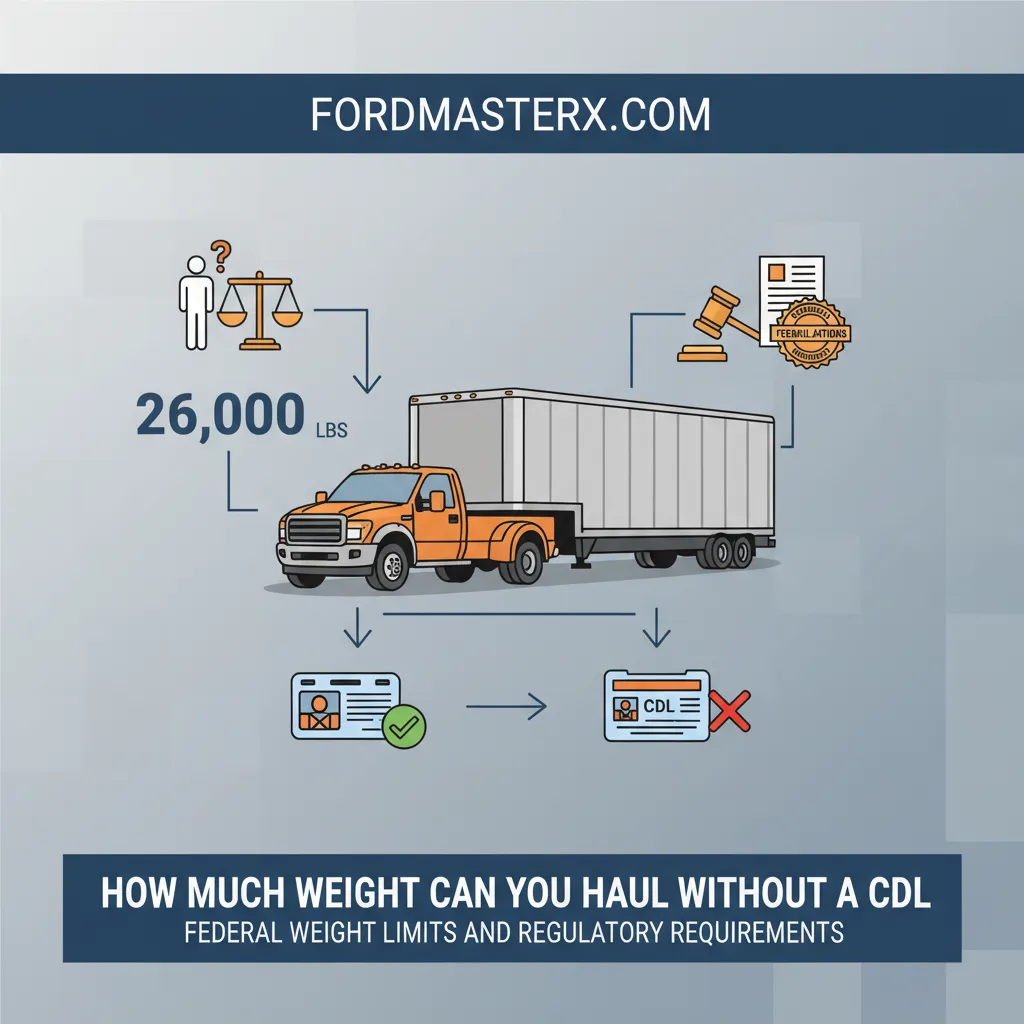
How Much Weight Can You Haul Without A Cdl: Federal Weight Limits And Regulatory Requirements

Operating heavy machinery requires precision and legal literacy, particularly when determining whether a Commercial Driver’s License (CDL) is necessary for your specific hauling needs. Confusion surrounding Gross Vehicle Weight Ratings (GVWR) often leads well-meaning drivers into legal jeopardy and significant fines for operating without the proper credentials. Understanding the nuances of federal weight limits is not just about staying compliant; it is about professional risk management and road safety. This comprehensive expert guide will clarify the exact weight thresholds, federal exemptions, and technical calculations required to haul freight safely and legally without a CDL, ensuring your operations remain reliable and trusted within the logistics industry.
Understanding the 26,001-Pound GVWR Threshold for Non-CDL Drivers
📤 Share Image
The cornerstone of federal transportation law is the weight threshold defined by the Federal Motor Carrier Safety Administration (FMCSA). Specifically, FMCSA Part 383.5 defines a Commercial Motor Vehicle (CMV) as any vehicle with a Gross Vehicle Weight Rating (GVWR) of 26,001 pounds or more. For professional operators, the distinction between “actual weight” and “weight rating” is where most compliance errors occur. Enforcement officers do not weigh you to decide if you need a CDL; they look at the manufacturer’s VIN plate.
The GVWR is the maximum operating weight of a vehicle as specified by the manufacturer, including the chassis, body, engine, fluids, fuel, accessories, driver, passengers, and cargo. If you are driving an empty dump truck with a GVWR of 33,000 pounds, you are legally “operating a heavy vehicle” and must possess a CDL, even if the scale shows the truck only weighs 15,000 pounds at that moment. Conversely, a vehicle rated at exactly 26,000 pounds or less typically falls under the requirements of a standard Class C driver’s license, provided it isn’t hauling hazardous materials or a large number of passengers.
Always verify the GVWR on the vehicle’s certification label, usually located on the driver-side door jamb. Never assume based on the model name. While most Ford F-350s are rated under 14,000 lbs, some medium-duty trucks like the International 4300 are specifically de-rated to 25,999 lbs by the manufacturer to allow for non-CDL operation.
To maintain professional compliance, you must understand that “staying under the limit” means staying under the rating, not just the weight on the scale. For businesses, choosing trucks with a 25,999-pound GVWR is a common strategy to expand their fleet without the added cost and administrative burden of hiring CDL-certified drivers. This “Class 6” weight bracket is the upper limit of non-CDL utility.
By The Numbers
CDL Requirement Threshold (lbs)
USDOT Number Trigger (lbs)
Calculating Gross Combined Weight Rating (GCWR) for Towing
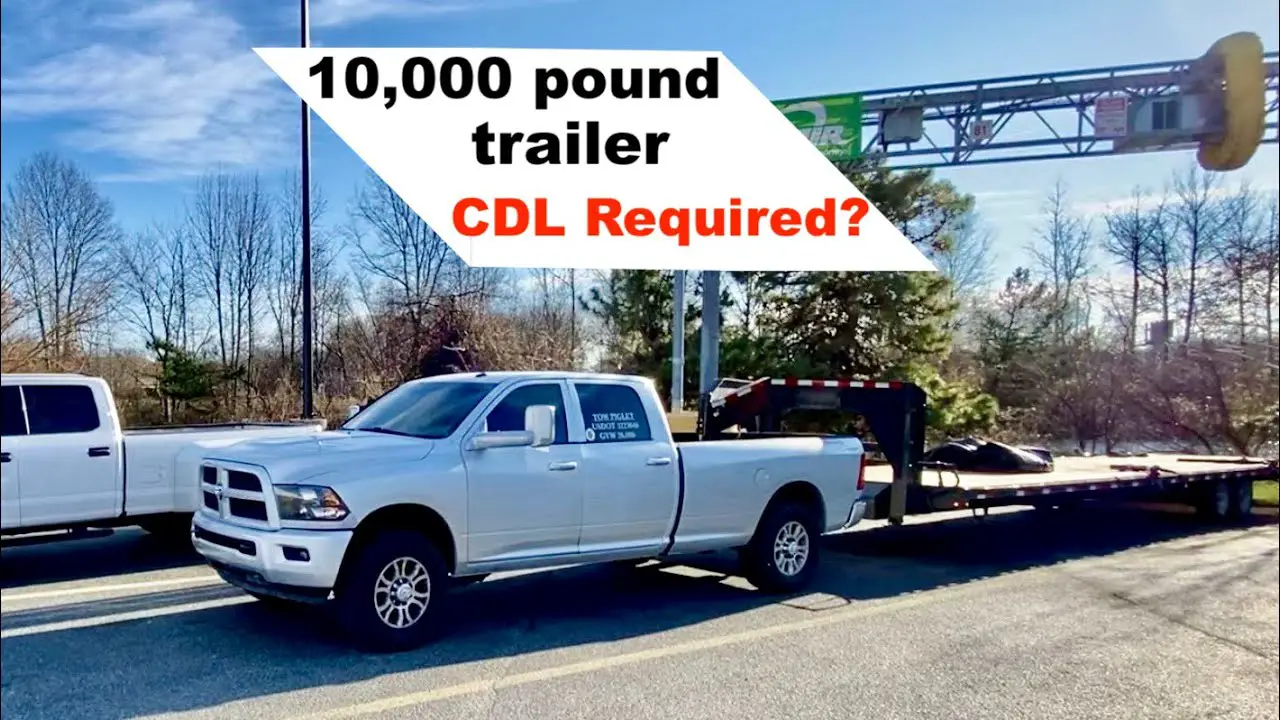
When a trailer is introduced, the math becomes more complex. You are no longer just looking at the truck’s GVWR; you are now calculating the Gross Combined Weight Rating (GCWR). This is the sum of the truck’s GVWR and the trailer’s GVWR. The federal “cliff” for a Class A CDL occurs when two conditions are met simultaneously:
- • The total GCWR is 26,001 pounds or more.
- • The trailer’s GVWR is more than 10,000 pounds.
This is frequently referred to as the “10,000 Pound Rule.” If your trailer is rated at 10,000 lbs or less, you can generally tow it with any non-CDL truck, even if the total combined weight exceeds 26,000 lbs (though you must still stay within the truck’s towing capacity). However, if the trailer is rated at 10,001 lbs or more, you must look at the combined total.
The Non-CDL Towing Sweet Spot
Consider a professional scenario where a driver uses a truck with a 12,000 lb GVWR to pull a 14,000 lb GVWR equipment trailer. The total GCWR is 26,000 pounds. Since the total does not exceed the 26,001-lb threshold, this configuration typically avoids CDL requirements in most jurisdictions. This is a common setup for landscapers and contractors who need to move heavy skid steers without hiring CDL drivers.
If the truck is rated at 13,000 lbs and the trailer is rated at 14,000 lbs, the total GCWR is 27,000 lbs. Because the trailer is over 10,000 lbs AND the total is over 26,000 lbs, a Class A CDL is mandatory. Ignorance of this “combined” math is the leading cause of roadside citations for non-CDL operators.
Beyond the license requirements, technical safety is paramount. When approaching these weight limits, professional weight distribution is critical. Even if you are legally under the GCWR limit, improper loading can result in axle overloads, which are separate legal violations. Reliable hauling requires high-quality weight-distribution hitches and ensuring that the trailer’s braking system is fully integrated with the tow vehicle to handle the increased momentum.
Federal Exemptions: Farmers, Military, and Emergency Vehicles
While the weight rules are strict for commercial freight, the federal government recognizes that certain industries require more flexibility. The MAP-21 Act (Moving Ahead for Progress in the 21st Century Act) provided significant relief for the agricultural sector. Under the “Covered Farm Vehicle” exemption, farmers and their employees can often haul equipment and agricultural products without a CDL, even if the vehicle weight exceeds 26,001 pounds.
Farm Exemption
Allows transport of grain or livestock within a 150-air-mile radius of the farm without a CDL, provided the operation is non-hire.
Emergency Services
Operators of fire trucks and ambulances are exempt from CDL requirements while performing official duties, regardless of vehicle weight.
Active-duty military personnel also benefit from exemptions when operating tactical vehicles for defense purposes. Furthermore, the “Personal Use” or RV exemption is a major carve-out. It is common to see 40,000-pound luxury motorhomes driven by individuals with standard licenses. This is because the CDL requirement is fundamentally tied to commercial activity. If you are not hauling for-hire or as part of a business, many states allow heavy vehicle operation under a “Non-Commercial Class A or B” license rather than a full CDL.
However, these protections have limits. If a farmer begins hauling grain for a neighbor for a fee, or if a military member operates a heavy vehicle for a private logistics company on their off-days, the exemptions vanish. Professional compliance requires a strict separation between exempt activities and commercial hauling.
The Air Brake Myth and Hazardous Material Restrictions
One of the most persistent myths in the industry is that any truck with air brakes requires a CDL. This is categorically false. The presence of air brakes does not, by itself, trigger the need for a CDL. You can legally drive a 24,000-pound box truck equipped with air brakes using a standard Class C license. The air brake “endorsement” is actually an “air brake restriction” on a CDL; it only applies if you were already required to have a CDL due to weight.
However, weight isn’t the only trigger for a CDL. There are specific “automatic triggers” that override the 26,001-pound rule:
The Hazmat Exception is the most critical to remember. If you are driving a 5,000-pound pickup truck but are hauling a quantity of explosives or chemicals that requires a placard, you must have a CDL with a Hazardous Materials endorsement. There is no weight minimum for hazmat compliance. Similarly, if your vehicle is designed to transport 16 or more passengers (including the driver), you are in CDL territory, regardless of the vehicle’s physical weight.
While air brakes don’t trigger a CDL, they do require expert inspection. A non-CDL driver operating an air-brake-equipped vehicle is still responsible for ensuring the system is functional. Reliable safety depends on the driver knowing how to check for air leaks and ensuring the compressor maintains proper pressure—tasks usually taught in CDL school but often neglected by non-CDL operators.
Best Practices for Reliable and Trusted Non-CDL Operations
Maintaining a professional standing in the logistics or construction industry means going beyond the bare legal minimum. To ensure your non-CDL hauling is both safe and reliable, you should adopt the same habits as million-mile highway veterans. This starts with a trusted pre-trip inspection routine. Even though you aren’t required to submit a DVIR (Driver Vehicle Inspection Report) in the same way a CDL driver might, catching a frayed trailer plug or a low tire prevents the kind of roadside failures that lead to expensive DOT interventions.
📋
Operational Excellence Checklist
Use professional-grade CAT scales to verify your actual loaded weight. Ensure you are not exceeding individual axle ratings, even if your total GVWR is within limits.
Ensure your commercial policy explicitly covers the specific weight and cargo you are hauling. Some “standard” commercial policies have exclusions for certain trailer weights.
A notable case study involves a mid-sized landscaping company that implemented a “scale-first” policy. By requiring all drivers to scale their trailers at a trusted local yard before hitting the highway, the company eliminated overweight fines entirely. Before this policy, they averaged $4,500 annually in violations. Overweight fines are no joke; they can range from $500 to over $10,000 depending on the state and the severity of the overload.
Finally, consider maintaining a driver’s logbook voluntarily. While not strictly required for many non-CDL tasks (depending on the “short-haul” 150-mile radius rule), a logbook is a reliable way to prove hours of service compliance if you are stopped by a skeptical DOT officer. Continuous education on changing DOT regulations will maintain your complete professional standing and ensure your operations never skip a beat.
✅ Pros of Non-CDL Operation
- Lower driver recruitment costs
- Less intensive DOT medical filing
- Fewer drug/alcohol clearinghouse requirements
- Lower insurance premiums for smaller vehicles
❌ Cons & Risks
- Strict weight limits reduce payload capacity
- Higher risk of accidental overweight violations
- DOT numbers still required for commercial use
- Liability risks if math is calculated incorrectly
Navigating the complexities of federal weight limits requires a diligent approach to both math and law. The 26,001-pound GVWR is the primary boundary for CDL requirements in the United States, but as we have explored, trailer weight and combined ratings must be meticulously calculated to avoid triggering Class A CDL mandates. Furthermore, non-weight factors like hazardous materials and passenger counts can override standard weight-based exemptions, demanding a high level of situational awareness from the driver. To ensure complete compliance, always consult with a professional compliance officer or your local DMV to verify state-specific interpretations before commencing heavy-haul operations. Staying informed is the hallmark of a trusted, professional operator.
Frequently Asked Questions
Can I drive a truck with a 26,000 lb GVWR without a CDL?
Yes, you can operate a vehicle with a GVWR of exactly 26,000 pounds or less with a standard driver’s license, provided you are not hauling hazardous materials or transporting more than 15 passengers. This makes 26,000 lbs the ‘sweet spot’ for many box truck and delivery businesses looking to avoid the complexities of CDL management.
Does towing a trailer automatically require a CDL?
No. Towing a trailer only requires a CDL if the trailer’s GVWR exceeds 10,000 pounds and the total combined weight rating (GCWR) of the truck and trailer exceeds 26,000 pounds. If your truck is 10,000 lbs and your trailer is 10,000 lbs, your total is 20,000 lbs, which is well within the non-CDL limits.
Is it true that air brakes require a CDL regardless of weight?
This is a common misconception. There is no ‘air brake’ endorsement on a standard license; rather, there is an air brake restriction on a CDL. If your vehicle is under 26,001 lbs GVWR, you can legally drive it with air brakes on a standard license without a CDL, provided it is not for-hire in a way that triggers other regulations.
What is the penalty for hauling over the weight limit without a CDL?
Penalties vary by state but typically include heavy fines, vehicle impoundment, and an immediate ‘out-of-service’ order from DOT officers. Furthermore, operating a vehicle outside your license class can void your insurance coverage, leaving you personally liable for any damages or injuries sustained during an accident.
Are RVs exempt from CDL weight requirements?
In most states, RVs used strictly for personal, recreational use are exempt from federal CDL requirements, even if they exceed 26,000 lbs. However, some states like California and Texas require a ‘Non-Commercial Class A or B’ license for very heavy motorhomes, so you should always verify your specific state’s regulations.