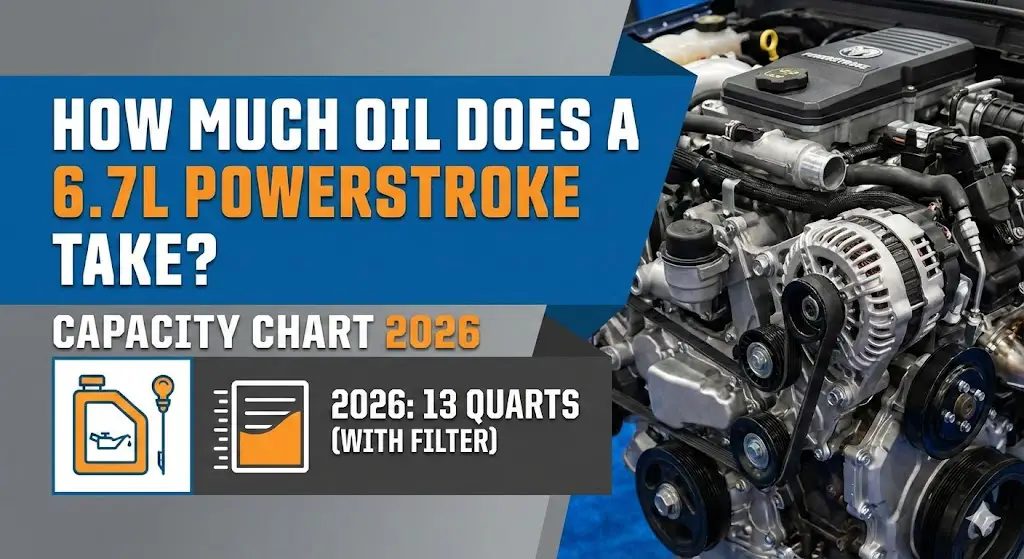
How Much Oil Does a 6.7 Powerstroke Take? Capacity, Specs & Maintenance 2026

Since its initial release for the 2011 model year, the Ford 6.7L Powerstroke V8 diesel engine—internally codenamed the “Scorpion”—has served as the undisputed backbone of the Ford Super Duty lineup. Replacing the Navistar-sourced powertrains of previous generations, Ford brought the engineering of the 6.7L entirely in-house. This transition allowed engineers to fundamentally redesign the engine’s fluid management and thermal regulation systems.
Unlike its predecessors, which include the 7.3L, 6.0L, and 6.4L engines that all uniformly required 15 quarts of engine oil, the 6.7L Powerstroke introduced a highly optimized, variable-capacity lubrication system.
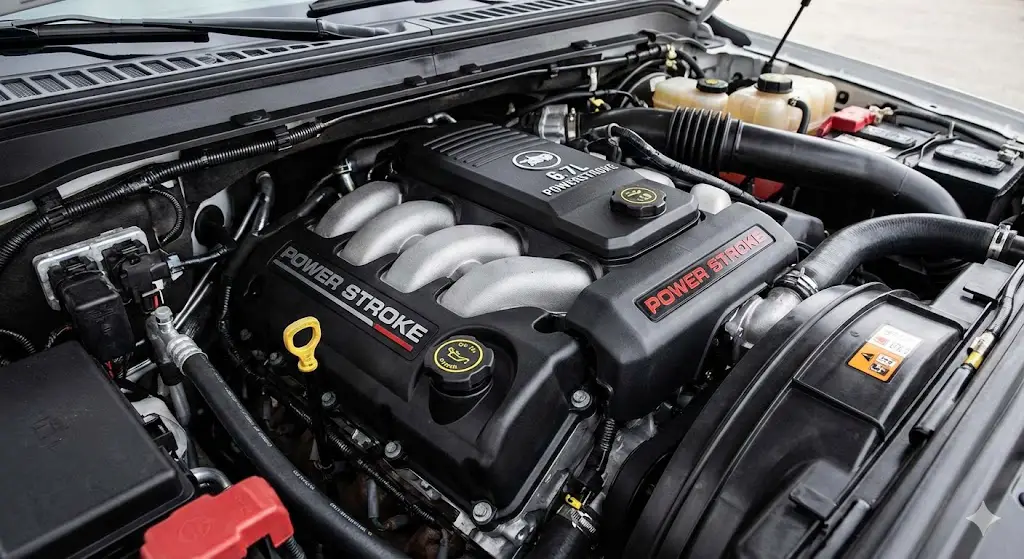
The engine oil in a modern high-pressure common-rail diesel engine performs functions far beyond basic hydrodynamic lubrication. In the 6.7L Powerstroke, the oil serves as a critical thermal management fluid. It is responsible for cooling the undersides of the piston skirts through dedicated oil squirters, lubricating the dual-boost or variable-geometry turbocharger assembly spinning at over 100,000 RPM, and suspending the heavy soot loads inherently generated by modern Exhaust Gas Recirculation (EGR) systems.
Consequently, understanding the exact oil capacity for your specific model year, adhering to Ford’s proprietary WSS-M2C171-F1 chemical specification, and maintaining rigorous service intervals is paramount to preventing catastrophic internal engine failure.
This comprehensive analysis details the exact fluid capacities across all chassis configurations, the chemical controversies surrounding diesel oil standards, filter part number evolutions, torque specifications, and exhaustive maintenance procedures for the 6.7L Powerstroke platform.
6.7L POWERSTROKE
The Ultimate Oil Capacity & Maintenance Guide
Total Oil Capacity
This capacity applies to all generations of the 6.7L Powerstroke V8 Turbo Diesel (2011 through 2024+). This volume assumes a filter change.
Quick Specs
- Filter Part # Motorcraft FL-2051-S
- Drain Plug Torque 30 lb-ft (40 Nm)
- Standard Viscosity 10W-30 / 5W-40
- Drain Plug Size 12mm Standard
Capacity Comparison
While 13 quarts is substantial, how does it compare to its predecessors and competitors? The older 7.3L and 6.0L held even more, while the modern gas “Godzilla” engine requires significantly less.
Comparison of oil capacities with filter change (Quarts)
Which Oil Weight?
Ford recommends specific viscosities based on ambient temperature and duty cycle. Using the correct weight is critical for turbo bearing longevity and cold starts.
10W-30
Standard DutyFactory fill for normal driving conditions. Suitable for temperatures above 0°F (-18°C).
5W-40
Full SyntheticHighly Recommended. Best for heavy towing, biodiesel use, and extreme heat or cold. Provides superior turbo protection.
0W-30 / 0W-40
Severe ColdRequired for operation in arctic climates where temperatures frequently drop below -20°F (-29°C).
The Cost of Maintenance
Changing 13 quarts of synthetic diesel oil isn’t cheap, but doing it yourself saves significantly on labor. Here is the typical breakdown for a DIY Full Synthetic oil change using Motorcraft parts compared to a dealership service.
Pro Tip:
Buy Rotella T6 or Motorcraft 5W-40 in 2.5-gallon jugs or 1-gallon packs to save money. You will need 3 gallons + 1 quart.
DIY Cost Composition
Change Intervals
The “Intelligent Oil Life Monitor” (IOLM) tracks your driving habits. However, relying solely on the computer can be risky for long-term reliability.
Severe Duty (5k – 7.5k): Towing, idling, off-road, biodiesel, or stop-and-go traffic.
Normal Duty (7.5k – 10k): Mostly highway driving, unladen, moderate temperatures.
The 13-Quart Procedure
Drain
Locate the twist-lock drain plug (yellow plastic on newer models) or standard bolt. Have a large catch pan ready!
Filter
Remove the FL-2051-S filter. Ensure the old O-ring is removed. Lube the new gasket with fresh oil before installing.
Fill
Add 12 quarts first. Start engine, run for 30 seconds, shut off. Wait 2 minutes for oil to settle.
Check
Check dipstick. Add the remaining ~1 quart as needed to reach the hash marks. Reset IOLM.
6.7 Powerstroke Oil Capacity by Year and Chassis Configuration
The total engine oil capacity of a 6.7L Powerstroke ranges between 13 and 17 quarts, with the exact volume heavily dependent upon the vehicle’s model year, the engine output configuration, and the specific chassis classification. Over the engine’s production lifespan, Ford engineers have continuously revised the geometry of the oil pan and the total fluid volume to accommodate increasing horsepower output, longer intelligent maintenance intervals, and the intense thermal demands of commercial towing applications.
Fluid Capacity Data Matrix (2011–Present)
The following matrix synthesizes the official manufacturer oil capacity specifications across all Ford Super Duty and Medium Duty platforms equipped with the 6.7L Powerstroke engine. All capacities listed represent a complete service fill, which includes the volume required to saturate a new oil filter.
| Model Year Range | Vehicle Chassis Classification | Engine Variant | Oil Capacity (Quarts) | Metric Equivalent (Liters) |
| 2011–2022 | F-250, F-350, F-450, F-550, F-600 | Standard Output | 13.0 Quarts | 12.3 Liters |
| 2011–2022 | F-650, F-750 (Medium Duty) | Commercial Output | 15.0 Quarts | 14.2 Liters |
| 2023–Present | F-250, F-350, F-450, F-550, F-600 | Standard & High Output | 15.0 Quarts* | 14.2 Liters |
| 2023–Present | F-650, F-750 (Medium Duty) | Commercial Output | 17.0 Quarts | 16.1 Liters |
*Diagnostic Note on 2023+ Super Duty Capacities: While Ford’s official service manuals rigidly dictate a 15.0-quart capacity for 2023 and newer F-250 through F-600 models, extensive field reporting from technicians indicates a dipstick calibration variance. Due to the revised dimensions of the new High Output oil pan and dipstick tube geometry, adding exactly 15 quarts may result in the fluid level resting near the “MIN” line on the dipstick. Some operators report adding up to 17 quarts to reach the “MAX” line; however, industry best practices dictate strictly adhering to the 15-quart OEM specification to avoid aeration, unless the vehicle is equipped with an aftermarket deep sump oil pan.
[Visual Plan: Comparison Matrix Chart]
Chart Type: Grouped Bar Chart
X-Axis: Model Year & Chassis Type (2011-2022 Super Duty, 2011-2022 Medium Duty, 2023+ Super Duty, 2023+ Medium Duty).
Y-Axis: Oil Capacity in Quarts (Scale 0 to 20).
Data Plot: 13 Quarts, 15 Quarts, 15 Quarts, 17 Quarts respectively.
Purpose: To provide a rapid, skimmable visual reference for users trying to identify their specific truck’s capacity at a glance before purchasing oil.
Engineering Analysis: The 2023 High Output Capacity Increase
The architectural shift from a 13-quart system in the 2011–2022 Super Duty trucks to a 15-quart system for the 2023+ models represents a significant evolution in Ford’s powertrain fluid dynamics. When the 6.7L Scorpion engine was originally conceptualized, the 13-quart capacity was a deliberate engineering departure from the 15-quart standard utilized in previous Navistar-built engines. This initial reduction in fluid volume was achieved through a highly efficient, tight-tolerance lower oil pan design that successfully minimized crankshaft windage and oil aeration while maintaining strict federal emissions compliances and long-term durability.
However, the powertrain landscape shifted dramatically with the introduction of the 2023 High Output (HO) 6.7L Powerstroke variant. Pushing performance figures well north of 500 horsepower and an astonishing 1,200 lb-ft of torque, the internal friction and combustion temperatures increased exponentially. To combat this, Ford engineers designed larger oil pans for the 2023+ models. This 15.3% increase in total fluid volume provides a vastly larger thermal sink, allowing the engine oil to absorb and dissipate heat away from the piston crowns and the turbocharger bearings much more effectively. Furthermore, the increased fluid volume directly correlates to an extended lubricant life span, granting Ford the ability to stretch the Intelligent Oil Life Monitor (IOLM) maximum service interval from 10,000 miles up to 15,000 miles under ideal driving conditions.
Fluid Specifications: The WSS-M2C171-F1 Requirement and Chemical Controversies
Determining the correct fluid volume is merely one half of the lubrication equation; the chemical composition and additive package of the motor oil are equally, if not more, critical to the engine’s survival. For all 6.7L Powerstroke engines across all model years, Ford explicitly mandates the use of diesel motor oils that carry the proprietary WSS-M2C171-F1 certification.
The API CK-4 Standard Controversy
The stringent enforcement of the WSS-M2C171-F1 standard is deeply rooted in a major petroleum industry shift that occurred in December 2016. During this period, the American Petroleum Institute (API) rolled out the new CK-4 and FA-4 heavy-duty diesel oil categories to officially replace the outgoing, long-standing CJ-4 standard. In preparation for this industry-wide transition, Ford powertrain engineers conducted exhaustive internal wear testing on the new CK-4 formulations.
The results of this internal testing revealed a critical deficiency in the new API standard. Certain SAE 10W-30 motor oils bearing the newly minted API CK-4/SN classification were formulated with significantly reduced levels of phosphorus—often dropping below 1,000 parts per million (ppm). Phosphorus is typically delivered into motor oil via an anti-wear chemical compound known as ZDDP (Zinc Dialkyldithiophosphate). As camshaft lobes actuate against the valvetrain lifters under extreme pressure, the localized heat causes the ZDDP to break down and form a sacrificial, glass-like tribofilm over the metal surfaces, preventing direct metal-on-metal contact.
Because the API lowered the allowable phosphorus limits in CK-4 oils to prevent ash accumulation from prematurely clogging Diesel Particulate Filters (DPFs), Ford discovered that these low-phosphorus oils failed to provide adequate valvetrain wear protection in the 6.7L Powerstroke. In an unprecedented move, Ford officially rejected the blanket API CK-4 standard. The manufacturer issued a technical service bulletin stating that no API CK-4 oil should be used in a Powerstroke engine unless it had been specifically tested and approved by Ford to meet the stringent minimum 1,000 ppm phosphorus threshold of their proprietary WSS-M2C171-F1 specification. Therefore, regardless of brand preference, operators must visually verify the presence of the WSS-M2C171-F1 approval on the rear label of the oil jug.
Approved Viscosity Grades by Climate and Duty Cycle
The 6.7L Powerstroke is a globally utilized platform, and as such, it can safely operate on several different oil viscosities depending entirely upon ambient geographical temperatures, anticipated load demands, and the utilization of biodiesel fuel blends.
- SAE 10W-30 (Synthetic Blend or Full Synthetic): This is the standard factory fill weight and is the most highly recommended viscosity for normal daily driving, commuting, and light towing in moderate climates where temperatures range between 0°F and 100°F. It offers excellent cold-start pumpability, reducing hydraulic drag on the oil pump, which in turn maximizes fuel economy and ensures immediate lubrication to the top end of the engine.
- SAE 15W-40 (Heavy Duty Conventional or Synthetic): This thicker viscosity is the premier choice for commercial vehicles operating continuously in hot climates (ambient temperatures above 20°F) or those subjected to severe duty cycles. Severe duty includes constant heavy payload hauling, dragging fifth-wheel RVs through mountainous terrain, or prolonged stationary idling. The increased base oil thickness maintains superior hydrodynamic film strength under extreme shear forces and elevated thermal loads. Additionally, 15W-40 is strictly recommended by Ford when operating the engine on biodiesel blends up to B20, as biodiesel promotes fuel dilution which thins the engine oil over time.
- SAE 5W-40 (Full Synthetic): Representing the ultimate all-season protection, full synthetic 5W-40 is highly recommended for severe duty service and is virtually mandatory for cold climates where temperatures frequently plummet below -20°F. A 5W-40 formulation provides the robust, high-temperature film strength of a 40-weight oil under heavy loads, while maintaining the fluid dynamics of a 5-weight oil when frozen, ensuring rapid, unrestricted oil delivery to the turbocharger bearings during sub-freezing cold starts. This viscosity is also fully approved for B20 biodiesel operations.
- SAE 0W-40 (Full Synthetic): This highly specialized viscosity is formulated exclusively for extreme arctic environments where ambient winter temperatures consistently remain at or below -22°F (-30°C). It prevents the oil from gelling in the pan, allowing the engine to crank over smoothly in deadly cold conditions.
Chart Type: Horizontal Gantt-style Temperature Band Chart
Y-Axis: Oil Viscosity Grades (0W-40, 5W-40, 10W-30, 15W-40).
X-Axis: Temperature in Fahrenheit (-40°F to 120°F+).
Data Plot:
- 0W-40: -40°F to 50°F
- 5W-40: -20°F to 120°F+
- 10W-30: 0°F to 100°F
- 15W-40: 20°F to 120°F+Purpose: To visually map which oil viscosity is appropriate for the reader’s specific local climate, aiding in immediate decision-making.
Oil Filter Evolution: Motorcraft FL-2051S versus FL-2124-S
For over a decade of production, the Motorcraft FL-2051S stood as the undisputed OEM standard oil filter for the 6.7L Powerstroke. However, coinciding with the massive engine architecture upgrades introduced in 2023, Ford silently phased out the legacy filter and introduced a newly engineered replacement: the Motorcraft FL-2124-S.
Comparative Analysis of Filter Engineering
While the legacy FL-2051S remains widely available through third-party retailers and is still utilized by many owners of 2011–2022 trucks, the new FL-2124-S has completely superseded it within Ford’s official parts catalog. Most importantly, the FL-2124-S is fully backwards compatible with all 6.7L engines dating back to the 2011 model year.
The physical and internal differences between the two units highlight a clear advancement in filtration technology. The new FL-2124-S filter is notably heavier, weighing approximately 35 to 40 grams more than the outgoing FL-2051S. This increased mass is not cosmetic; it is attributed to a significantly denser, higher-capacity synthetic and cellulose glass blend filter media. This denser media is explicitly designed to trap finer, sub-micron soot particles and accommodate the extended 15,000-mile service intervals now recommended for the 2023+ Super Duty trucks, preventing the filter from entering bypass mode under heavy soot loading.
Furthermore, the FL-2124-S features an upgraded anti-drain back valve constructed from a more resilient, heat-resistant silicone elastomer material. This valve is a critical component; it ensures that a column of oil remains trapped in the upper engine galleys and the filter housing after the engine is shut down. By preventing the oil from draining entirely back into the pan, the engine avoids momentary dry starts, virtually eliminating the primary cause of daily metal-to-metal bearing wear. While both filters utilize a standard spin-on full-flow architecture, the updated internal geometry of the FL-2124-S is also optimized to handle the significantly higher base oil pressures generated by the High Output (HO) 6.7L oil pump. When purchasing a complete maintenance kit for a Powerstroke, the package will now almost exclusively feature the updated FL-2124-S.
Torque Specifications and the Drain Plug Dilemma
One of the most heavily debated and misunderstood topics in 6.7L Powerstroke maintenance involves the oil pan drain plug. Throughout the production run of the engine, Ford has utilized different lower oil pan materials, leading to entirely different drain plug designs, removal procedures, and torque specifications.
The Composite (Plastic) Oil Pan Era
For certain model years, Ford engineers opted to utilize a composite plastic lower oil pan. This decision was primarily driven by goals to reduce overall vehicle weight and to dampen internal engine noise, vibration, and harshness (NVH).
Vehicles equipped with the composite pan utilize a unique, yellow plastic quarter-turn drain plug (Ford Part # BC3Z-6730-A). No traditional wrenches or sockets are required to service this plug. While the plug face features a 3/8″ square drive indentation, utilizing a ratchet often applies excessive torque. The correct OEM procedure dictates pushing the plug inward by hand to compress the internal O-ring and unlock the retaining tabs, then twisting the plug counter-clockwise. This allows the technician to slowly back the plug out and control the massive flow of the 13-to-15-quart oil volume, preventing a massive spill. To reinstall, the plug is pushed inward and turned clockwise until a highly distinct “click” is felt, indicating the locking tabs have engaged.
Despite the tool-less convenience, the plastic locking tabs and the integral rubber Viton O-ring are highly prone to thermal fatigue, degradation, and snapping during removal, which can disastrously leave a vehicle stranded in a service bay. To permanently rectify this design flaw, thousands of owners opt to replace the factory yellow plug with aftermarket billet aluminum, double-O-ring drain plugs (such as the highly regarded units manufactured by UPR Products) for vastly enhanced reliability and leak prevention.
The Traditional Steel Oil Pan
Models equipped with the traditional stamped steel lower oil pan utilize a standard threaded metal drain plug. Servicing the steel pan requires a standard 16mm socket or box-end wrench.
The official torque specification for a standard metal oil drain plug on the 6.7L Powerstroke is widely established at 15 to 20 lb-ft (foot-pounds). The primary mechanical objective of this torque value is to crush the sealing washer or copper gasket sufficiently to create a leak-proof seal, without applying so much force that it strips the fine threads welded into the thin steel oil pan. If an inch-pound or foot-pound torque wrench is unavailable in the garage, the accepted industry standard is to thread the bolt entirely by hand until the gasket mates flush with the pan, followed by a light, controlled tug (roughly a 1/4 turn) with a standard-length ratchet.
Oil Filter Installation Torque
The oil filter (whether utilizing the FL-2051S or the newer FL-2124-S) should absolutely never be over-tightened. An excessively torqued spin-on filter will crush and bind the rubber base gasket, welding it to the housing heat cycle after heat cycle, rendering it nearly impossible to remove during the subsequent service interval.
Installation requires lubricating the rubber O-ring gasket with a film of fresh engine oil. The filter is then spun onto the threaded housing stud until the rubber gasket makes initial, solid contact with the metal mating surface. From this point of contact, the filter should be tightened an additional 3/4 to 1 full turn exclusively by hand. If a technician insists on using a torque wrench equipped with a 93mm flute socket, the general engineering specification for spin-on filters of this physical diameter is approximately 10 to 14 lb-ft.
Step-by-Step DIY Oil Change Guide
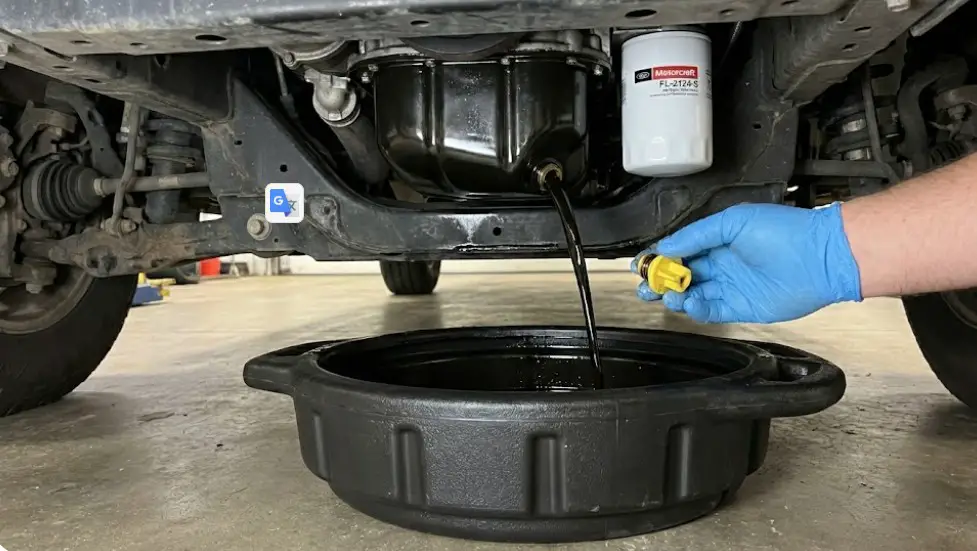
Performing a Do-It-Yourself (DIY) oil change on the 6.7L Powerstroke is a highly rewarding, straightforward process that requires no advanced mechanical training and can easily save hundreds of dollars annually over dealership labor rates.
Required Tools and Materials Checklist
- Engine Oil: 13, 15, or 17 Quarts of WSS-M2C171-F1 approved synthetic diesel oil (exact volume depending on your verified year and model).
- Filtration: Motorcraft FL-2124-S (or legacy FL-2051S) Oil Filter.
- Catch Pan: A heavy-duty, large-capacity oil drain pan. Due to the massive fluid volume of this engine, a pan with a minimum capacity of 20 quarts (5 gallons) is absolutely mandatory to prevent overflowing.
- Wrenches: A 16mm socket and 3/8″ drive ratchet (for vehicles with a steel pan).
- Filter Tool: A 93mm fluted oil filter socket or large-capacity adjustable filter pliers.
- Cleanup: Industrial shop rags and highly absorbent spill pads.
Execution Procedure
- Thermal Preparation: Ensure the truck is parked on level, solid ground. Start the engine and allow it to idle for approximately five minutes. Warming the oil drastically lowers its viscosity, allowing it to flow out of the pan rapidly while simultaneously suspending harmful soot particulates in the fluid so they are drained away, rather than settling as sludge at the bottom of the pan. Shut the engine off and allow the oil to settle for a few minutes.
- Drain the Crankcase: Slide the 20-quart catch pan directly beneath the drain plug. Using the 16mm socket, carefully back out the metal drain plug (or manually twist and unlock the yellow plastic plug). Allow the vast volume of oil to drain completely. Due to the sheer quantity, this draining process should be permitted to continue for at least 10 to 15 minutes to ensure the pan is empty.
- Remove the Filter: Reposition the catch pan directly beneath the oil filter, which is vertically mounted on the passenger side of the engine block near the oil pan. Use the 93mm filter wrench to break the filter loose. Professional Technique: Because the filter holds nearly a full quart of oil, unscrewing it immediately will result in oil pouring down your arm and the side of the engine block. To avoid this, use a tapered punch tool to hammer a small hole directly into the bottom center of the old oil filter. Allow the filter to drain straight down into the pan for 15 minutes before unscrewing it completely.
- Prepare and Install the New Filter: Thoroughly wipe the engine block’s filter housing mating surface clean with a lint-free rag. Ensure the old rubber gasket is not stuck to the block. Pre-fill the core of the new FL-2124-S filter with roughly 1 quart of fresh oil; this critical step minimizes the duration of the dry-start when the engine is first fired up. Lubricate the new rubber gasket with fresh oil. Spin the filter onto the housing until contact is made, then tighten it exactly 3/4 of a turn by hand.
- Reinstall the Drain Plug: Wipe the drain port clean. Reinstall the metal drain plug, ideally utilizing a brand-new crush washer, and torque the bolt to the specified 15-20 lb-ft. If utilizing the composite pan, push the plastic plug inward and twist clockwise until it securely clicks and locks into its detent.
- Refill the Engine: Remove the yellow oil fill cap located under the hood. Carefully pour the exact required system capacity into the engine, taking care to subtract the 1 quart of oil that was already used to pre-fill the filter.
- System Verification: Start the engine and let it idle for 30 to 45 seconds to build hydraulic oil pressure and fully circulate the fluid through the new filter media and oil cooler. Shut the engine off. Wait a minimum of 5 minutes for the oil in the upper valvetrain to drain back down into the pan. Pull the yellow dipstick, wipe it clean, reinsert it fully, and pull it again to verify the final resting fluid level is perfectly situated between the “MIN” and “MAX” crosshatched indicators.
Resetting the Intelligent Oil Life Monitor (IOLM)
Once the physical fluid exchange is complete, the vehicle’s Powertrain Control Module (PCM) must be manually reset to track the new service interval accurately and extinguish the dashboard maintenance warnings. Depending on the specific trim level (XL/XLT versus Lariat/Platinum digital clusters), there are two primary methods to accomplish this.
Method 1: Steering Wheel Menu Controls (Standard for Most 2011-2022 Models)
- Insert the key and turn the ignition to the “ON” or “RUN” position, but do not crank the engine.
- Utilizing the directional directional pad located on the left side of the steering wheel, navigate through the main gauge cluster menu.
- Scroll right to
Settings, then selectAdvanced Settings, followed byVehicle. - Scroll down to the
Oil Life ResetorFilter Resetmenu option. - Press and firmly hold the
OKbutton on the steering wheel. - A visual progress bar will appear on the screen. Continue holding the button until the screen confirms “Oil Life Reset to 100%”.
Method 2: The Universal Pedal Override Method
If the steering wheel menus are difficult to navigate or the vehicle is an older base model, Ford engineers integrated a universal manual override sequence using the vehicle’s foot pedals.
- Switch the ignition to the “ON” position without starting the engine.
- Simultaneously press both the accelerator pedal and the brake pedal fully to the floorboards.
- Keep both pedals fully depressed. After approximately three seconds, a message will display on the dash stating, “Service: Oil reset in prog.”.
- Continue holding both pedals firmly to the floor for an additional 20 to 25 seconds. Eventually, the display will change to read “Service: Oil reset complete.” Release the pedals and cycle the ignition off.
Severe Duty Operations and Optimal Maintenance Intervals
While determining the correct oil capacity is vital, the frequency at which that fluid is exchanged is the ultimate determining factor in the longevity of the 6.7L Powerstroke. Because the Scorpion engine utilizes a complex emissions matrix—including a cooled Exhaust Gas Recirculation (EGR) valve and a highly restrictive Diesel Particulate Filter (DPF)—massive amounts of abrasive soot and carbon are inevitably reintroduced into the intake tract and ultimately washed down the cylinder walls into the engine oil.
The Danger of Extended Service Intervals
Ford equips the Super Duty with an Intelligent Oil Life Monitor (IOLM) that utilizes complex algorithms based on operating temperatures, engine load, fuel consumed, and idling hours to calculate oil degradation. Following this monitor, the theoretical maximum service interval for 2011–2022 models is 10,000 miles, while the larger fluid capacity of the 2023+ models theoretically permits intervals up to 15,000 miles under perfect, normal highway conditions.
However, the chemical reality of soot loading paints a different picture. While advanced synthetic base oils resist thermal viscosity breakdown remarkably well, no amount of synthetic engineering can prevent the physical accumulation of solid soot ash in the fluid. As soot agglomerates, the oil acts as a liquid abrasive. Independent laboratory oil analyses (such as those from Blackstone Labs) frequently demonstrate that pushing an EGR-equipped diesel engine beyond the 7,500-mile mark significantly increases the statistical risk of piston ring wear, cylinder wall scuffing, and turbocharger journal bearing fatigue.
For this reason, master diesel technicians and fleet operators strictly categorize nearly all real-world truck usage as “Severe Duty.” If a truck is frequently used to tow heavy payloads, operates in dusty agricultural environments, utilizes B20 biodiesel, experiences extensive stationary idling, or endures extreme heat and cold fluctuations, the maintenance interval must be drastically reduced. Under severe duty parameters, a rigid, mileage-based 5,000-mile service interval is universally recommended by diesel professionals to guarantee maximum engine protection, regardless of what the digital dashboard monitor indicates.
Secondary Fluid Capacities for Comprehensive Maintenance
A true preventative maintenance schedule requires contextual awareness of the entire powertrain. When performing a complete fluid service on the 6.7L Powerstroke platform, operators must also monitor and maintain the following secondary system capacities to ensure holistic vehicle health :
| Powertrain Component | Fluid Specification | Approximate Capacity Range |
| Engine Coolant (Primary Radiator System) | Motorcraft Yellow Prediluted Antifreeze | 29.4 – 31.7 Quarts |
| Engine Coolant (Secondary Charge Air System) | Motorcraft Yellow Prediluted Antifreeze | 8.1 Quarts |
| Automatic Transmission (6R140 / 10R140) | Motorcraft MERCON ULV | 16.7 – 18.1 Quarts |
| Diesel Exhaust Fluid (DEF) Reservoir | API Certified DEF Fluid | 5.0 – 7.4 Gallons |
| Front Differential (4×4 Models) | 80W-90 Gear Oil | 2.7 – 3.0 Quarts |
| Rear Differential | 75W-140 Synthetic Gear Oil | 3.1 – 7.0 Quarts |
FAQs
What Actually Happens if I Overfill my 6.7 Powerstroke with Oil?
Adding more than the strictly specified capacity (for example, blindly pouring 15 quarts into a 2015 model that only requires 13 quarts) causes the static oil level in the pan to rise abnormally high. When the engine is running, the rapidly spinning crankshaft counterweights will physically strike this elevated pool of oil. This high-speed mechanical agitation whips oxygen into the fluid, a destructive condition scientifically known as oil aeration or foaming.
Because foam is compressible—unlike a pure, solid liquid—the engine’s mechanical oil pump cannot pressurize it effectively. This leads to an immediate drop in hydrodynamic oil pressure across the entire engine, resulting in rapid metal-on-metal contact at the main and rod bearings. Additionally, excess fluid volume drastically increases internal crankcase pressure, which will aggressively force oil to blow past the rear main seal, the front crankshaft seal, and the delicate turbocharger seals, causing severe, expensive external leaks.
What are the Mechanical Symptoms of Running Low on Oil?
Underfilling the system—or failing to check the dipstick between long service intervals—starves critical internal components of both lubrication and vital cooling. Mechanical symptoms manifest as a noticeable loss of pulling power, sluggish acceleration, elevated engine coolant temperatures, and audible ticking or knocking sounds radiating from the upper valvetrain. The single component most highly susceptible to catastrophic low oil pressure is the turbocharger. The turbocharger turbine shaft spins at speeds exceeding 100,000 RPM and relies entirely on a pressurized film of oil to float the bearings; momentary oil starvation will result in rapid bearing seizure, metal transfer, and complete turbocharger failure.
Is it Safe to Use 15W-40 Oil in the Winter?
While 15W-40 is a highly robust oil favored by commercial haulers, its cold-weather pumpability is severely limited. Ford’s official documentation states that 15W-40 is only acceptable for use in ambient environmental temperatures remaining consistently above 20°F (-6°C). Utilizing a heavy 15W-40 oil in sub-zero winter temperatures will result in a thick, molasses-like, sluggish oil flow during a morning cold start. This delay in pumpability starves the turbocharger bearings and upper valvetrain of crucial lubrication for several seconds every time the key is turned, causing rapid, cumulative wear. For true winter climates, a 5W-40 full synthetic or a 10W-30 is strongly mandated to guarantee rapid fluidity and prevent accelerated cold-start damage.
Why Does the Dipstick Read Low on 2023+ Models When Filled with Exactly 15 Quarts?
Many owners of 2023 and newer Super Duty trucks observe that after executing a perfect oil change and adding exactly 15 quarts (the volume dictated by the official owner’s manual), the oil level rests near or directly on the “MIN” line of the dipstick. This visually alarming scenario is attributed to a calibration variance and the revised geometry of the new High Output oil pan and the dipstick tube assembly. Industry experts and master technicians strongly advise against the instinct to blindly top off the engine to force the oil level to the dipstick’s “MAX” line. Adding an extra 2 to 2.5 quarts to reach the full mark on a standard F-250 through F-600 greatly increases the risk of crankshaft aeration. Operators should strictly adhere to the OEM 15-quart specification by volume, unless operating the medium-duty F-650/F-750 chassis, which possesses a uniquely larger pan expressly designed for 17 quarts.