Ford 5.4 Firing Order & Coil Packs Diagram: Diagnosis Guide

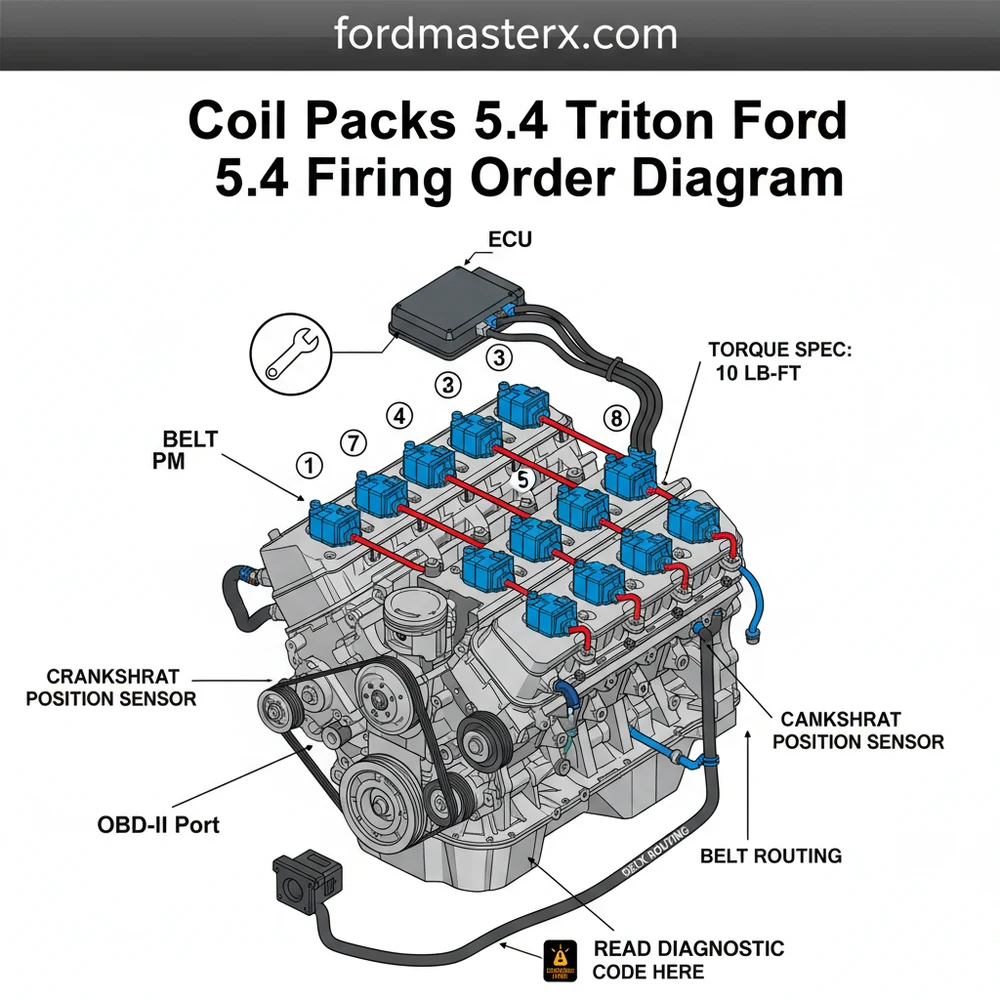
The Ford 5.4 Triton firing order is 1-3-7-2-6-5-4-8. Cylinders 1 through 4 are located on the passenger side, while 5 through 8 are on the driver side. This diagram helps you locate specific coil packs when the ECU triggers a diagnostic code for a misfire via the OBD-II system.
📌 Key Takeaways
- The firing order 1-3-7-2-6-5-4-8 is critical for engine timing and diagnosis
- Cylinders are numbered 1-4 on the passenger side and 5-8 on the driver side
- Always use an OBD-II scanner to pinpoint the specific cylinder misfire code
- Applying the correct torque spec prevents common 5.4L spark plug blowouts
- Use this diagram whenever replacing ignition coils or troubleshooting rough idles
Maintaining a Ford 5.4L Triton engine requires a clear understanding of its ignition architecture, specifically how the coil-on-plug (COP) system interacts with the engine’s cylinders. Whether you are dealing with a persistent misfire or performing a routine tune-up, having access to a reliable coil packs 5.4 triton ford 5.4 firing order diagram is the first step toward a successful repair. This guide is designed to help you identify cylinder locations, understand the firing sequence controlled by the ECU, and troubleshoot common ignition failures using diagnostic codes. By the end of this article, you will have the technical knowledge to confidently navigate the engine bay and restore your vehicle’s performance.
The Ford 5.4 Triton engine uses a Coil-on-Plug (COP) system, meaning each cylinder has its own dedicated ignition coil. Unlike older distributor systems, the firing order is managed electronically by the Engine Control Unit (ECU) to optimize combustion timing and fuel efficiency.
The 5.4 Triton engine, found in millions of F-Series trucks and SUVs, follows a specific spatial orientation for its cylinders. When you stand in front of the vehicle looking at the engine, the cylinders are numbered from front to back. The passenger side (Bank 1) contains cylinders 1, 2, 3, and 4. The driver side (Bank 2) contains cylinders 5, 6, 7, and 8. Understanding this layout is critical because the firing order for the Ford 5.4 engine is 1-3-7-2-6-5-4-8. This sequence determines the exact millisecond each coil pack receives a signal from the ECU to fire the spark plug.
The diagram below illustrates the physical location of each coil pack and the corresponding cylinder numbers. Note that the ignition coils are secured to the intake manifold by small 7mm or 8mm bolts. The wiring harness connects to each coil via a plastic clip, which can become brittle over time due to engine heat. In the diagram, the front of the engine (where the accessory belt and cooling fan are located) is at the top, while the firewall is at the bottom. This layout is consistent across the 2-valve and 3-valve versions of the 5.4L Triton, though the specific coil pack design may vary slightly by model year.
In addition to cylinder placement, the diagram highlights the proximity of the coil packs to other vital components. For instance, the front-most cylinders (1 and 5) are located near the thermostat housing and coolant crossover. This is a common area where a failed gasket can lead to coolant flow issues, often resulting in “drowned” coil packs and subsequent misfires. Furthermore, the diagram serves as a map for tracing the OBD-II diagnostic codes. If your scanner displays a P0303 code, the diagram tells you immediately to focus on the third cylinder back on the passenger side.
Always label your wiring harness connectors with masking tape before removal. While the harness is generally length-specific, labeling prevents confusion during reassembly and ensures the ECU signals reach the correct cylinder according to the firing order.
Reading and interpreting the coil packs 5.4 triton ford 5.4 firing order diagram is the foundation of the replacement process. To perform a successful installation or diagnosis, follow these detailed steps to ensure the job is done safely and accurately.
Step 1: Preparation and Safety
Before touching any electrical components, park the vehicle on a level surface and disconnect the negative battery terminal. This prevents accidental electrical shorts that could damage the sensitive ECU. Allow the engine to cool completely; the 5.4 Triton retains heat in its deep spark plug wells, and working on a hot engine increases the risk of stripping threads in the aluminum cylinder heads.
Step 2: Gather Required Tools
To access and replace the coil packs, you will need the following materials:
- ✓ 7mm or 8mm socket (for coil hold-down bolts)
- ✓ 5/8″ or 9/16″ spark plug socket (depending on engine variant)
- ✓ Long socket extensions and a universal joint (for rear cylinders)
- ✓ Dielectric grease and compressed air
- ✓ OBD-II code reader for clearing codes
Step 3: Clear Obstructions
On the 5.4 Triton, the air intake assembly often obscures the driver-side coils (cylinders 5-8). Remove the air filter housing and the intake tube to gain clear access. On some models, you may need to temporarily move the accessory belt or power steering reservoir bracket to reach the front-most cylinders without straining the wiring harness.
Step 4: Identify the Target Cylinder
Using the firing order diagram, locate the specific cylinder you intend to service. If you are replacing all eight coils, it is best to work one at a time to avoid cross-connecting the harness. Use a can of compressed air to blow out the area around the coil and the spark plug well before removal. This prevents dirt and debris from falling into the combustion chamber once the plug is removed.
Step 5: Disconnect and Remove the Coil Pack
Depress the plastic tab on the electrical connector and pull it away from the coil. Remove the single hold-down bolt securing the coil to the manifold. Grasp the coil body and pull it straight upward with a slight twisting motion. If the rubber boot sticks, a gentle tug usually frees it. Inspect the removed coil for signs of moisture or carbon tracking.
Do not over-tighten the coil hold-down bolts. The torque spec for these small bolts is typically only 5 to 7 lb-ft (60-84 lb-in). Excessive force can easily strip the plastic or aluminum threads, requiring a costly manifold repair.
Step 6: Install the New Coil Pack
Apply a small amount of dielectric grease to the inside of the new coil’s rubber boot. This helps create a moisture-proof seal and prevents the boot from bonding to the spark plug porcelain. Slide the coil down onto the spark plug until you feel it “seat” on the terminal. Reinstall the hold-down bolt and reconnect the electrical clip until it clicks audibly.
Step 7: Final Inspection and System Check
Reinstall any components removed for access, such as the air intake. Reconnect the battery. Start the engine and listen for a smooth idle. If you previously had a check engine light, use your OBD-II tool to perform a system scan and clear any stored diagnostic code (like P0301-P0308). This allows the ECU to relearn the idle parameters with the new ignition components.
The Ford 5.4L Triton is notorious for ignition-related issues that can be frustrating to diagnose without a diagram. The most frequent problem is a “low-grade misfire” that doesn’t always trigger a steady check engine light but causes a noticeable shudder during overdrive. These misfires often stem from moisture entering the spark plug wells, typically from a leaking heater hose or the aforementioned coolant flow issues at the intake crossover. By referring to the firing order diagram, you can identify which cylinders are most susceptible to these leaks (usually 1 and 5).
Another common issue involves the timing chain and its effect on ignition. If the ECU detects that the camshaft timing is off, it may retard ignition across multiple cylinders, leading to codes that mimic a bad coil pack. If you see multiple misfire codes (P0300) along with “camshaft position sensor” codes, the problem likely lies deeper in the engine’s mechanical timing rather than the coils themselves. Furthermore, inspect the OBD-II data for “long-term fuel trims.” If the values are extremely high, the engine may be compensating for a vacuum leak, which can cause coils to fail prematurely due to the increased electrical demand of firing in a lean environment.
To maximize the lifespan of your coil packs, always prioritize high-quality components. While aftermarket options are plentiful, the 5.4 Triton engine is famously sensitive to coil resistance values; using OEM-spec Motorcraft coils is generally recommended to avoid compatibility issues with the ECU. During maintenance, check the condition of your accessory belt and pulleys; a failing alternator or erratic belt tension can cause electrical “noise” that disrupts the ignition signal.
Furthermore, ensure your spark plugs are torqued correctly. For the 3-valve 5.4L engines, the spark plug torque spec is especially critical (typically 25 lb-ft) to prevent the plugs from backing out or “spitting” out of the head, which destroyed the coil pack in the process. Regular inspection of the cooling system is also vital. A small leak in the coolant flow path can drip directly into cylinder #4 or #8 near the firewall, causing an immediate failure of the coil boot. By following the coil packs 5.4 triton ford 5.4 firing order diagram and maintaining a rigorous service schedule, you can keep your Triton engine running smoothly for hundreds of thousands of miles.
Step-by-Step Guide to Understanding the Ford 5.4 Firing Order & Coil Packs Diagram: Diagnosis Guide
Identify the correct cylinder using the 5.4 Triton firing order diagram to ensure you are working on the right coil.
Locate the electrical connector on the coil pack and depress the locking tab to disconnect it from the harness.
Understand how the 7mm retaining bolt secures the coil to the intake manifold and remove it carefully using a socket wrench.
Apply a small amount of dielectric grease to the inner lip of the new coil boot for better moisture protection and conductivity.
Verify that the new coil is seated firmly over the spark plug before reinstalling the 7mm bolt to the proper torque spec.
Complete the repair by using an OBD-II scanner to clear the check engine light and perform a test drive to confirm the misfire is resolved.
Frequently Asked Questions
Where are the coil packs 5.4 Triton located?
On the Ford 5.4L Triton engine, the eight coil-on-plug (COP) units are located directly on top of the spark plugs. Cylinders 1, 2, 3, and 4 are on the passenger side (front to back), while 5, 6, 7, and 8 are on the driver side (front to back).
What does the Ford 5.4 firing order diagram show?
The diagram illustrates the specific sequence in which the ECU triggers each spark plug to ignite. It also maps out the physical location of each cylinder (1-8) relative to the front of the vehicle, which is essential for identifying which coil pack corresponds to a specific misfire code.
How many electrical connections does each coil pack have?
Each Ford 5.4 Triton coil pack has one primary two-pin electrical connector that links it to the engine wiring harness and the ECU. This connector provides the low-voltage trigger signal. The secondary connection is the spring-loaded boot that sits directly on top of the spark plug terminal.
What are the symptoms of a bad coil pack?
Symptoms of a failing 5.4 Triton coil pack include a flashing check engine light, rough idling, poor fuel economy, and engine hesitation under load. These issues often trigger a specific diagnostic code like P0301 through P0308, indicating which cylinder is experiencing a misfire according to the ECU.
Can I replace the Ford 5.4 coil packs myself?
Yes, replacing coil packs on a 5.4 Triton is a manageable DIY task for most owners. However, access to the rear cylinders (4 and 8) can be tight. It is vital to use the correct torque spec when installing spark plugs alongside new coils to prevent plug blowout.
What tools do I need for coil pack replacement?
You will need a 7mm socket and ratchet to remove the coil-on-plug retaining bolts. An OBD-II scanner is necessary to read any stored diagnostic code and reset the check engine light. A torque wrench is also highly recommended to ensure all components meet the manufacturer’s specific torque spec.