Best Tuner For 7.3 Powerstroke: Top Ranked Performance Upgrades For Ford Diesels

The Ford 7.3 Powerstroke is legendary for its million-mile reliability, but in stock form, its performance is often overshadowed by modern diesel counterparts. Owners frequently struggle with sluggish throttle response, inadequate towing power, and outdated shift patterns that don’t match today’s driving demands. While the HEUI injection system was revolutionary for its time, the factory calibrations were conservative, leaving significant potential on the table. In this guide, we will analyze the best tuners for the 7.3 Powerstroke, ranking the top curated hardware options to unlock significant horsepower and torque safely. From the versatility of the PHP Hydra to the diagnostic capabilities of the SCT X4, we provide a selection of performance upgrades designed to modernize your Ford Super Duty without compromising its historic longevity.
Understanding the 7.3 Powerstroke Tuning Architecture and PCM Logic
📤 Share Image
To effectively tune a 7.3L Powerstroke, one must first understand the EEC-V Powertrain Control Module (PCM) architecture. Unlike modern common-rail diesels that rely on high-speed CAN-bus communication for flash tuning, the 7.3L utilizes a Hydraulic Electronic Unit Injection (HEUI) system. In this setup, the PCM manages high-pressure oil through the Injection Pressure Regulator (IPR) and fires the injectors via the Injector Driver Module (IDM). The hardware itself is rugged, but the “logic” is limited by the technology of the mid-90s.
The most effective way to modify this engine is through the J3 service port located on the back of the PCM. This port was originally intended for factory diagnostics and testing, but performance engineers discovered it allows a hardware chip to bypass the internal PROM (Programmable Read-Only Memory) and execute custom code in real-time. This is known as “chip tuning,” and it is vastly superior for this platform because it allows for instantaneous power level switching without shutting off the engine.
By The Numbers
Avg. Injector Pulse Width
Peak HPOP Pressure
Model Years Supported
When you install a chip or a flash tuner, you are essentially rewriting the maps for injector pulse width, injection timing, and High-Pressure Oil Pump (HPOP) demand. Furthermore, for those with the 4R100 automatic transmission, the tuner manages line pressure and shift schedules. This is critical because the factory shift points often cause the engine to fall out of its power band, particularly when towing heavy loads.
OBS vs. Super Duty Architecture
The 1994-1997 Old Body Style (OBS) trucks use a slightly different PCM strategy compared to the 1999-2003 Super Duty models. OBS trucks generally have smaller injectors (AA codes) and a different turbocharger (TP38), requiring specific tuning to prevent “smoky” conditions. The 2002-2003 models feature the most advanced PCM calibrations, which the curated tuners below utilize to maximize efficiency.

The PHP Hydra Chip: Curated Excellence for Customizable Power
The Power Hungry Performance (PHP) Hydra Chip is the most recommended tuning platform in the 7.3L community today. What sets it apart is its 17-position capacity and its open-platform nature. Unlike older chips that required you to mail the hardware back to a shop for an update, the Hydra allows you to download tunes via a USB cable using the HydraFlash software.
Infinite Customization
Access custom files from industry leaders like Gearhead, 1023 Diesel, and Jelibuilt without swapping hardware.
Digital Display
A must-know feature is the sleek LED controller that mounts to your dash for real-time position switching.
The versatility of the Hydra is unmatched. Consider a scenario where you are towing a 10,000lb trailer through the mountains. You can set the chip to a “Heavy Tow” tune, which modifies the 4R100 transmission’s shift points to keep the engine in its torque peak and increases line pressure to prevent clutch slippage. Once the trailer is unhooked, you can switch to a “Daily Driver” or “Extreme” tune for spirited unloaded driving—all while moving down the highway.
Key Features of the Hydra Platform
- Bypass Mode (00): Allows the truck to run on the factory PCM calibration, which is essential for emissions testing or troubleshooting.
- Whisper Mode: A curated setting that modifies injection timing to significantly reduce engine noise—perfect for drive-thrus or late-night arrivals.
- Broad Compatibility: Supports all 7.3 Powerstroke calibrations from 1994 to 2003, including T444E medium-duty applications found in buses and service trucks.
- Anti-Theft: Includes a “No Start” position that disables the injectors, providing an extra layer of security.
When installing a Hydra Chip, use a green abrasive pad to thoroughly clean the J3 port’s copper contacts. If the contacts aren’t shiny and clean, the truck may stall or fail to start when the chip is plugged in.
TS Performance 6-Position Chip: An Essential Budget-Friendly Solution
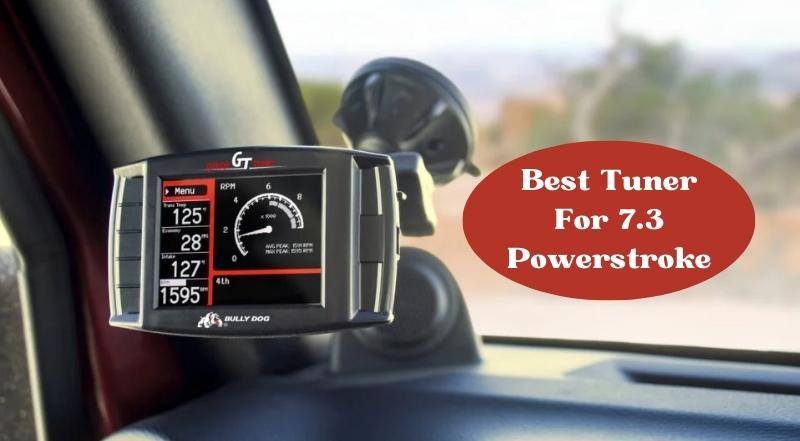
While the Hydra offers high-tech flexibility, the TS Performance 6-Position Chip remains an essential, popular choice for owners who want a “set-it-and-forget-it” solution. This chip uses a mechanical rotary dial to switch between six pre-loaded power levels. It is the definition of simplicity and has been a staple in the diesel performance industry for over a decade.
The 140HP “Extreme” setting is highly recommended for trucks with upgraded intake and exhaust systems, as it pushes stock injectors to their maximum duty cycle. However, for a budget build where the owner simply wants to improve throttle response and highway passing power without spending over $300, the TS 6-Position is hard to beat.
The primary limitation here is the inability to easily update the chip. If you upgrade your injectors from stock to “Stage 1” or “Stage 2” units, you must physically mail the TS chip back to a tuner to be re-burned. For most 7.3L owners who plan to keep their engine mostly stock, this is rarely an issue.
SCT X4 Performance Programmer: Essential OBDII Diagnostic and Flash Tuning
The SCT X4 represents a different approach to tuning. Rather than sitting on the J3 port like a chip, the SCT X4 is a handheld programmer that flashes the PCM through the OBDII port. This is often the recommended selection for late-model (2002-2003) 7.3L owners who prioritize a modern interface and integrated diagnostics.
✅ Pros
- Full-color digital gauge display for real-time monitoring.
- Ability to read and clear Ford-specific DTCs.
- Stores up to 10 custom tune files.
- No physical PCM removal required for installation.
❌ Cons
- No “Shift-on-the-Fly” capabilities.
- Longer time required to switch power levels (3-5 minutes).
- Must remain plugged in for gauge use.
The SCT X4 excels as a troubleshooting tool. For instance, if your truck begins to run roughly, you can use the X4 to monitor Injection Control Pressure (ICP) and Injection Pressure Regulator (IPR) duty cycle. If you see your ICP dropping below 500 PSI at idle, you’ve immediately identified a failure in the high-pressure oil system. This dual-purpose role as a tuner and a diagnostic scanner makes it a valuable asset for any high-mileage diesel owner.
Critical Safety Measures: Essential Gauges to Pair with Your Tuner
Tuning a 7.3 Powerstroke is inherently safe if done correctly, but it is dangerous to add 100+ horsepower without monitoring the engine’s vitals. The 7.3L uses cast aluminum pistons which have a melting point. When you increase fuel delivery via a tuner, you increase the heat generated in the combustion chamber. Without proper monitoring, you can easily exceed the structural limits of the engine.
Sustained Exhaust Gas Temperatures (EGTs) over 1,300°F will lead to piston crown failure. When towing, you should never allow EGTs to remain above 1,250°F for more than a few seconds. If temps climb, you must back off the throttle or switch to a lower power setting.
📋
The “Safety First” Installation Sequence
Drill and tap the driver-side exhaust manifold before the turbo. This provides the most accurate “Pre-Turbo” temperature reading.
The 4R100 is the weak link. Keep fluid temps below 220°F. If you see 230°F+, you are cooking the seals and shortening the trans life.
Stock Garrett TP38/GTP38 turbos are safe up to 25-28 PSI. Beyond 30 PSI, you risk overspeeding the turbine and causing a “burst” failure.
By following this curated selection of hardware and safety protocols, you can transform your 7.3 Powerstroke into a modern performer. Whether you choose the PHP Hydra for its infinite customizability or the TS Performance for its classic reliability, the result will be a truck that pulls harder, shifts smoother, and remains a dependable tool for years to come.
In summary, the PHP Hydra stands as the most versatile and customizable tuning platform available, making it the top ranked choice for both novices and enthusiasts. The TS Performance 6-Position chip offers an essential, cost-effective entry point for those seeking immediate power gains without the need for complex software updates. Regardless of your choice, monitoring EGTs and Transmission temps is non-negotiable for anyone adding a tuner to their 7.3L. Evaluate your specific towing needs, mechanical upgrades, and budget, then choose the tuner that offers the best balance of customizability and safety for your Ford Super Duty. With the right tuning, your 7.3L will continue to prove why it is one of the greatest diesel engines ever built.
Frequently Asked Questions
Can a tuner damage my 7.3 Powerstroke engine?
While the 7.3 Powerstroke is robust, a tuner can cause damage if you do not monitor Exhaust Gas Temperatures (EGTs). Aggressive tunes increase fuel delivery, which can lead to excessive heat. As long as you stay within safe temperature limits (under 1,250°F) and maintain your cooling system, a tuner is generally safe for high-mileage engines.
What is the difference between a chip and a flash tuner for the 7.3?
A chip, like the PHP Hydra, plugs directly into the J3 port on the PCM and allows for ‘on-the-fly’ changes while driving. A flash tuner, like the SCT X4, connects to the OBDII port and rewrites the PCM software. For the 7.3L, chips are generally preferred because they offer more positions and immediate switching between power levels.
Do I need to upgrade my injectors to use a 140HP tune?
You do not technically need upgraded injectors to run a 140HP tune, but you will not realize the full power potential on stock hardware. Stock AD-code injectors are limited by their fuel volume capacity. To truly benefit from high-horsepower tunes, upgrading to larger ‘Stage 1’ or ‘Stage 2’ single-shot injectors is recommended to match the tuner’s commands.
How much fuel economy improvement can I expect from a tuner?
Most 7.3 Powerstroke owners report an increase of 1 to 2 MPG when using a ‘Daily’ or ‘Economy’ tune. This improvement comes from optimized injection timing and better transmission shift points, which allow the engine to operate more efficiently. However, these gains are often offset if the driver utilizes the extra power aggressively.
Is the installation of a 7.3 Powerstroke chip difficult?
The installation is straightforward but requires precision. You must remove the PCM from the engine bay or cabin (depending on the year) and use a cleaning pad to remove the protective silicone coating from the J3 port connectors. If the contact points are not perfectly clean, the truck may fail to start or stall. It usually takes 45-60 minutes.