6.7 Powerstroke Oil Capacity with Filter: The Ultimate Maintenance Guide 2026

The 6.7L Powerstroke V8 diesel engine, engineered in-house by Ford and codenamed the “Scorpion,” represents a pinnacle of modern high-output, low-emission powertrain architecture. Since its highly anticipated introduction in the 2011 model year, the platform has undergone continuous, iterative refinement to support ever-increasing payload capacities, stringently enforced federal emissions standards, and extreme thermal loads. Among the most critical parameters for sustaining the mechanical longevity of this robust engine is the precise management of its lubrication system.
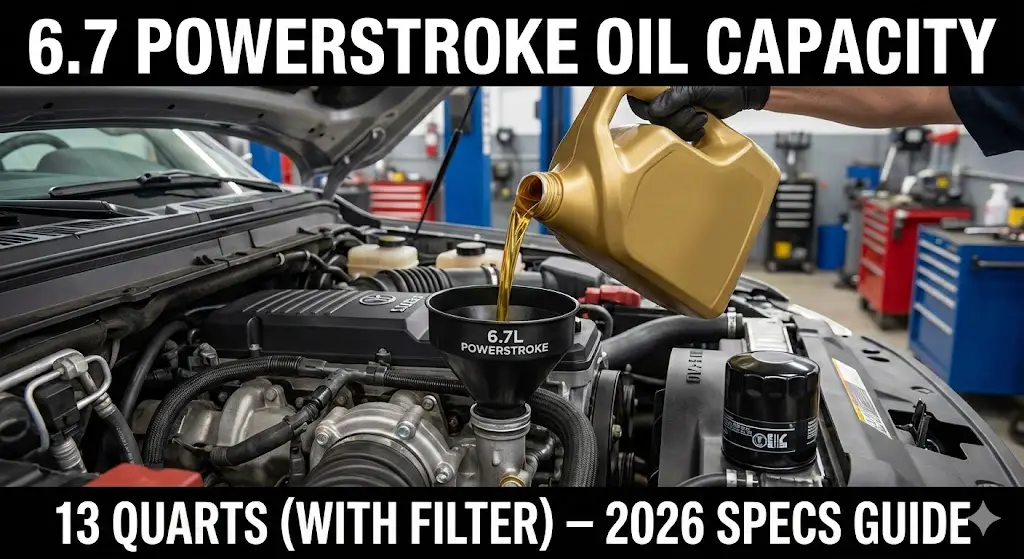
Understanding the exact 6.7 Powerstroke oil capacity with filter is not merely a matter of routine fluid maintenance; it is a critical engineering requirement for preventing catastrophic failure modes such as hydrodynamic bearing starvation, oil aeration, and premature valvetrain degradation. The lubrication system must not only reduce friction between rotating assemblies but also act as a primary cooling medium, carrying away the immense thermal energy generated by piston under-crowns and the high-pressure turbocharger.
This comprehensive report provides an exhaustive, data-driven analysis of fluid capacities, viscosity temperature dependencies, filtration standards, hardware evolution, and the rigorous original equipment manufacturer (OEM) specifications required to protect the 6.7L Powerstroke block across all production years.
6.7L Powerstroke
Maintenance Data Center (2011-2025)
Essential fluid capacities, specifications, and maintenance intervals for Ford Super Duty owners. Visualize the health of your engine.
Core Capacity
This capacity applies to ALL 6.7L model years (2011-Present).
Viscosity Selection Guide
Select your oil weight based on the lowest ambient temperature you expect to encounter.
Pro Tip: Ford recommends 5W-40 Full Synthetic for severe duty service (towing, idling) to better protect the turbocharger bearings in high heat while maintaining cold flow.
Service Intervals: Normal vs. Severe
Don’t rely solely on the dashboard monitor if you work your truck hard.
Normal Duty
Highway driving, empty bed, flat terrain.
7,500 – 10k MilesSevere Duty
Towing >1000lbs, extensive idling, off-road, frequent stops.
5,000 – 7,500 MilesDIY vs. Dealer Cost
Estimated savings per oil change: $130+
Filter Specifications
Motorcraft OEM
- Thread Size M22 x 1.5
- Bypass Valve Top-Mounted
- Torque Spec + 3/4 Turn
- Mobil 1 Alt M1-405
Critical Torque Specs
WARNING: Check Pan Type!
| Component | Torque |
|---|---|
| Drain Plug (Metal Pan) | 33 lb-ft (44 Nm) |
| Drain Plug (Plastic) | Hand Tight / Click |
| Oil Filter | Contact + 3/4 Turn |
| Wheel Lugs (Bonus) | 165 lb-ft |
6.7 Powerstroke Oil Capacity by Year
The total volumetric oil capacity of the 6.7L Powerstroke engine is heavily dependent on the model year of the engine block and the specific chassis configuration into which it is installed. While the early production models were engineered and standardized around a 13-quart sump, the demand for enhanced thermal mass and prolonged additive lifespan prompted Ford powertrain engineers to significantly increase the oil pan volume in later iterations.
| Model Year | Truck Classification | Oil Capacity (With Filter) | Metric Equivalent |
| 2011–2022 | F-250 to F-600 (Super Duty) | 13 Quarts | 12.3 Liters |
| 2015–2022 | F-650 / F-750 (Medium Duty) | 15 Quarts | 14.2 Liters |
| 2023–2025+ | F-250 to F-600 (Super Duty) | 15 Quarts | 14.2 Liters |
| 2023–2025+ | F-650 / F-750 (Medium Duty) | 17 Quarts | 16.1 Liters |
For the 2011 through 2022 model years, the F-250 through F-600 Super Duty trucks utilize a 13-quart capacity. Starting in 2023, Ford officially increased the specified oil capacity for F-250 through F-600 models to 15 quarts, while Medium Duty F-650 and F-750 models saw an increase to 17 quarts.
This precise volume increase represents a calculated engineering decision rather than an arbitrary modification. A larger oil sump acts as an expanded thermal sink, more effectively dissipating the extreme heat generated by the advanced variable geometry turbocharger (VGT) and the internal piston cooling jets. Furthermore, the additional fluid volume dilutes microscopic soot concentrations and prolongs the efficacy of the engine oil's Total Base Number (TBN), which is essential for combating acidic buildup during extended, heavy-duty towing cycles.
The 2023+ Capacity Shift: Understanding the Dipstick Discrepancy
A widely documented phenomenon among operators of 2023 and newer Super Duty trucks is what industry professionals refer to as the "dipstick discrepancy." Following a standard 15-quart oil change with a simultaneous filter replacement, the engine oil dipstick may incorrectly indicate a severely low oil level. This has led many vehicle owners and independent mechanics to erroneously add up to 17 or 17.5 quarts in a misguided attempt to reach the "MAX" or "FULL" line scored onto the dipstick indicator.
Adding engine oil beyond the OEM-specified 15 quarts poses a severe operational risk to the engine's survival. When the crankcase is overfilled, the rapidly rotating crankshaft counterweights make direct physical contact with the static oil reservoir at the bottom of the pan. This high-velocity mechanical agitation whips the high-viscosity diesel fluid into a froth, a condition known as oil aeration or foaming. Aerated oil behaves differently than pure liquid; it compresses under mechanical load, which drastically reduces the hydraulic pressure delivered to critical valvetrain components and starves the turbocharger journal bearings of their necessary fluid film. Conversely, chronically underfilling the engine limits thermal mass, promoting dangerous overheating and accelerating the breakdown of friction modifiers.
To effectively combat these false dipstick readings, official service bulletins—such as Special Service Message (SSM) 49477—stipulate a revised measurement protocol. Technicians and owners must wait a minimum of 15 minutes after shutting off the engine before checking the fluid level. The 6.7L engine utilizes complex internal oil galleries, overhead valvetrain pooling areas, and a massive timing gear apparatus; the heavy diesel motor oil requires substantial time to drain completely back into the lower pan via gravity. If the dipstick reading is taken immediately after shutdown, the indicator will reflect a falsely low volume, prompting the dangerous overfilling scenario. The golden rule for 2023+ models remains absolute: input exactly 15 quarts, execute the filter change, and trust the measured volume over an immediate dipstick reading.
Critical Fluid Specifications: Why Ford Mandates WSS-M2C171-F1
In the realm of modern diesel emissions systems, the formulation of motor oil is a highly delicate chemical balancing act. Lubricants must provide maximum boundary protection for high-friction internal engine components without simultaneously poisoning the Diesel Particulate Filter (DPF) or the Selective Catalytic Reduction (SCR) systems via inevitable exhaust blow-by.
The API CK-4 Controversy and Accelerated Wear
In late 2016, the American Petroleum Institute (API) introduced the CK-4 and FA-4 diesel oil specifications to replace the outgoing, older CJ-4 standard. These new lubricant formulations were specifically designed to be low in sulfated ash, phosphorus, and sulfur (commonly referred to in the industry as SAPS). The primary objective of lowering SAPS was to extend the operational lifespan of DPFs and sensitive catalytic converters across the broader transportation sector.
However, following extensive internal durability testing on engine dynamometers, Ford engineers discovered a critical flaw. They determined that standard CK-4 formulations, which typically contained less than 1,000 parts per million (ppm) of phosphorus, provided inadequate boundary lubrication for the unique architecture of the 6.7L engine. Phosphorus, usually derived from the additive Zinc Dialkyldithiophosphate (ZDDP), is a sacrificial anti-wear element. Its reduction led to accelerated, high-mileage wear specifically on the 6.7L Powerstroke's rocker arm fulcrums and valvetrain assembly.
The Implementation of the WSS-M2C171-F1 Standard
Faced with the prospect of widespread valvetrain failures, Ford explicitly rejected standard CK-4 and the low-viscosity FA-4 oils for the 6.7L Powerstroke engine. To guarantee engine protection and maintain warranty integrity, Ford authored its own stringent chemical specification: WSS-M2C171-F1.
Any lubricant introduced into the crankcase of a 6.7L engine must carry this exact specification on its labeling. To meet the WSS-M2C171-F1 requirements, an oil must either be a legacy CJ-4 formulation or a heavily modified CK-4 formulation that has been artificially boosted by the blender to contain between 1,000 and 1,200 ppm of phosphorus. Utilizing non-approved lubricants that merely state "CK-4" without the corresponding Ford approval code will result in unmitigated valvetrain degradation, increased tailpipe emission levels, and the outright voiding of the vehicle's powertrain warranty.
A complete and continuously updated database of approved fluids is maintained by Ford's chemical division and can be accessed via their official(https://www.fcsdchemicalsandlubricants.com) portal or www.motorcraft.com. Prominent aftermarket options that successfully meet this rigorous standard include specific, boosted formulations from AMSOIL (Signature Series Max-Duty), Shell Rotella T6, Mobil Delvac, and Valvoline Premium Blue. When purchasing oil, operators must verify that the WSS-M2C171-F1 designation is clearly printed on the rear label, often located near the API donut symbol.
Selecting the Correct Oil Viscosity for Your Climate and Duty Cycle
Because the 6.7L Powerstroke relies on its engine oil for both primary boundary lubrication and critical hydraulic actuation within the high-pressure valvetrain lifters, selecting the appropriate Society of Automotive Engineers (SAE) viscosity grade is paramount. Viscosity selection is not static; it must be dynamically adjusted based on ambient geographical temperatures, anticipated duty cycles, and the specific fuel type being utilized.
According to official Ford literature and the OEM SAE viscosity charts, the standard factory fill for general climate operation where ambient temperatures remain above 0°F (-18°C) is SAE 10W-30. This specific weight offers excellent flow characteristics for immediate cold-start lubrication while maintaining sufficient hydrodynamic film strength at operating temperatures.
However, heavy-duty operational parameters often dictate alternative viscosities:
| SAE Viscosity Grade | Optimal Temperature Range | Recommended Use Case / Duty Cycle |
| 10W-30 | 0°F to 100°F+ | Normal duty, highway cruising, unladen driving. Factory standard fill. |
| 15W-40 | 20°F to 100°F+ | Heavy duty, max-payload towing, extreme summer heat. |
| 5W-40 (Full Synthetic) | -20°F to 100°F+ | Severe duty, high idle times, winter towing, Biodiesel (B20) usage. |
| 0W-40 (Full Synthetic) | -40°F to 100°F+ | Extreme arctic climates. Ensures cold-cranking fluidity. |
Data compiled from Ford Super Duty Owner's Manual specifications and extreme climate operational guidelines.
- Biodiesel Blends (Up to B20): The proliferation of biodiesel presents a unique challenge. When utilizing B20 biodiesel (20% biomass, 80% petroleum), the rate of fuel dilution inside the engine oil increases exponentially during the DPF active regeneration cycles. To counteract the dangerous thinning of the lubricant base stock caused by raw fuel washing past the piston rings, Ford mandates a step-up to SAE 5W-40 or SAE 15W-40 full synthetic motor oil.
- Severe Duty Service: For commercial operators engaged in prolonged towing, hauling maximum payloads across mountainous terrain, or maintaining extended idling hours, the superior thermal shear resistance of a full synthetic SAE 5W-40 provides unmatched film retention and prevents high-temperature oxidation.
- Extreme Cold Weather: In arctic or sub-zero climates where ambient temperatures frequently drop below -22°F (-30°C), traditional 15W-40 conventional oil will gel into a semi-solid state, leading to catastrophic bearing starvation upon ignition. In these harsh environments, SAE 0W-40 is strictly recommended to minimize engine cranking periods and ensure immediate top-end lubrication. Furthermore, Ford strongly advises utilizing the integrated engine block heater at any ambient temperature below -9°F (-23°C) to maintain fluid viscosity.
OEM vs. Bypass Filtration: Motorcraft FL-2124-S and Beyond
Effective particulate removal is the final, essential defense mechanism against internal engine abrasion. The physical factory standard for 6.7L engine oil filtration has evolved significantly over the platform's production run to match the increasing demands of the engine block.
The Evolution: Motorcraft FL-2051S vs. FL-2124-S
For over a decade, the standard OEM oil filter utilized for the 6.7L Powerstroke was the Motorcraft FL-2051S. Built to exacting factory standards, this traditional spin-on filter provided excellent full-flow media capacity. However, as of recent production cycles, Ford has officially superseded the aging FL-2051S with the vastly upgraded Motorcraft FL-2124-S (also referenced under Part # BC3Z-6731-B or MU2Z-6731-C).
The new FL-2124-S filter features advanced synthetic blending in its filtration media, allowing it to trap finer particulates while maintaining a higher flow rate under extreme pressure. It is fully backward compatible with all 2011–2025+ 6.7L engines and acts as a direct-fit factory replacement. If an official Motorcraft filter cannot be sourced in the field, any aftermarket replacement utilized must explicitly state that it meets Ford's structural and micron-rating specification WSS-M99P55-D1 to ensure the bypass valve pressure parameters align with the engine's oil pump.
The Ultimate Upgrade: Bypass Oil Filtration Systems
While a premium full-flow filter like the FL-2124-S is highly effective at capturing physical wear metals and particles larger than 15 to 20 microns, the very nature of diesel combustion produces massive amounts of microscopic soot particulate. These carbonaceous soot particles are often less than 2 microns in diameter—small enough to pass cleanly through the porous media of any standard full-flow filter. Over thousands of miles, this soot agglomerates, effectively turning the engine oil into a highly abrasive liquid sandpaper that exponentially increases valvetrain wear.
To actively counter this destructive phenomenon, many commercial fleet operators and longevity enthusiasts employ aftermarket Bypass Oil Filtration Systems. A bypass system works by safely diverting a highly restricted, small percentage (typically 10%) of the pressurized oil away from the main engine galley. It forces this diverted fluid through an ultra-dense, depth-style filtration media before slowly returning it directly to the oil sump.
These heavy-duty systems—manufactured by specialized companies like AMSOIL, Insane Diesel, and Frantz—boast the incredible capability of removing up to 39 percent of soot contaminants smaller than 1 micron. The downstream, long-term effects of implementing a secondary bypass filtration circuit include dramatically extended safe oil drain intervals, improved dynamic oil cooling (due to the increased fluid capacity of the bypass hoses and external filter housing), the effective removal of trace internal moisture, and the preservation of the oil's hydrodynamic properties long past standard degradation thresholds.
Oil Pan Architecture and Drain Plug Specifications
The mechanical hardware housing the engine oil has not remained static. The 6.7L Powerstroke has utilized two distinct oil pan architectures during its continuous production life, each dictating a very different physical approach to the routine oil change procedure.
2011–2022: Stamped Steel Pans and Threaded Plugs
Early iterations (spanning model years 2011 through 2022) of the 6.7L feature a traditional, heavy-duty stamped steel oil pan. (Note: A small batch of original 2011–2013 models temporarily utilized an early plastic design before being rapidly retrofitted back to steel via warranty claims). These steel pans employ a conventional threaded metal drain plug featuring an M14-1.50 thread pitch, requiring a 16mm socket or a standard 3/8-inch square drive tool for removal.
When reinstalling the threaded drain plug into the steel pan, a fresh crush washer or elastomer gasket must be utilized, and the plug should be meticulously tightened with a calibrated torque wrench to exactly 29 to 32 ft-lbs. Over-torquing is a remarkably common error that risks permanently stripping the delicate pan threads—a catastrophic mistake that necessitates either dropping the entire upper and lower pan assembly for replacement or carefully threading a steel helicoil while lying beneath the chassis.
The aftermarket eagerly supports this generation with high-capacity cast aluminum oil pans, prominently manufactured by Pacific Performance Engineering (PPE) and Mag-Hytec. These premium replacement pans integrate external aerodynamic cooling fins for vastly enhanced heat dissipation and add an extra full quart of fluid capacity, further lowering bulk oil temperatures during extreme towing operations.
2023–2025: Composite Pans and Quarter-Turn Plugs
Beginning predominantly in the 2023 Super Duty model year, Ford transitioned the entire assembly line to a reinforced composite (heavy-duty plastic) oil pan. This radical change was implemented primarily to reduce overall engine weight and to dynamically dampen the acoustic harmonic resonance emanating from the massive lower rotating assembly.
The composite pan utilizes a highly specialized yellow plastic quarter-turn drain plug rather than a traditional threaded metal bolt. This plug requires absolutely no tools for installation; it is engineered with an internal O-ring and is designed to be seated firmly hand-tight until it clicks into its locking detent. Attempting to use conventional wrenches, ratchets, or pliers on this mechanism will instantly fracture the fragile plastic retaining clips, causing immediate, catastrophic fluid loss upon engine ignition. For fleet operators seeking enhanced durability over the OEM plastic, the aftermarket offers CNC-machined billet stainless steel replacements for the quarter-turn plugs, which also feature integrated neodymium magnets to capture ferrous metallic wear materials circulating in the oil.
Comprehensive Step-by-Step 6.7L Powerstroke Oil Change Guide
Performing a driveway or fleet-yard oil change on the 6.7L Powerstroke is a highly rewarding maintenance task that saves considerable dealership labor rates. However, due to the immense fluid volumes involved, it requires preparation and the correct tooling.
Required Tools and Fluid Supplies:
- 13 to 17 Quarts of WSS-M2C171-F1 approved Diesel Motor Oil (depending on model year).
- Motorcraft FL-2124-S Engine Oil Filter.
- Heavy-duty oil filter wrench or specialized filter pliers.
- 16mm socket or 3/8-inch drive ratchet (for 2011-2022 steel pans).
- Large capacity fluid drain pan (must safely hold a minimum of 20 quarts to prevent overflow).
- Replacement M14-1.50 drain plug crush washer (for steel pans).
The Step-by-Step Procedure:
- Thermal Preparation: Warm up the engine for approximately five minutes. This critically lowers the viscosity of the heavy 15W-40 or 10W-30 oil, allowing it to suspend settled particulate matter and drain significantly faster.
- Drain the Sump: Position the high-capacity drain pan beneath the oil pan. Carefully remove the M14-1.50 threaded plug (or hand-twist the yellow quarter-turn composite plug). Allow the system to drain completely until it reaches a slow drip.
- Replace the Filter: Relocate the drain pan beneath the oil filter housing. Utilizing the filter pliers, loosen the Motorcraft filter. Expert Warning: The filter itself holds over a quart of heavy oil and will make a mess if dropped. Prime the new FL-2124-S filter by pre-filling it with fresh oil, and thoroughly lubricate the rubber O-ring gasket to prevent binding. Thread the new filter on by hand until the gasket makes contact, then tighten a final quarter to half turn.
- Reinstall Drain Plug: Reinsert the drain plug. If utilizing the steel pan, torque strictly to 29–32 ft-lbs with a new crush washer. If utilizing the composite pan, lock the quarter-turn plug purely by hand.
- Refill the Crankcase: Remove the upper engine oil fill cap and insert a wide-mouth funnel. Pour in the exact specified volume (13, 15, or 17 quarts) of fresh fluid.
- Prime and Inspect: Start the engine and allow it to idle for two minutes, closely monitoring the dashboard for the oil pressure gauge to stabilize. Inspect beneath the truck for any active weeping around the filter seal or drain plug. Shut off the engine, wait the mandatory 15 minutes, and verify the final level on the dipstick.
- System Reset: Turn the vehicle ignition to the "ON" position without starting the engine. Navigate through the steering wheel menu to "Vehicle Info," select "Oil Life," and hold the "OK" button to reset the Intelligent Oil-Life Monitor back to 100%.
Intelligent Oil-Life Monitor and Duty Cycle Maintenance Intervals
The 6.7L Powerstroke is technologically equipped with an advanced Intelligent Oil-Life Monitor (IOLM). Unlike older systems that relied on a dumb mileage counter, the IOLM uses highly complex algorithmic modeling to dynamically calculate the true degradation of the engine oil. It factors in engine operating temperatures, ambient climate data, total idle time, payload sensor readings, and the frequency of DPF active regeneration cycles. Therefore, relying purely on fixed, traditional mileage intervals is functionally obsolete; the exact service interval must be dictated by the truck's specific real-world duty cycle.
| Duty Cycle Category | Typical Operating Conditions | Recommended Mileage Interval | Corresponding Engine Hours |
| Normal | Light payloads, flat to moderately hilly terrain, minimal to no idling. | 7,500 – 10,000 miles | 300 – 400 Hours |
| Severe | Heavy towing, mountainous off-road terrain, extended daily idling, extreme heat/cold. | 5,000 – 7,500 miles | 200 – 299 Hours |
| Extreme | Maximum gross combined weight rating (GCWR) continuously, severe off-road dust. | 2,500 – 5,000 miles | 100 – 199 Hours |
Data metrics compiled from intelligent oil life monitor guidelines and heavy-duty service schedules.
It is critical for fleet managers to note that extensive idling hours degrade diesel engine oil exceptionally rapidly. Idling causes incomplete combustion and resultant "cylinder wash," a destructive process that introduces raw, unburned diesel fuel directly into the crankcase, catastrophically lowering the oil's viscosity. Operators falling into the Severe or Extreme categories—such as commercial hotshot haulers, agricultural workers, or emergency service vehicles—must strictly adhere to the truncated 5,000-mile or 200-hour metric to prevent premature main bearing scuffing.
Furthermore, the oil change interval should serve as the trigger for a holistic maintenance sweep. The primary and secondary fuel filters must be replaced every 15,000 miles to prevent CP4 high-pressure injection pump failure, the engine air filter inspected every 45,000 miles, and the primary cooling system flushed initially at 105,000 miles.
Frequently Asked Questions
Why does my 2024 Powerstroke show low oil after adding the required 15 quarts?
This is caused by the slow fluid drain-back rate of the 6.7L's internal architecture. Ford's official service bulletin (SSM 49477) mandates waiting a full 15 minutes after the engine is shut off before checking the dipstick. Checking it immediately will result in a false low reading. Never add oil past the OEM spec to satisfy an immediate dipstick read, as this will cause aeration.
Can I use standard API CK-4 15W-40 in my 6.7L engine?
Only if it also explicitly carries the Ford WSS-M2C171-F1 approval on the rear label. Standard CK-4 oils often have reduced phosphorus levels (under 1000 ppm) designed for emissions equipment longevity, which Ford proved causes accelerated wear on the 6.7L rocker arms. If the bottle only says CK-4 without the Ford specification, do not use it.
What is the torque spec for the 6.7 Powerstroke oil drain plug?
If your truck is equipped with the stamped steel oil pan (2011–2022), the M14-1.50 threaded drain plug must be torqued to 29–32 ft-lbs using a new crush washer. If you have the 2023+ composite plastic pan, the yellow quarter-turn plug requires no tools and must be seated firmly hand-tight until it clicks into place.
What is the difference between the Motorcraft FL-2051S and FL-2124-S filters?
The FL-2124-S is the modern, superceding OEM factory replacement that completely replaces the older FL-2051S filter design. It features upgraded internal media manufactured to more stringent specifications to handle modern synthetic fluid pressures. It is a direct-fit replacement for all 2011 through 2025+ models.
Are bypass oil filters worth the investment for a 6.7 Powerstroke?
For vehicles operating in the Severe or Extreme duty cycles, absolutely. While the primary Motorcraft full-flow filter removes larger particulates, secondary bypass systems (like those from AMSOIL or Frantz) filter a small percentage of oil through a dense media, removing up to 39% of microscopic soot particles smaller than 1 micron. This dramatically extends safe oil drain intervals and prevents the oil from becoming highly abrasive over time.