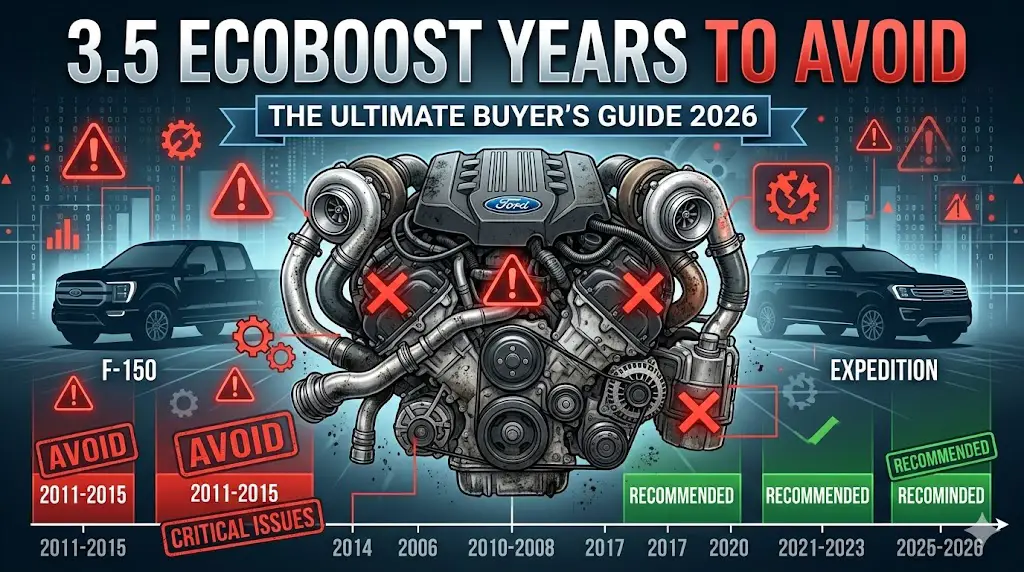
3.5 EcoBoost Years to Avoid: The Ultimate Buyer’s Guide 2026

The Ford 3.5-liter EcoBoost V6 engine represents one of the most significant paradigm shifts in modern automotive engineering. By successfully demonstrating that a relatively small-displacement, forced-induction V6 could reliably replace traditional, naturally aspirated V8 engines in light-duty trucks and large SUVs, Ford altered the trajectory of the American automotive market. First introduced in 2010 for the 2011 model year under the “TwinForce” concept, the engine has seen widespread adoption across the F-150, Expedition, Lincoln Navigator, Transit commercial vans, and even the halo Ford GT supercar.
However, the application of twin-turbocharging and direct fuel injection in heavy-duty platforms introduced severe thermal and mechanical stresses that traditional engines rarely encounter. Over three distinct engine generations, well-documented engineering oversights—ranging from timing chain elongation and cam phaser locking pin failures to catastrophic internal water pump leaks—have created specific model years that present high financial risks for second-hand buyers. Determining the exact 3.5 EcoBoost years to avoid requires a granular understanding of the powertrain’s evolution, the specific metallurgical and software flaws present in early production runs, and the subsequent mechanical revisions implemented by Ford’s engineering teams.
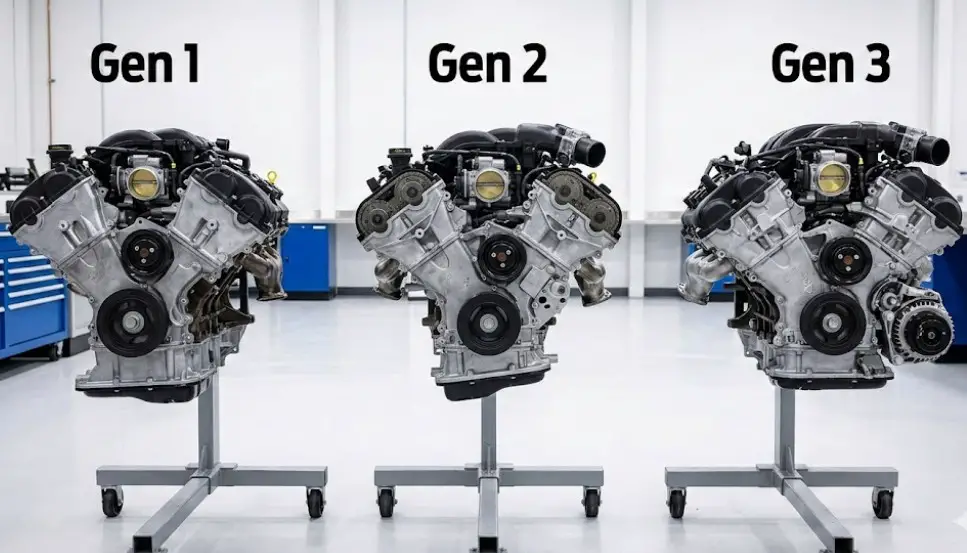
This comprehensive research report evaluates the technical architecture of the 3.5L EcoBoost across all three generations, isolates component-level failure rates, details the exact model years that prospective buyers must avoid, and provides an exhaustively detailed buyer and maintenance guide optimized for long-term reliability.
3.5 EcoBoost Years to Avoid
The definitive, data-driven guide to Ford’s flagship V6. Discover the exact model years plagued by timing chain stretch, and the safe years you can buy with confidence.
The Quick Verdict: Buy vs. Avoid
Since its debut in 2011, the 3.5L EcoBoost has seen major revisions. While highly capable, early models suffered from severe design flaws. Here is the bottom-line categorization based on NHTSA complaint data and Master Tech service bulletins.
Strictly Avoid
High rates of catastrophic timing chain stretch and intercooler condensation.
- 2011 Model Year
- 2012 Model Year
- 2013 Model Year
- 2017 Model Year (Gen 2 Teething Issues)
Proceed w/ Caution
Improved, but still susceptible to cam phaser rattles and transmission jerks.
- 2014 Model Year
- 2018 Model Year
- 2019 Model Year
Safe to Buy
Revised cam phasers, dual injection, and sorted software logic.
- 2015 – 2016 (Late Gen 1)
- 2020 Model Year
- 2021 Model Year
- 2022+ Model Years
Complaint Volume by Model Year
Analyzing powertrain-specific complaints per 100,000 vehicles sold reveals a clear pattern. The initial launch years (2011-2013) show drastically higher failure rates compared to later revisions.
Data source synthesized from historical CarComplaints powertrain defect reports.
Generation 1 vs. Generation 2
Gen 1 (2011-2016)
Direct Injection OnlyThe original 3.5L EcoBoost changed the truck market but acted as a beta test. Because it utilized direct injection exclusively, fuel never washed over the intake valves, leading to severe carbon buildup.
- ✘ Single Timing Chain (Prone to stretch)
- ✘ Direct Injection Only (Carbon buildup)
- ✘ Poor Intercooler Design (Condensation misfires)
Gen 2 (2017-Present)
Dual InjectionFord completely overhauled the engine for 2017. They added port fuel injection to clean the intake valves, upgraded to a dual-chain timing system, and redesigned the turbos.
- ✔ Dual Timing Chains (Thicker, more durable)
- ✔ Port + Direct Injection (Self-cleaning valves)
- ✔ Electronic Wastegates (Better turbo control)
The “Big Three” Fatal Flaws
When the 3.5L EcoBoost fails, it usually falls into one of a few distinct categories. Understanding the distribution of these issues is crucial for prospective buyers looking at the used market.
1. Timing Chain Stretch & Cam Phasers
Affecting mostly 2011-2014 models (chains) and 2017-2019 models (phasers). It presents as a loud “cold start rattle”. Ignoring this leads to engine timing failure.
2. Intercooler Condensation
Early Gen 1 models cooled the intake charge too well in humid climates, pooling water. Hard acceleration forced water into the engine, causing shuddering and limp mode.
3. Ignition System Wear
Turbocharged engines are hard on spark plugs. The 3.5L eats plugs every 40,000 to 50,000 miles. Misfires are common if maintenance is deferred.
Distribution of Major Powertrain Failures
Average Out-of-Warranty Repair Costs
Why is it so critical to avoid the bad years? The repair bills. Because the F-150 requires cab-off procedures for some engine work, labor costs are exceptionally high.
Estimates based on independent shop averages (Parts + Labor). Dealership rates will be 20-40% higher.
Expert Conclusion
The 3.5L EcoBoost is not inherently a bad engine, but its early iterations were flawed. If you are shopping the used market, **strictly avoid 2011-2013 F-150s**. If your budget allows, target a **2020 or newer** model where Ford has virtually eliminated the cam phaser issues and perfected the dual-injection system. If you must buy a Gen 1, look for a 2015 or 2016 with thorough maintenance records showing frequent (5k mile) oil changes.
The Engineering Evolution of the 3.5L EcoBoost
Understanding which model years carry the highest mechanical risk requires a fundamental understanding of how the engine’s internal architecture has evolved. Ford has entirely overhauled the 3.5L EcoBoost three times over its lifespan, with each successive generation attempting to resolve the catastrophic failures or drivability nuisances of the last.
First-Generation 3.5L EcoBoost (2011–2016)
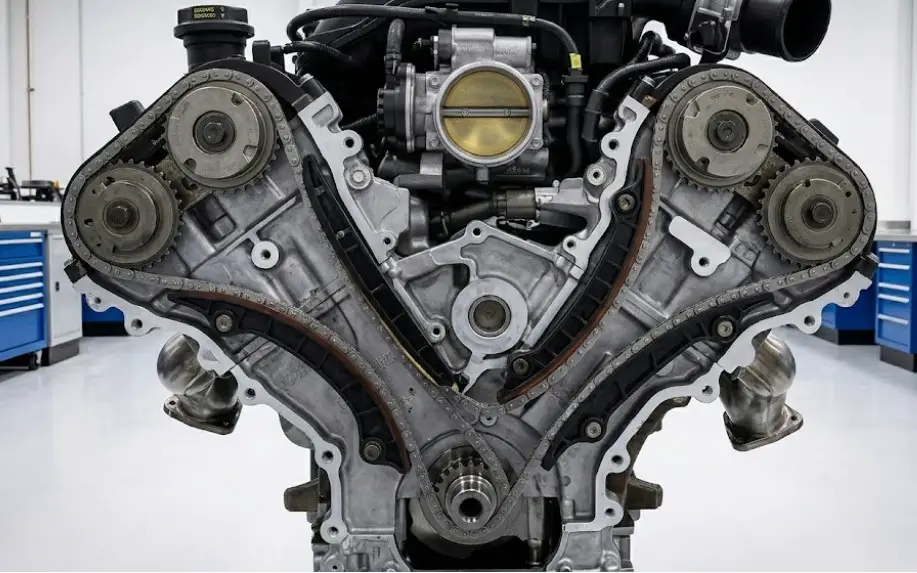
The inaugural Generation 1 architecture was heavily based on the naturally aspirated Duratec 3.5-liter 60-degree V6 engine block. To handle the increased cylinder pressures of forced induction, the block featured six-bolt press-fit main bearing caps, a forged-steel, fully counterweighted crankshaft, and cast aluminum pistons utilizing a steel ring carrier with floating wrist pins.
The fuel delivery system relied exclusively on high-pressure Direct Fuel Injection operating at 2,150 PSI. Early production models spanning 2011 to 2012 utilized Hitachi-sourced fuel systems, while the 2013 through 2016 variants transitioned to a more robust Bosch direct injection system. The valvetrain utilized a unique Direct-Acting-Mechanical-Bucket (DAMB) shimless-bucket design, a configuration where the camshaft lobe pushes directly on the valve. Forced induction was achieved via twin BorgWarner turbochargers tuned to produce up to 15 PSI of boost pressure. The earliest iterations utilized a mechanical blow-off valve integrated directly into the compressor housing, whereas later Gen 1 models adopted an electronic blow-off valve.
The critical flaw in the Generation 1 architecture was its timing and lubrication system. The engine utilized a single, extraordinarily long primary timing chain to drive the intricate valvetrain, lubricated by a traditional gerotor oil pump. This single-chain design proved highly susceptible to elongation over time, setting the stage for one of the engine’s most notorious reliability issues.
Second-Generation 3.5L EcoBoost (2017–2020)
For the 2017 model year, Ford introduced a clean-sheet redesign of the powertrain, internally codenamed D35. This second-generation engine was engineered specifically to improve low-end torque, reduce hydrocarbon emissions, and resolve the persistent flaws that plagued the Gen 1 platform.
The most significant mechanical advancement was the introduction of a dual fuel-injection system. By pairing traditional Port Fuel Injection with the existing Direct Injection system, Ford engineered a solution that allowed fuel to wash over the intake valves, permanently resolving the rampant carbon buildup issues that choked earlier engines. The problematic single primary timing chain was completely discarded in favor of a vastly superior dual-chain cam drive system. This setup utilized separate, robust chains to drive each cylinder bank, driven by a double gear sprocket on the crankshaft to improve engine harmonics and eliminate chain stretch.
The BorgWarner turbochargers were heavily revised, receiving linear electronic wastegates and turbine wheels forged from a lighter Mar-M-247 super-alloy. This aerospace-grade material drastically reduced rotational mass, improving turbo spool responsiveness and allowing for higher sustained boost pressures. The valvetrain transitioned away from the DAMB design to a roller-finger follower valvetrain paired with hollow camshafts to save weight.
However, this generation introduced its own suite of severe engineering oversights. The Variable Cam Timing (VCT) phaser design utilized a fragile locking pin mechanism that resulted in widespread cold-start rattling and eventual mechanical failure. Furthermore, early 2017 and 2018 models temporarily utilized a composite plastic oil pan and plastic drain plug assembly that warped under thermal cycling, leading to persistent, unfixable oil leaks until Ford reverted to an aluminum pan in mid-2018.
Third-Generation 3.5L EcoBoost (2021–Present)
The current Generation 3 engine represents the pinnacle of the EcoBoost platform, designed primarily as an extensive refinement of the Gen 2 block to systematically bulletproof the known weak points.
While the bore, stroke, connecting rods, and head gaskets remained identical to the Gen 2 architecture, the block and cylinder heads were entirely recast. The high-pressure direct-injection system was drastically upgraded, increasing operational pressure from the Gen 1’s 2,150 PSI to a staggering 3,675 PSI (250 bar). The ultra-high-pressure fuel pump was strategically relocated to the driver’s side of the engine bay to improve acoustic harmonics and reduce mechanical vibration.
Ford permanently resolved the Gen 2 cam phaser disaster by introducing redesigned “ML3Z” phasers alongside new metal timing chain guides and heavy-duty tensioners. The linear wastegates were replaced with more precise rotary electronic wastegates, and a Cooled Exhaust Gas Recirculation (EGR) system was integrated into the intake tract. This cooled EGR system significantly improves the engine’s knock resistance, allowing the powertrain to produce maximum output even when operating on lower-grade fuels.
| Engineering Specification | Gen 1 (2011-2016) | Gen 2 (2017-2020) | Gen 3 (2021+) |
| Fuel Delivery System | Direct Injection Only (2,150 PSI) | Dual System: Port & Direct Injection | Dual System: Port & Direct (3,675 PSI) |
| Timing Chain Architecture | Single Long Primary Chain | Dual Primary Chains | Dual Primary Chains with Metal Guides |
| Valvetrain Design | DAMB Shimless Bucket | Roller-Finger Follower | 5.0L Coyote-Style Valvetrain |
| Cam Phaser Reliability | Moderate to High | Extremely Low (HL3Z Part Defect) | Very High (ML3Z Updated Parts) |
| Oil Pan Material | Stamped Aluminum | Composite Plastic (17-18) / Aluminum (18.5+) | Stamped Aluminum |
| Turbo Wastegate Actuation | Mechanical / Electronic Vacuum | Linear Electronic Actuation | Rotary Electronic Actuation |
| Primary Known Defect | Timing Chain Elongation, Carbon Buildup | Cam Phaser Lock Pin Failure, CDF Drum | Early Production Intake Valve Fractures |
3.5 EcoBoost Years to Avoid: Isolating High-Risk Model Years
Statistical failure data, extensive(https://www.nhtsa.gov/) records, Technical Service Bulletins, and vast archives of owner documentation reveal two distinct periods of elevated financial risk for the 3.5L EcoBoost. Consumers navigating the used vehicle market must exercise extreme caution or completely avoid the following model years unless the seller can provide exhaustive documentation proving that the defective factory components have been preemptively replaced with updated revisions.
High-Risk Era 1: 2011, 2012, 2013, and 2014 Models (Early Gen 1)
The inaugural years of the 3.5L EcoBoost are universally considered the most problematic regarding the frequency of systemic failures and overall operational rough-running. Ford’s initial foray into combining heavy-duty towing applications with small-displacement turbocharging resulted in several severe oversights.
The most catastrophic failure associated with these early models is timing chain elongation. The single primary timing chain design simply lacked the tensile strength to withstand the immense torque loads generated by the twin turbochargers. Furthermore, turbocharged direct-injection engines are highly prone to fuel dilution, where raw fuel blows past the piston rings and degrades the engine oil. This thinned, soot-loaded oil acts as an abrasive, rapidly wearing down the pins and links of the timing chain. As the chain stretches beyond the tensioner’s operational limits, the engine’s internal timing becomes desynchronized. The powertrain control module will throw a P0016 diagnostic trouble code, and the engine will experience severe cold-start rattling, sluggish performance, and eventual piston-to-valve contact if left unaddressed.
The 2011 and 2012 models are uniquely plagued by intercooler condensation ingestion. Because the factory Charge Air Cooler (intercooler) was overly efficient at cooling the intake charge, high-humidity environments (such as the American Southeast) caused ambient moisture to condense and pool inside the bottom of the intercooler casing. When the driver executed a hard acceleration maneuver, the sudden rush of boost pressure would sweep this pooled water directly into the engine’s combustion chambers. This resulted in violent engine shuddering, sudden misfires, and the vehicle entering a protective “limp mode”. Resolving this requires implementing TSB 13-8-1, which involves installing restrictive air deflectors and reprogramming the PCM, or upgrading to an aftermarket performance intercooler with a built-in weep hole.
Because these years only featured direct injection, fuel was sprayed directly into the combustion chamber rather than upstream of the intake valves. Consequently, there was no solvent fuel wash to clean the backs of the intake valves. Carbon blow-by from the PCV system baked onto the valves under extreme heat, eventually accumulating into thick deposits that heavily restricted cylinder airflow, drastically reduced fuel economy, and caused rough, stumbling idle conditions. Furthermore, the 2013 through 2015 models suffer from notoriously weak Positive Crankcase Ventilation (PCV) valve cover adapters. When these adapters fail, the engine pulls raw crankcase oil into the intake tract, resulting in heavy blue or white smoke billowing from the tailpipe after extended periods of idling.
High-Risk Era 2: 2017, 2018, and 2019 Models (Early Gen 2)
While the highly anticipated 2017 redesign successfully eradicated the carbon buildup and timing chain stretch issues of the first generation, it introduced a new suite of remarkably expensive failures, making the 2017 to 2019 models arguably the most financially hazardous years to own outside of the warranty period.
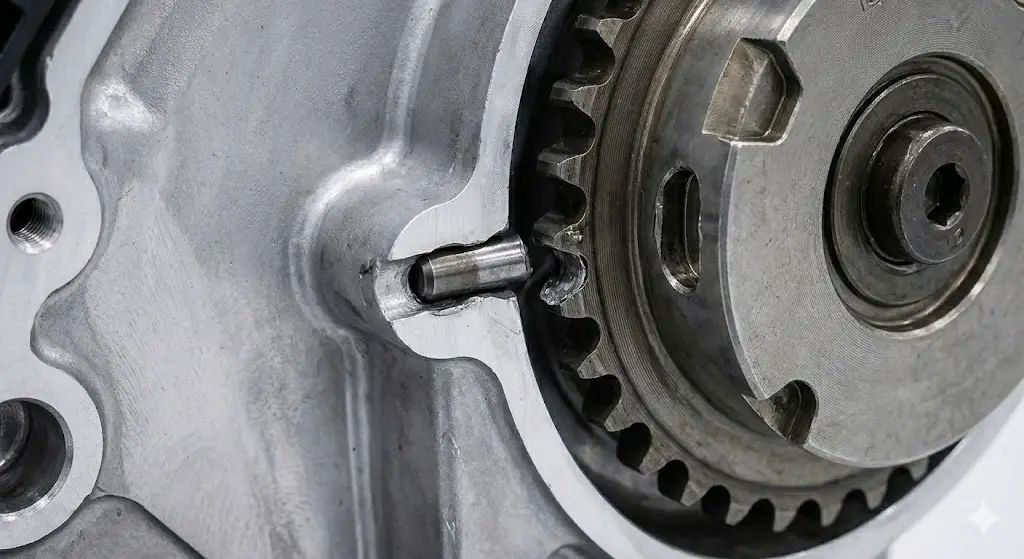
The defining failure of the early Gen 2 powertrain is the catastrophic breakdown of the Variable Cam Timing (VCT) phasers. These hydraulic gears advance or retard the camshaft timing based on engine load. Inside the phaser assembly is a delicate locking pin designed to hold the gear in place when the engine is shut off and oil pressure drops to zero. On the 2017-2020 engines, the metallurgy of this pin and its surrounding aluminum housing was deficient. The pin would shear off or wear an oblong groove into the housing. When the engine was subsequently cold-started, the lack of immediate oil pressure allowed the unsecured phasers to clatter violently against the camshafts, generating a horrific metallic rattling noise for two to five seconds. If ignored, the loose phasers would eventually damage the camshafts and alter the engine’s timing enough to cause total mechanical failure.
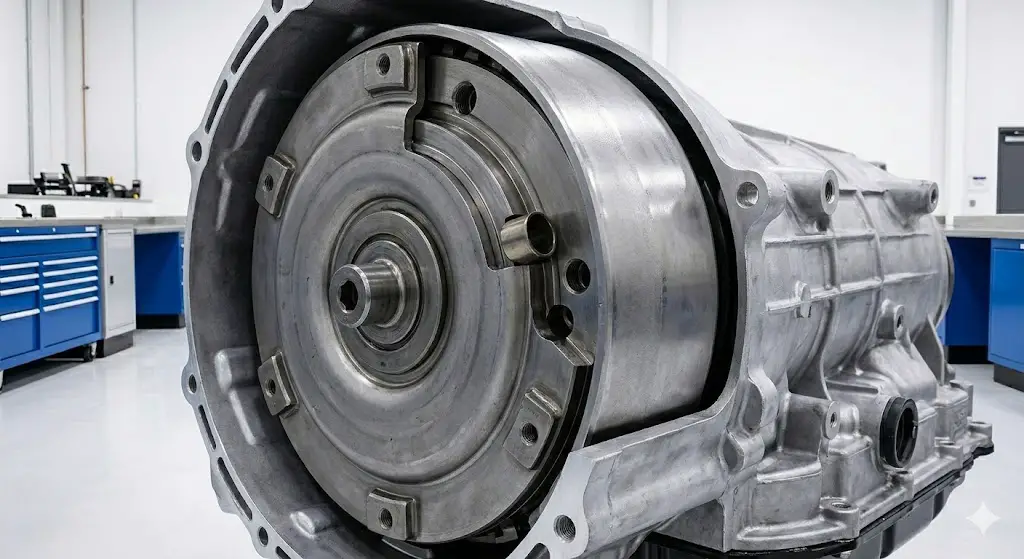
Compounding the engine issues, the 2017 model year marked the debut of the 10-speed 10R80 automatic transmission. In models produced between the transmission’s inception and August 2022, the internal Clutch/Direct/Forward (CDF) clutch cylinder drum bushing was improperly secured. The immense hydraulic pressures within the transmission cause this bushing to “walk” or slide out of its intended position, completely blocking vital hydraulic fluid ports. The resulting fluid starvation leads to violent, delayed engagements when shifting from Park to Drive, severe slipping and flaring on the 3-4 and 5-6 upshifts, torque converter shudder, and eventual total transmission failure.
Finally, the 2017 and 2018 models were subjected to a failed engineering experiment involving composite plastic oil pans. In an effort to reduce vehicle weight, Ford utilized a plastic pan mated to the aluminum block with a silicone sealant. The vastly different thermal expansion coefficients of plastic and aluminum caused the pan to warp under the intense heat of the twin-turbo V6, breaking the silicone seal and leading to persistent, unfixable oil leaks. Ford abandoned the plastic design and quietly reverted to a stamped aluminum pan midway through the 2018 production run.
The Safest 3.5 EcoBoost Years to Buy
Conversely, certain model years represent the absolute pinnacle of each respective generation’s reliability curve, strategically situated in periods where earlier design flaws were engineered out of the production line but before unproven next-generation technologies were introduced.
The Gen 1 Sweet Spot: 2015 and 2016 Models
For budget-conscious consumers evaluating the older F-150, Expedition, or Transit markets, the 2015 and 2016 model years are highly recommended. By the 2015 production run, Ford had quietly updated the timing chain materials to resist elongation, heavily revised the intercooler design and PCM software to completely prevent moisture ingestion, and transitioned the engine to the highly reliable Bosch direct-injection fuel system paired with larger turbochargers.
Perhaps more importantly, these model years predate the problematic 10-speed transmission. The 2015 and 2016 3.5L EcoBoost engines are mated exclusively to the 6R80 six-speed automatic transmission. The 6R80 is widely regarded by automotive technicians as one of the most reliable and heavy-duty light-truck transmissions ever produced by Ford, entirely devoid of the catastrophic CDF drum failures that plague later models.
The Gen 3 Benchmark: 2023 to Present
Statistical data and dealership repair metrics indicate that the 2023 and newer models are the most mechanically sound 3.5L EcoBoost vehicles ever manufactured.
By the 2021 model year, Ford had completely resolved the cam phaser disaster by integrating the heavily redesigned “ML3Z” part number phasers directly onto the assembly line, effectively eliminating the cold-start rattle plague of the 2017-2020 era. Furthermore, according to(https://www.nhtsa.gov/) (which superseded TSB 22-2428), the engineering team finally updated the 10R80 transmission’s CDF drum to include a machined physical lip that prevents the internal bushing from walking out of alignment. This updated part (JL3Z-7H351-B) was implemented on the factory assembly line for all vehicles built on or after August 16, 2022. Purchasing a 2023 or newer model essentially guarantees that the vehicle contains both the permanent ML3Z cam phaser fix and the permanent 10-speed transmission fix.
Deep-Dive Component Failure Analysis & Repair Economics
When a 3.5L EcoBoost engine experiences a systemic failure, the resulting repair bills are often staggering. The complex physical packaging of the twin-turbocharger setup, extensive cooling plumbing, and the dual-overhead-cam valvetrain drive labor hours incredibly high. The following section provides an exhaustive breakdown of the primary failure points, the underlying mechanical mechanisms, and the current economic impact of repairing them.
1. The VCT Cam Phaser Failure (Gen 2 Architecture)
As previously outlined, the Variable Cam Timing phaser failure is the defining flaw of the 2017-2020 era. The initial symptom is a brief, violent metallic clatter upon a cold start. Ford attempted to mitigate the fallout by releasing Customer Satisfaction Program 21B10, which was a Powertrain Control Module (PCM) software flash designed to increase oil pressure during engine cranking to rapidly fill the phasers and mask the noise. However, this software update often caused engine shuddering at low RPMs, forcing Ford to abandon the digital fix and transition to physical hardware replacement under program 21N03.
The physical repair is immensely invasive. The procedure requires a technician to evacuate the air conditioning system, drain the engine coolant, remove the intake manifold, remove the turbocharger plumbing, extract the valve covers, and completely remove the front engine timing cover just to access the phasers. Once exposed, the defective “HL3Z” phasers are removed and replaced with the updated “ML3Z” components.
Because the engine is already dismantled, master technicians universally recommend replacing the primary timing chains, chain tensioners, plastic chain guides, and the external water pump simultaneously, as the overlapping labor makes these preventative replacements highly cost-effective. Dealership repair quotes in 2024 range dramatically based on geographic location, typically falling between $3,500 and $6,500. The standard book time for the labor alone accounts for 11 to 17 hours.
2. The Internal Water Pump Trap (Transverse Platforms)
While the longitudinal 3.5L EcoBoost variants found in the F-150, Expedition, and Navigator utilize a traditional, externally mounted water pump driven by the accessory serpentine belt, the transverse-mounted variants face a catastrophic design flaw that borders on planned obsolescence.
In Front-Wheel-Drive and All-Wheel-Drive vehicles—specifically the Ford Explorer Sport, Ford Taurus SHO, Ford Flex, Lincoln MKS, and Lincoln MKT—packaging constraints forced engineers to locate the water pump entirely inside the engine block, driven directly by the engine’s primary internal timing chain. The water pump relies on a primary rubber seal to keep coolant separated from the internal engine cavity. If this primary seal fails, the coolant is theoretically supposed to exit the engine via a designated “weep hole”.
However, if the secondary seal fails or the weep hole becomes clogged with debris, pressurized engine coolant violently bypasses the safety mechanisms and empties directly into the engine’s crankcase. Coolant immediately emulsifies the engine oil into a milky sludge, completely destroying its lubricating properties. Without lubrication, the engine rapidly spins its main bearings and suffers total catastrophic seizure.
Because the entire timing system must be dismantled to access this pump, preemptive preventative replacement costs upwards of $3,500. If the pump fails and contaminates the oil, a complete engine replacement is required, routinely exceeding $8,000 in parts and labor. For transverse-mounted models, the internal water pump must be treated as a strict wear item, requiring replacement every 80,000 to 100,000 miles to prevent total vehicle loss.
3. Exhaust Manifold Warpage and Sheared Studs
Turbochargers rely on exhaust gases to spin their turbine wheels, generating immense thermal energy. Under heavy load or towing conditions, the Exhaust Gas Temperatures (EGTs) of a 3.5L EcoBoost can easily exceed 1,500°F (815°C). The factory cast-iron exhaust manifolds utilized on both Gen 1 and Gen 2 engines struggle to manage this extreme thermal expansion.
Because the rear cylinders of the V6 naturally run hotter than the front cylinders, the immense heat causes the cast-iron manifold to physically warp and bend away from the engine block over time. The manifold is secured to the aluminum cylinder head using relatively weak, mild-steel studs. As the heavy iron manifold warps, it exerts massive shear force on these studs, eventually snapping them flush against or deep inside the aluminum cylinder head. The primary symptom is a high-pitched squealing or loud ticking noise emanating from the wheel well under hard acceleration. The noise often vanishes once the engine reaches operating temperature and the surrounding metal expands to temporarily seal the exhaust leak.
4. Jiffy-Tite Turbo Coolant Fittings and Vacuum Pumps
The turbochargers themselves are cooled by engine coolant, which is routed through lines connecting to the turbos via specialized “Jiffy-Tite” quick-disconnect fittings containing internal rubber O-rings. Over roughly 100,000 miles of thermal cycling, the extreme heat degrades these O-rings, leading to steady coolant leaks dripping down the sides of the block. While the fittings themselves are exceptionally cheap to purchase, accessing the turbochargers to replace them is incredibly laborious, often taking certified technicians up to 10 hours of labor. To prevent recurrent failures, many enthusiasts upgrade the plumbing entirely to aftermarket braided steel lines and threaded AN-fittings.
Furthermore, early F-150s lacking the upgraded braking components rely on a mechanical vacuum pump driven off the rear of the camshaft to supply vacuum to the brake booster. These mechanical pumps are prone to leaking oil and seizing over time. By 2013, Ford transitioned to an electric vacuum pump mounted behind the driver’s side headlight, though this unit is also known to suffer from water intrusion and corrosion failure.
| Observed Symptom / Warning Sign | Most Likely Component Failure | Affected Generations & Years | Estimated Repair Cost (Parts & Labor) |
| Loud 3-to-5 second rattle on cold start | Defective VCT Cam Phasers (Locking Pin) | Gen 2 (2017-2020) | $3,500 – $6,500 |
| P0016 Code, Sluggish Power, Cold Rattle | Stretched Primary Timing Chain | Gen 1 (2011-2014) | $2,000 – $3,000 |
| High-pitched squeal under heavy load | Warped Exhaust Manifold / Broken Studs | Gen 1 & Gen 2 | $1,500 – $2,000 |
| Harsh shift from Park to Drive, 3-4 Flare | 10R80 Transmission CDF Drum Bushing | Gen 2 & 3 (2017 – Aug 2022) | $4,000 – $6,000 (Full Rebuild) |
| Rapid coolant loss + Milky engine oil | Internal Water Pump Seal Failure | Transverse Engines Only | $8,000+ (Engine Replacement) |
| Stumbling/Misfire in high humidity | Intercooler Condensation Ingestion | Gen 1 (2011-2012) | Software Re-flash / Aftermarket |
High Output (H.O.) vs. Standard 3.5L EcoBoost Reliability
Ford engineered a specialized High Output (H.O.) variant of the 3.5L EcoBoost to serve as the halo engine for its premium performance vehicles. This engine produces an impressive 450 horsepower and 510 lb-ft of torque and was heavily utilized in the 2017-2020 F-150 Raptor and the premium trims of the 2018-2022 Expedition and Lincoln Navigator.
While the H.O. engine utilizes the exact same foundational engine block as the standard Gen 2 powertrain, there are highly critical mechanical deviations. The H.O. variant features significantly larger turbochargers, a more aggressive valvetrain camshaft profile, and a lowered compression ratio (dropped to 10.0:1) to safely accommodate the massively increased boost pressures without triggering pre-detonation (engine knock).
However, regarding long-term reliability, the H.O. engine suffers from the exact same fundamental flaws as the standard 3.5L EcoBoost of the same era. The H.O. engines found in Raptors and Navigators are equally susceptible to the HL3Z cam phaser lock-pin failures, the 10R80 transmission CDF drum slippage, and exhaust manifold warpage. Prospective Raptor or Navigator buyers must exercise the same diligence regarding the 2017-2020 model years as standard F-150 buyers. By the introduction of the Gen 3 architecture in 2021, the internal mechanical differences between the standard and H.O. engines were largely eliminated; both engines now share identical internals and compression ratios, with the power disparities dictated almost entirely by aggressive software tuning maps and specialized dual exhaust systems.
Critical NHTSA Recalls and Technical Service Bulletins (TSBs)
A thorough understanding of NHTSA recalls and official Ford Technical Service Bulletins is absolutely critical for any prospective buyer evaluating a used 3.5 EcoBoost vehicle. When inspecting a target vehicle, verifying the completion of the following actions via a VIN check is mandatory.
- NHTSA Recall 24V851 (2024-2025 Models): A highly alarming recent investigation revealed that a hydraulic insertion press at the engine manufacturing plant misaligned the engine cup plug by approximately 1.5 millimeters against the cylinder head bore. This manufacturing defect can lead to a rapid, catastrophic oil leak, posing an immediate fire risk if the oil contacts the blistering hot exhaust manifolds. This recall currently affects specific 2024 and 2025 F-150, Expedition, and Lincoln Navigator models.
- Intake Valve Fracture Investigation (2021-2022 Models): While this defect primarily targets the smaller 2.7L and 3.0L “Nano” EcoBoost engines, the NHTSA expanded its initial probe into catastrophic engine failures across over 700,000 Ford vehicles, including the F-150, Bronco, and Explorer. Faulty metallurgy in the intake valves causes the valves to shatter under thermal stress and drop directly into the active combustion chamber, destroying the engine block instantly.
- TSB 24-2101 / 22-2428 (10R80 CDF Drum Replacement): This massive bulletin addresses the harsh shifting, delayed engagements, and illuminated Malfunction Indicator Lamps (DTC codes P0751, P0752, etc.) caused by the axial movement of the CDF clutch cylinder. The TSB explicitly notes that vehicles built on or before August 15, 2022, require a highly invasive internal transmission tear-down. Technicians must replace the defective CDF cylinder (part 7H351) with the newly updated design featuring the machined retaining lip.
- TSB 21B10 / 21N03 (Cam Phaser Replacement): This was a multi-tiered service program attempting to mitigate the financial fallout of the VCT rattle. Ford initially pushed a software update (21B10) attempting to manipulate oil pressure during startup to mask the acoustic rattle. When the software inevitably failed, 21N03 provided prorated warranty coverage for the physical replacement of the phasers with the updated ML3Z parts. The extended warranty coverage for this program officially expired on January 1, 2023, leaving current owners to pay out of pocket.
Preventative Maintenance Protocols: Maximizing Engine Longevity
The factory Ford owner’s manual suggests utilizing the “Intelligent Oil-Life Monitor,” which frequently allows oil change intervals to stretch up to 10,000 miles (16,000 km) under what the computer defines as “normal” driving conditions. Automotive engineering specialists, fluid analysts, and master mechanics unanimously agree that adhering to this 10,000-mile interval is highly detrimental to the longevity of the 3.5L EcoBoost.
Turbocharged, direct-injected engines operate under immense cylinder pressures and are inherently vulnerable to “fuel dilution.” This occurs when raw, unburned fuel blows past the piston rings during the compression stroke and mixes with the engine oil in the crankcase. The fuel chemically breaks down the oil, drastically reducing its viscosity and lubricity. Thinned, diluted, and soot-loaded oil cannot properly lubricate the delicate pins of the primary timing chains, nor can it maintain the rapid hydraulic pressure required to operate the VCT cam phasers, directly accelerating their mechanical failure.
The Master Technician Maintenance Schedule
To mitigate the risk of timing chain stretch, phaser rattle, and turbocharger bearing failure, owners must disregard the factory suggestions and adopt a severe-duty maintenance philosophy:
- Engine Oil & Filter: The oil must be changed every 5,000 miles or 6 months, whichever occurs first. Owners should exclusively utilize high-quality full synthetic 5W-30 oil (such as Motorcraft Premium Synthetic Blend or premium alternatives like AMSOIL) and the OEM Motorcraft FL-500-S filter, which contains the exact anti-drain-back valve specifications required to keep oil in the upper valvetrain during cold starts.
- Spark Plugs: Forced induction environments literally “blow out” weak sparks, demanding immense ignition energy. Spark plug gaps naturally erode and widen over time. A gap exceeding 0.025 inches will cause engine misfires under heavy turbo boost, destroying fuel economy and power. Replace spark plugs strictly every 40,000 to 60,000 miles. Always utilize OEM parts: Motorcraft SP-580 for 2011-2016 models, SP-594 for 2017-2021 models, and SP-596 for 2022+ models.
- Ignition Coils: Due to the extreme thermal stress of the twin-turbo setup, ignition coil packs degrade much faster than in naturally aspirated V8s. Replace the coil packs every 70,000 to 80,000 miles utilizing OEM Motorcraft parts (DG-549 for early models or DG-585 for later models).
- 10R80 Transmission Fluid: Entirely disregard the factory 150,000-mile “lifetime” fluid recommendation. To protect the highly complex valve body and mitigate clutch shedding, drop the transmission pan, change the filter, and replace the specialized Mercon ULV fluid every 60,000 miles.
- Baffled Oil Catch Cans (Gen 1 Priority): For 2011-2016 models lacking port fuel injection, installing an aftermarket baffled oil catch can (such as the Mishimoto Baffled kit or the J&L Oil Separator 3.0) is highly recommended. These devices intercept oily, particulate-laden PCV vapors before they can reach the intake manifold, vastly reducing the rate of carbon caking on the intake valves.
| Maintenance Task | Factory Ford Recommendation | Expert/Severe-Duty Recommendation | Recommended OEM Part/Fluid |
| Engine Oil & Filter | Up to 10,000 Miles | Every 5,000 Miles | 5W-30 Full Synthetic / FL-500-S |
| Spark Plugs | 100,000 Miles | 40,000 – 60,000 Miles | Motorcraft SP-580 / SP-594 / SP-596 |
| Ignition Coils | As Needed (Failure) | 70,000 – 80,000 Miles | Motorcraft DG-549 / DG-585 |
| Transmission Fluid | 150,000 Miles | 60,000 Miles | Mercon LV (6-speed) or ULV (10-speed) |
| Engine Air Filter | 30,000 Miles | 20,000 – 30,000 Miles | Motorcraft FA-1883 |
FAQs
How long can I expect a Ford 3.5 EcoBoost engine to last? T
he lifespan of a 3.5L EcoBoost is almost entirely dependent on the owner’s adherence to preventative maintenance. With meticulous 5,000-mile synthetic oil changes, immediate remediation of coolant leaks, and proactive replacement of known wear items (like water pumps and spark plugs), the engine routinely surpasses 200,000 miles. Highly documented fleet vehicles and exceptionally maintained personal trucks have exceeded 400,000 miles on their original engine blocks and turbos. However, following the factory 10,000-mile oil change interval virtually guarantees catastrophic timing chain or cam phaser failure before the engine reaches 150,000 miles.
Are the 2021 and newer 3.5 EcoBoost engines actually more reliable?
Yes, emphatically. The 3rd Generation (2021+) powertrains are considered the pinnacle of the EcoBoost platform’s reliability. Ford completely resolved the cam phaser defects by utilizing the updated ML3Z-series phasers straight from the factory. Furthermore, the 10R80 transmission CDF drum flaw—which ruined thousands of 2017-2021 transmissions—was permanently corrected on the assembly line for vehicles built after August 15, 2022.
How do I know if the F-150 I am test-driving has the cam phaser rattle?
The definitive diagnostic symptom of the cam phaser defect is a loud, metallic clattering or rattling noise originating from the top front of the engine immediately upon a cold start. To test this, the vehicle must have sat unstarted for at least 6 to 8 hours to allow all oil pressure to bleed out of the upper valvetrain. Upon turning the key, the noise will manifest instantly and last for exactly 2 to 5 seconds before disappearing completely as the engine builds sufficient oil pressure to lock the loose phasers in place.
Is a catch can necessary for the 3.5 EcoBoost, and does walnut blasting work?
A baffled oil catch can is highly recommended for 1st Generation models (2011-2016) because their exclusively direct-injected fuel design makes them highly vulnerable to intake valve carbon buildup. If heavy carbon buildup has already occurred, traditional chemical induction cleaners will not work; the intake manifold must be removed, and the valves must be physically cleaned using a media-blasting process known as “walnut blasting”. However, catch cans are largely unnecessary for 2nd and 3rd Generation models (2017+), as Ford added Port Fuel Injection which actively washes the back of the intake valves with raw fuel, naturally preventing the carbon deposits from ever forming.
What is the difference between the 3.5 EcoBoost in the F-150 and the Explorer?
The critical difference lies in engine orientation and accessory packaging. The F-150, Expedition, and Navigator utilize a longitudinal mount tailored for rear-wheel-drive architectures, placing the water pump safely outside the engine block on the front timing cover. Conversely, the Explorer, Taurus, and Flex utilize a transverse mount tailored for front-wheel/all-wheel-drive architectures. This horizontal packaging forced Ford to place the water pump internally, driven by the timing chain. A water pump failure in a longitudinal F-150 results in a harmless puddle of coolant on the driveway; a water pump failure in a transverse Explorer dumps the coolant directly into the engine oil, utterly destroying the motor.
What are the exact symptoms of the 10R80 CDF Drum failure?
Before a complete transmission failure occurs, drivers will experience a specific set of drivability symptoms. The most common is a very hard or heavily delayed engagement when shifting from Park or Reverse into Drive. While accelerating, the transmission will exhibit a “flare” or slip, particularly on the 3-to-4 or 5-to-6 upshifts, where the engine RPM spikes wildly before the transmission violently slams into the next gear. Drivers may also experience a shuddering sensation at highway cruising speeds, indicating the torque converter or overdrive frictions are slipping due to fluid starvation.
Conclusions and Long-Term Purchasing Strategy
The Ford 3.5-liter EcoBoost is an undeniable triumph of modern automotive engineering, offering the towing capability and low-end torque of a heavy-duty diesel engine within the packaging of a lightweight gasoline V6. However, the sheer mechanical complexity of its twin-turbocharged, dual-injected design leaves very little margin for error. The highly iterative nature of automotive manufacturing meant that early adopters of the Gen 1 and Gen 2 platforms essentially served as real-world beta-testers for Ford’s powertrain engineering departments.
For consumers navigating the used truck and SUV market, a rigorous adherence to the following purchasing strategy is required to avoid financial devastation:
- Strict Avoidance Protocols: Second-hand buyers must exercise extreme caution regarding early Gen 1 models (2011-2014) due to systemic, recurring timing chain elongation and intake carbon buildup. Similarly, the early Gen 2 models (2017-2019) should be strictly avoided unless the seller can provide formal dealership invoices proving that the VCT cam phasers were explicitly replaced with the updated “ML3Z” components, and the 10R80 transmission was rebuilt utilizing the updated “JL3Z” CDF drum.
- Targeted Budget Acquisitions: Buyers seeking high towing capacity on a stricter budget should specifically target the 2015 and 2016 model years. These specific years benefit from the culmination of Gen 1 engineering revisions—featuring larger turbos, fixed intercooler designs, and reliable Bosch fueling—while retaining the virtually bulletproof 6R80 six-speed automatic transmission, completely bypassing the 10-speed transmission failures.
- The Premium Safety Net: Buyers seeking modern infotainment technology, maximum fuel efficiency, and minimal mechanical risk should exclusively target models built after August 2022. The 2023 and newer model years represent the absolute apex of the platform, containing every cumulative engineering fix Ford has developed over the past decade, rendering them structurally and mechanically sound long-term investments.
Regardless of the specific generation or model year selected, the long-term survival of any 3.5L EcoBoost engine hinges entirely on the owner’s commitment to strict, severe-duty maintenance. The rigid adherence to 5,000-mile synthetic oil change intervals is the single greatest and most cost-effective defense against the catastrophic timing, turbocharger, and hydraulic failures that defined the engine’s darker years.