Comprehensive Engineering Analysis and Operational Guide: The 2023 Ford F-250 Towing Capacity Architecture

The 2023 model year marks a definitive inflection point in the trajectory of the Ford F-Series Super Duty lineage. While the automotive industry at large has been incrementally shifting toward electrification and unibody efficiencies, the heavy-duty truck segment remains deeply rooted in the physics of raw mass, torque application, and structural rigidity. The release of the 2023 Ford F-250 represents not merely a cosmetic refresh but a foundational reimagining of what a Class 2B pickup truck can legally and physically accomplish.
With the introduction of an all-new standard powertrain, a high-output diesel variant that shatters previous torque ceilings, and a suite of digital towing technologies, Ford has positioned the F-250 to blur the traditional demarcation lines between the three-quarter-ton and one-ton segments.
However, this increase in capability introduces a complex matrix of operational parameters. The “Towing Capacity Chart” for the 2023 F-250 is no longer a linear progression of numbers; it is a multidimensional lattice governed by engine selection, axle ratio, cab configuration, drive capabilities, and specific package inclusions such as the High Capacity Trailer Tow Package. For the prospective owner, fleet manager, or automotive enthusiast, understanding these figures requires more than a cursory glance at a brochure.
It necessitates a deep dive into the engineering principles that dictate how 1,200 lb-ft of torque is transmitted to the pavement and how a chassis manages the kinetic energy of a 22,000-pound load descending a six percent grade.
This report serves as an exhaustive technical dossier on the 2023 Ford F-250’s towing capabilities. It synthesizes official technical specifications, Society of Automotive Engineers (SAE) J2807 test protocols, and real-world performance metrics to provide a definitive guide. We will dissect the powertrain architecture, analyze the structural limitations of the chassis, demystify the discrepancies between advertised maximums and door-jamb realities, and explore the technological ecosystem designed to mitigate the inherent risks of heavy haulage.
2023 FORD F-250
Towing Capacity Masterclass
Decoding the towing charts. From the massive 6.7L High Output Diesel to the agile 6.8L Gas V8, discover exactly what the 2023 Super Duty can pull.
1. The Powerhouse Lineup
Towing starts under the hood. For 2023, Ford introduced the new 6.8L V8 as the base, but the real story is the high-torque diesel options. Torque is your best friend when moving heavy loads from a standstill. Notice the massive gap between gas and diesel torque figures below.
Comparison of Horsepower (HP) vs. Torque (lb-ft) across all 2023 engine options.
2. The Towing Leaderboard
Not all F-250s are created equal. While marketing materials scream “40,000 lbs” (often referring to the F-350/F-450), the F-250 has its own distinct hierarchy.
Key Takeaway
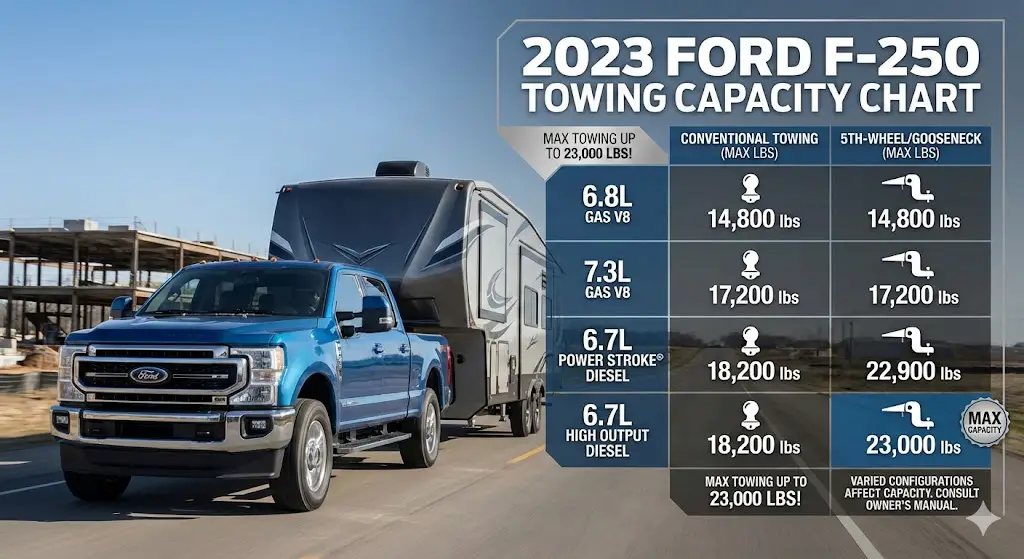
The 6.7L High Output Diesel is the undisputed king, capable of pulling up to 23,000 lbs with a gooseneck setup and the High Capacity Axle Upgrade Package.
3. The “Golden Ratio” Matrix
This is the chart you are looking for. Your towing capacity is strictly defined by the intersection of your Engine and your Axle Ratio. A higher numerical ratio (e.g., 4.30) provides more torque multiplication for heavier loads but may reduce fuel economy.
4×2 vs. 4×4: The Trade-off
It’s a common misconception that 4×4 always tows more. In reality, the added weight of the transfer case and front differential often slightly reduces maximum towing capacity compared to a 4×2 setup, as that weight eats into the GCWR (Gross Combined Weight Rating).
Hitch Type Matters
Conventional Towing
Weight carrying or weight distributing hitch attached to the rear bumper/frame. Maxes out around 18,200 lbs on the F-250.
5th Wheel / Gooseneck
Mounted in the truck bed over the rear axle. Unlocks the full potential, reaching up to 23,000 lbs with the HO Diesel.
Before You Haul: The Critical Checklist
Verify Door Sticker
Ignore the brochures. Your specific truck’s payload and towing limits are listed on the yellow/white sticker inside the driver’s door jamb.
Check GCWR
Calculate: (Truck Curb Weight + Passenger/Cargo Weight + Trailer Weight). This must never exceed your Gross Combined Weight Rating.
Tire Pressure
Heavy loads require max inflation. Ensure rear tires are at the PSI specified for “Heavy Load” on your tire placard.
Powertrain Architecture and Torque Management
The capability of any towing vessel is fundamentally limited by its ability to generate and manage force. The 2023 F-250 lineup features four distinct engine configurations, each engineered for a specific operational envelope. Unlike previous generations where engine choices were often a simple binary between “base gas” and “premium diesel,” the 2023 lineup offers a granular hierarchy of power plants.
The 6.8L V8: A New Foundation for Fleet Efficiency
For years, the 6.2L Boss V8 served as the entry-level standard for the Super Duty. In 2023, this was replaced by the all-new 6.8L V8, a strategic shift designed to improve low-end torque availability for commercial applications.
Engineering Design and Output
The 6.8L engine is a derivative of the larger 7.3L architecture, utilizing a pushrod design (overhead valve) rather than the overhead cam design found in the 5.0L Coyote engines. The pushrod design is favored in heavy-duty applications for its compact physical dimensions—allowing for better cooling airflow within the engine bay—and its inherent low-RPM torque characteristics.
- Horsepower: 405 hp
- Torque: 445 lb-ft 2
Towing Application Analysis
While 405 horsepower is robust, the critical metric for towing is the 445 lb-ft of torque. This engine is mated to the TorqShift-G 10-speed automatic transmission, a lighter-duty variant of the transmission found in the diesel models. The primary advantage of this engine is its weight; being significantly lighter than the diesel options, it preserves payload capacity. It is ideally suited for conventional towing loads in the 5,000 to 12,000-pound range, such as utility trailers,
medium-sized boats, and construction compressors. However, without forced induction, its performance is subject to atmospheric density; towing at high altitudes (e.g., the Eisenhower Tunnel) will result in noticeable power loss compared to turbocharged alternatives.
The 7.3L “Godzilla” V8: The Gas Towing Apex
The 7.3L V8, affectionately known as “Godzilla,” represents the pinnacle of modern gasoline heavy-duty performance. For 2023, Ford engineers refined the air intake and tuning to extract additional efficiency and power.
Performance Metrics
- Horsepower: 430 hp
- Torque: 485 lb-ft
The Mechanics of Gas Towing
The 7.3L engine bridges the gap between the standard gas engine and the diesel. With nearly 500 lb-ft of torque, it offers sufficient force to move 15,000-pound loads without the complexity and maintenance costs associated with modern diesel emissions systems (DPF, SCR, DEF). When paired with the 4.30 axle ratio, the 7.3L effectively utilizes the mechanical advantage of the gearing to multiply torque at the wheels, allowing for a maximum conventional towing capacity of up to 18,200 lbs. Real-world data suggests that while this engine is capable, heavy towing will result in fuel consumption figures in the single digits (8-9 MPG), a trade-off for the lower upfront acquisition cost.9
The 6.7L Power Stroke V8 Turbo Diesel (Standard Output)
The 6.7L Power Stroke has been the backbone of Ford’s heavy towing capabilities for over a decade. The 2023 iteration continues this legacy with enhancements to the fuel injection system to optimize combustion.
Specifications
- Horsepower: 475 hp
- Torque: 1,050 lb-ft
Diesel Dynamics
The defining characteristic of this engine is its torque curve. Unlike gas engines that require high RPMs to generate peak force, the Power Stroke delivers its massive 1,050 lb-ft of torque at low RPMs, allowing for a relaxed towing experience even with maximum loads. This engine is paired with the heavy-duty 10-speed TorqShift transmission, which features a wider gear ratio spread to keep the engine in its power band. For owners towing heavy 5th wheels or frequenting mountainous terrain, the standard diesel remains the logical choice due to its integrated exhaust braking, which provides essential deceleration control on downgrades.
The 6.7L High Output Power Stroke V8: Engineering Excess
New for 2023, the High Output (HO) variant is Ford’s answer to the escalating torque wars with Ram and GM. This is not simply a software tune; it involves hardware changes.
Technical Enhancements
The HO engine features a water-jacketed turbocharger to manage the extreme thermal loads generated by higher boost pressures. Additionally, stainless steel exhaust manifolds replace the standard cast iron components to improved durability under heat cycles.
- Horsepower: 500 hp
- Torque: 1,200 lb-ft
The F-250 Constraint
While the HO engine offers best-in-class numbers, its application in the F-250 SRW (Single Rear Wheel) chassis is a study in diminishing returns. The engine’s capability often exceeds the legal and structural ratings of the Class 2B truck. While it offers superior acceleration—clocking 0-60 mph in as little as 5.5 seconds, remarkable for a heavy-duty truck—the maximum towing capacities are often identical to the standard diesel due to suspension and tire limitations.11 The HO engine is less about unlocking new towing tiers on the F-250 and more about confidence, passing power, and maintaining speed on steep ascents.
Table 1: 2023 F-250 Engine Performance Overview
| Engine | Displacement | Configuration | Horsepower | Torque (lb-ft) | Max Conventional Towing (lbs)* | Max 5th-Wheel Towing (lbs)* |
| 6.8L Gas | 415 cu in | V8 Pushrod | 405 | 445 | 14,800 | 14,800 |
| 7.3L Gas | 445 cu in | V8 Pushrod | 430 | 485 | 18,200 | 17,200 |
| 6.7L Diesel | 406 cu in | V8 Turbo | 475 | 1,050 | 22,000 | 22,900 |
| 6.7L HO Diesel | 406 cu in | V8 Turbo | 500 | 1,200 | 22,000 | 23,000 |
Section 2: Chassis Engineering and Suspension Dynamics
To understand the towing chart, one must look beneath the sheet metal. The 2023 F-250 is constructed on a fully boxed high-strength steel frame, a design choice that provides the torsional rigidity necessary to resist twisting forces applied by heavy trailers.
The Aluminum Advantage
Ford continues to utilize high-grade aluminum alloy for the bodywork. While controversial upon its introduction, this material strategy has proven vital for towing. By shaving hundreds of pounds from the body weight, Ford engineers can reinvest that mass into the frame, axles, and suspension components without exceeding the Gross Vehicle Weight Rating (GVWR) limits. This weight redistribution is a key reason why the F-250 can offer competitive payload numbers despite its heavy-duty running gear.
Suspension Geometry
The F-250 employs a Twin-I-Beam front suspension on 4×2 models and a solid Mono-Beam axle with coil springs on 4×4 models. The rear suspension utilizes a solid axle with leaf springs.
- Ride vs. Capacity: The inherent conflict in heavy-duty truck design is balancing unladen ride quality with loaded stability. For 2023, Ford refined the spring rates to reduce the “empty truck bounce” common in this segment. However, softer springing can lead to greater rear-end squat under tongue load. This makes the proper setup of weight distribution hitches more critical than ever.
The “High Capacity” Axle Differentiation
One of the most confusing aspects for buyers is the difference between a standard F-250 and one equipped with the High Capacity Trailer Tow Package (Option Code 535).
- Standard Axle: The base F-250 utilizes the Sterling 10.5-inch rear axle. This axle is robust but is the limiting factor for the standard diesel tow ratings (typically capped around 20,000 lbs).
- Upgraded Axle: Selecting the High Capacity package on diesel models often swaps the rear axle for the Dana M275 (historically an F-350 component) or a reinforced version of the 11.6-inch axle, depending on the specific build date and configuration. This upgrade includes additional leaf springs and a massive increase in the Gross Combined Weight Rating (GCWR), effectively allowing the F-250 to mimic the towing capabilities of an F-350 Single Rear Wheel (SRW) truck.
- The “Paper” Truck: It is important to note that even with these upgrades, the F-250 often retains a 10,000-lb GVWR on its door sticker to satisfy Class 2B registration requirements in certain states, despite being mechanically identical to a truck rated for higher loads.
Detailed Analysis of Conventional Towing Capacities
Conventional towing, often referred to as “bumper pulling,” utilizes a receiver hitch attached to the rear frame. The 2023 F-250 charts reveal a strict hierarchy based on powertrain and axle ratio.
Gas Engine Conventional Limits
For the 6.8L and 7.3L engines, the limiting factor is often the torque multiplication available to get the load moving.
- 6.8L Limitations: With the 3.73 axle, the 6.8L engine tops out at 14,800 lbs for a Regular Cab 4×2. In the more popular Crew Cab 4×4 configuration, this drops to 14,400 lbs. While sufficient for most travel trailers, it falls short for heavy construction equipment.
- 7.3L and the 4.30 Axle: The 7.3L engine, when paired with the 3.55 axle, is limited to roughly 16,000-17,000 lbs. However, selecting the 4.30 electronic locking axle dramatically changes the equation. This deep gear ratio allows the engine to rev higher and apply more torque to the wheels, raising the conventional tow rating to 18,200 lbs. This makes the 7.3L with 4.30 gears a “unicorn” build—highly sought after by those who prefer gas but need diesel-like towing numbers. For more on axle identification, the is a vital resource for verification.
Diesel Engine Conventional Limits
The diesel engines are chassis-limited rather than power-limited.
- The 18,200 lb Baseline: Without the High Capacity Trailer Tow Package, most diesel F-250s are rated for a maximum of 18,200 lbs conventional towing. This limitation is due to the standard rear spring pack and hitch receiver rating.
- The 22,000 lb Ceiling: To unlock the headline-grabbing 22,000 lb conventional capacity, the truck must be equipped with the High Capacity Trailer Tow Package (535) and the diesel engine. This configuration reinforces the rear suspension and ensures the hitch receiver is rated for the immense tongue weight (approx. 2,200 lbs) associated with such a trailer.
Fifth-Wheel and Gooseneck Towing Capabilities
When the trailer weight exceeds 20,000 lbs, or when greater stability is required, towing moves to the bed-mounted hitches: 5th-wheel (for RVs) and Gooseneck (for agriculture/commercial). This places the pin weight directly over the rear axle, improving handling but imposing significant stress on the truck’s payload capacity.
The Gas vs. Diesel Divide
The disparity in capability between gas and diesel becomes a chasm in this category.
- Gas Limits: The 6.8L maxes out at 14,800 lbs, while the 7.3L peaks at 17,200 lbs. These numbers are respectable but clearly position the gas trucks for recreational 5th wheels rather than heavy industrial hauling.
- Diesel Dominance: The 6.7L diesel pushes the F-250 into territory that was, until recently, the exclusive domain of dually (DRW) trucks.
- Standard Diesel: Max capacity of 22,900 lbs.
- HO Diesel: Max capacity of 23,000 lbs.
Configuration Nuances
Achieving these maximum numbers requires a specific, often rare, configuration: a Regular Cab or SuperCab 4×2 with the High Capacity package.
- Crew Cab Reality: The ubiquitous Crew Cab 4×4 configuration is heavier, which reduces the Available Payload and GCWR. Consequently, a fully loaded Crew Cab Platinum diesel will likely have a maximum 5th-wheel tow rating closer to 19,000 – 20,000 lbs rather than the theoretical 23,000 lbs, simply because the truck itself weighs more.
- Short Bed vs. Long Bed: The short bed (6.75′) limits the turning radius with a 5th-wheel trailer, often requiring a sliding hitch which adds weight and cost. The long bed (8′) provides better clearance and stability, making it the preferred choice for dedicated tow vehicles. For a detailed breakdown of bed dimensions.
Table 2: 5th-Wheel/Gooseneck Towing Matrix (Selected Configurations)
| Cab Style | Drive | Engine | Axle Ratio | Max Towing (lbs) |
| Regular Cab | 4×2 | 6.7L HO Diesel | 3.31 | 23,000 |
| Regular Cab | 4×4 | 7.3L Gas | 4.30 | 18,200 |
| SuperCab | 4×4 | 6.7L Diesel | 3.31 | 22,500 |
| Crew Cab | 4×4 | 6.7L HO Diesel | 3.31 | 21,600 |
| Crew Cab | 4×4 | 6.8L Gas | 3.73 | 14,400 |
The Operational Reality: Payload Capacity
Perhaps the most critical, yet most overlooked, aspect of the “Towing Capacity” discussion is payload. The towing chart tells you what the engine can pull, but the yellow tire and loading information sticker on the door jamb tells you what the chassis can carry. For the F-250, payload is almost always the limiting factor before maximum towing capacity is reached.
The GVWR Constraint
The F-250 is a Class 2B truck, which traditionally limits its Gross Vehicle Weight Rating (GVWR) to 10,000 lbs. This is a regulatory threshold to avoid commercial registration fees and insurance requirements in many jurisdictions.
- The Math: GVWR – Curb Weight = Payload Capacity.
- The Diesel Penalty: The 6.7L diesel engine and its associated emissions equipment weigh approximately 800-900 lbs more than the gas engines. This mass is subtracted directly from the payload.
Trim Level Impact: XL vs. Platinum
The marketing brochures advertise a maximum payload of 4,268 lbs. This figure corresponds to a base model Regular Cab gas truck with no options. As you climb the trim ladder, payload evaporates.
- F-250 XL 6.8L Gas: A basic work truck might see payload numbers in the 3,800 – 4,100 lb range. This is sufficient for a heavy slide-in camper or a large 5th wheel pin weight.
- F-250 Lariat 7.3L Gas: With added comfort features, payload typically drops to the 3,100 – 3,500 lb range.
- F-250 Platinum/Limited Diesel: This is the critical danger zone for heavy towers. Loaded with massaging seats, a panoramic moonroof, power running boards, and the heavy diesel engine, the curb weight skyrockets. Real-world reports from owners show payload stickers as low as 2,000 – 2,400 lbs.
The 5th Wheel Trap
Consider a 15,000 lb 5th-wheel trailer. The pin weight (the weight pressing down on the truck bed) is typically 20-25% of the trailer weight.
- Calculation: 15,000 lbs * 0.22 = 3,300 lbs.
- Scenario: If you have a Platinum F-250 Diesel with a 2,200 lb payload capacity, you are 1,100 lbs overweight with this trailer, even though the “Towing Capacity Chart” says the engine can pull 22,000 lbs.
- Conclusion: For luxury trims pulling heavy 5th wheels, the F-350 (with its higher 11,500+ lb GVWR) is the necessary choice to remain legal and safe. The F-250 diesel is best suited for heavy conventional towing (where tongue weight is only 10%) or lighter 5th wheels.
The Tremor Off-Road Package Analysis
The Tremor package (Option Code 17Y) is designed to compromise between a dedicated rock crawler and a heavy-duty tow rig. However, physics demands trade-offs.
Mechanical Changes
The Tremor package includes 35-inch all-terrain tires, a 1.7-inch suspension lift, specialized off-road shocks with increased travel, and a shorter front air dam for improved approach angles.
Impact on Towing
The suspension tuning on the Tremor is softer to allow for axle articulation over obstacles. This compliance is the enemy of towing stability. Softer springs allow for more body roll and sway under heavy loads.
- Derated Capacity: Consequently, Ford derates the conventional towing capacity of Tremor models, typically capping them at 18,200 lbs, regardless of whether the high-output engine is selected.2
- Payload Reduction: The heavy wheels, tires, and skid plates reduce the available payload. A diesel F-250 Tremor often has a payload in the 2,700 – 3,100 lb range.
Use Case Recommendation
The Tremor is an exceptional vehicle for the adventurer towing a ruggedized travel trailer (e.g., Black Series or Airstream Basecamp) to remote locations. It is ill-suited for the long-haul RVer pulling a massive toy hauler on the interstate, where the standard suspension (or an F-350 DRW) would offer superior stability and confidence.
Technology and Safety Ecosystem
The 2023 F-250 mitigates the stress of towing through a suite of advanced driver-assistance systems (ADAS). These features shift the burden of calculation and precision from the driver to the silicon.
Onboard Scales and Smart Hitch
This feature addresses the payload anxiety discussed in Section 5. Sensors mounted on the suspension measure the compression and calculate the weight of the payload in real-time.
- Smart Hitch: When connecting a trailer, the system utilizes the taillights (which act as a progress bar) or the center screen to indicate the tongue weight. This ensures the load is balanced correctly—too little tongue weight causes sway; too much unloads the front steer tires.
Pro Trailer Hitch Assist
Utilizing the rear camera and artificial intelligence, this system identifies the trailer coupler. With the hold of a button, the truck automatically controls the steering, throttle, and brakes to reverse perfectly under the coupler. This eliminates the need for a spotter and the frustration of “re-adjusting” multiple times.
Navigation and Blind Spot Systems
The navigation system in the 2023 Super Duty can be programmed with the trailer’s dimensions (height, length, width). It will then route around low bridges and tight turns. Additionally, the Blind Spot Information System (BLIS) with Trailer Coverage extends the monitoring zone to include the length of the trailer, providing a visual warning in the side mirrors if a vehicle is lurking in the trailer’s blind spot during lane changes.
Hitch Receiver Classifications and Compatibility
A point of friction for many new 2023 owners involves the physical hitch receiver size. As trucks have grown more capable, the components connecting them to trailers have had to scale up.
The 2.5-Inch vs. 3-Inch Debate
- Standard F-250: The vast majority of F-250 models come equipped with a 2.5-inch Class V receiver. This receiver is rated for the truck’s maximum conventional towing capacity.
- The 3-Inch Receiver: The larger 3-inch receiver is typically reserved for F-350 Dually and F-450 models that tow upwards of 24,000+ lbs. However, some specific high-capacity configurations of the F-250 have been rumored or observed with 3-inch receivers, leading to confusion.
- The Sleeve Issue: Owners moving from an older F-350 to a new F-250, or vice versa, may find their ball mounts incompatible. While reducer sleeves (3″ to 2.5″) exist, they introduce “slop” and rattle into the connection. This movement can be amplified into sway. It is strongly recommended to purchase a ball mount with the correct shank size for the receiver rather than using adapters.
Weight Distribution Requirements
Ford specifies that a weight-distribution hitch is required for conventional loads exceeding a certain threshold (typically 5,000 lbs, though newer receiver designs are pushing this higher). The 2023 receiver label explicitly states the “Weight Carrying” vs. “Weight Distributing” capacities. Ignoring this and towing 15,000 lbs on the ball alone (“dead weight”) can compromise the hitch attachment points and dangerously unload the front suspension.
Real-World Performance and Maintenance
Data charts are theoretical; the road is the reality. How does the 2023 F-250 perform when the rubber meets the asphalt?
Fuel Economy Under Load
- Gas (7.3L): The Godzilla engine is a thirsty beast when working. Owners report 8-9 MPG when towing heavy loads (10,000+ lbs). Unloaded highway cruising yields 14-16 MPG. With the 34-gallon tank (standard on some cabs), range anxiety can be an issue on long towing legs.
- Diesel (6.7L): The diesel shines here, typically returning 11-13 MPG under similar heavy loads. Unloaded, it can achieve 19-21 MPG. This efficiency, combined with the available larger fuel tanks, provides a significantly longer towing range, reducing the frequency of stressful fuel stops with a large trailer.
Maintenance Considerations
Towing accelerates wear. The “Intelligent Oil Life Monitor” adjusts the oil change interval based on engine load and temperature. Heavy towing will shorten this interval significantly.
- Oil Reset: For instructions on managing this system, the offers a procedural overview applicable to the shared electronic architecture of the Super Duty.
- Diesel Emissions: The 6.7L engine consumes Diesel Exhaust Fluid (DEF). Under heavy towing, DEF consumption increases. Owners should always carry a spare jug of DEF. Furthermore, the Crankcase Ventilation Filter on the 6.7L is a critical maintenance item; neglect can lead to oil leaks. See the for details.
Comparison to Competitors
To contextualize the F-250’s standing, brief comparison is warranted.
- vs. Chevrolet Silverado 2500HD: The Chevy generally offers a superior independent front suspension ride but has historically trailed Ford in raw torque numbers. The 2024 Chevy refresh brings it closer, but the 2023 Ford HO diesel still holds the torque crown.
- vs. Ram 2500: The Ram uses coil-sprung rear suspension (or air suspension) which offers a smoother unladen ride than the Ford’s leaf springs. However, the Cummins engine in the 2500 is often derated compared to the 3500 version to protect the transmission, whereas Ford offers the full-fat HO diesel in the F-250.
Conclusion and Strategic Recommendations
The 2023 Ford F-250 is an engineering marvel that successfully pushes the boundaries of the Class 2B segment. It offers the power of a semi-truck from the 1990s with the interior luxury of a Lincoln. However, the “Towing Capacity Chart” is a map, not a guarantee.
Key Takeaways:
- The “High Capacity” Mandate: If you intend to tow over 18,000 lbs with an F-250 diesel, the High Capacity Trailer Tow Package (535) is not optional; it is a structural necessity.
- The Payload Check: For luxury buyers (Platinum/Limited), the F-250 is functionally limited by payload, not power. If towing a heavy 5th wheel (>13,000 lbs), stepping up to an F-350 SRW is the only way to ensure you are not legally overloaded.
- The Gas Renaissance: The 7.3L V8 with 4.30 gears is a legitimate alternative to diesel for many weekend warriors, offering substantial towing capability (18,200 lbs) without the emissions system complexities.
- Know Your Truck: Always verify the Door Jamb Sticker of the specific VIN before purchase. No brochure chart supersedes the legal rating stamped on the B-pillar of the vehicle.