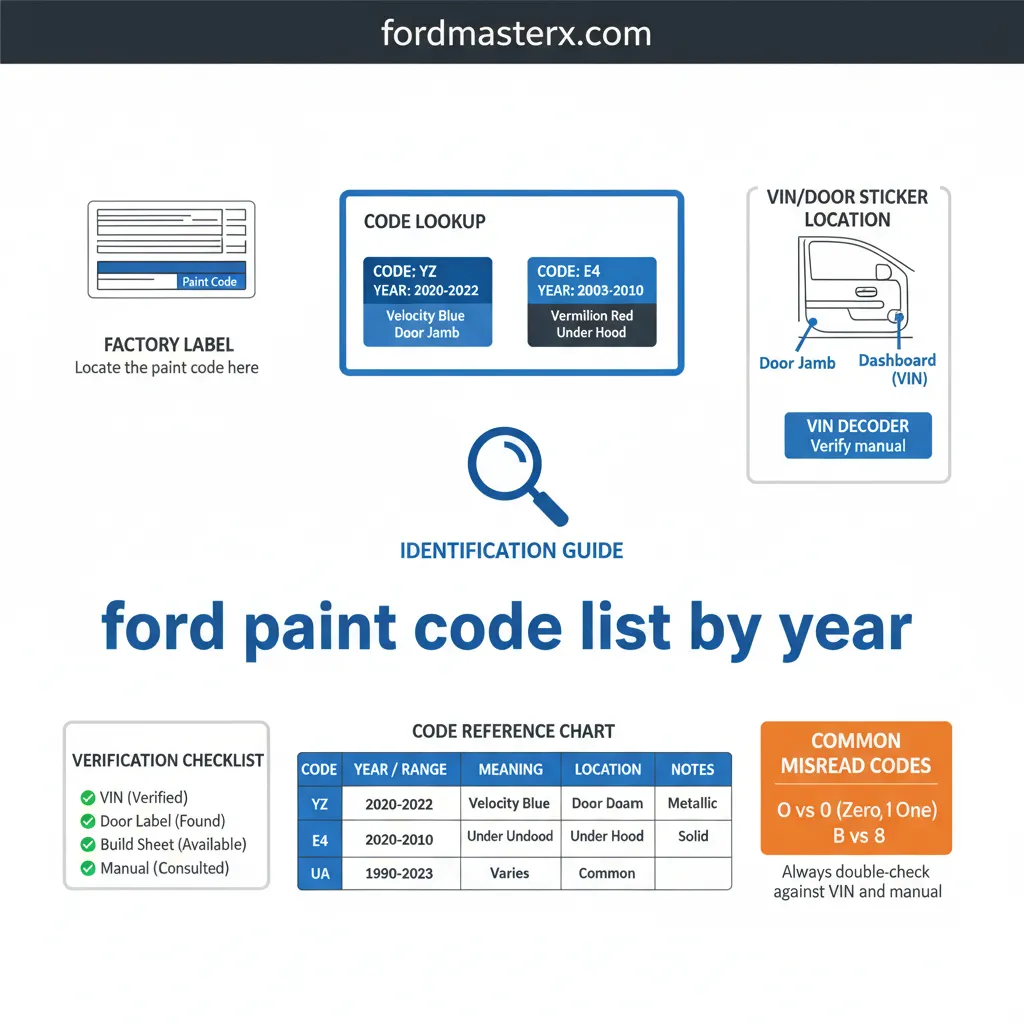
Ford Code Chart By Year: Identification Guide

Quick Answer
Ford paint codes are alphanumeric identifiers found on the vehicle’s door jamb, VIN sticker, or owner’s manual, crucial for color matching. This comprehensive chart details Ford paint codes by model year, spanning from early models through 2026, offering essential factory specification data. Always cross-reference the listed codes with your vehicle’s specific identification labels to ensure accuracy for repaints or repairs.
Identifying the correct paint code for your Ford vehicle is paramount for accurate color matching during repairs or restoration projects. Without the precise factory paint code, achieving an undetectable blend can be challenging, often leading to noticeable color discrepancies that detract from the vehicle’s aesthetic value. This expert guide provides a comprehensive Ford paint code chart by year, encompassing available models through 2026, alongside detailed instructions on where to locate and how to verify your specific vehicle’s paint identification for flawless results. Ford has utilized various paint coding systems over the decades, making accurate, year-specific identification critical for any paint work.
This chart compiles common Ford paint codes for a broad range of models from the late 1960s through the projected 2026 model year, reflecting factory specifications. While comprehensive, specific engine configurations or trim levels typically do not alter primary paint codes, though special editions might feature unique colors. Always cross-reference the code found on your vehicle’s physical label (door jamb, build sheet) with this chart and, ideally, a Ford service manual for absolute verification, as minor regional variations or special orders can occur. This guide focuses on standard production codes, and custom or aftermarket paint jobs are not covered. Last reviewed: May 2026.
Main Ford Paint Code Chart by Year (Available through 2026)
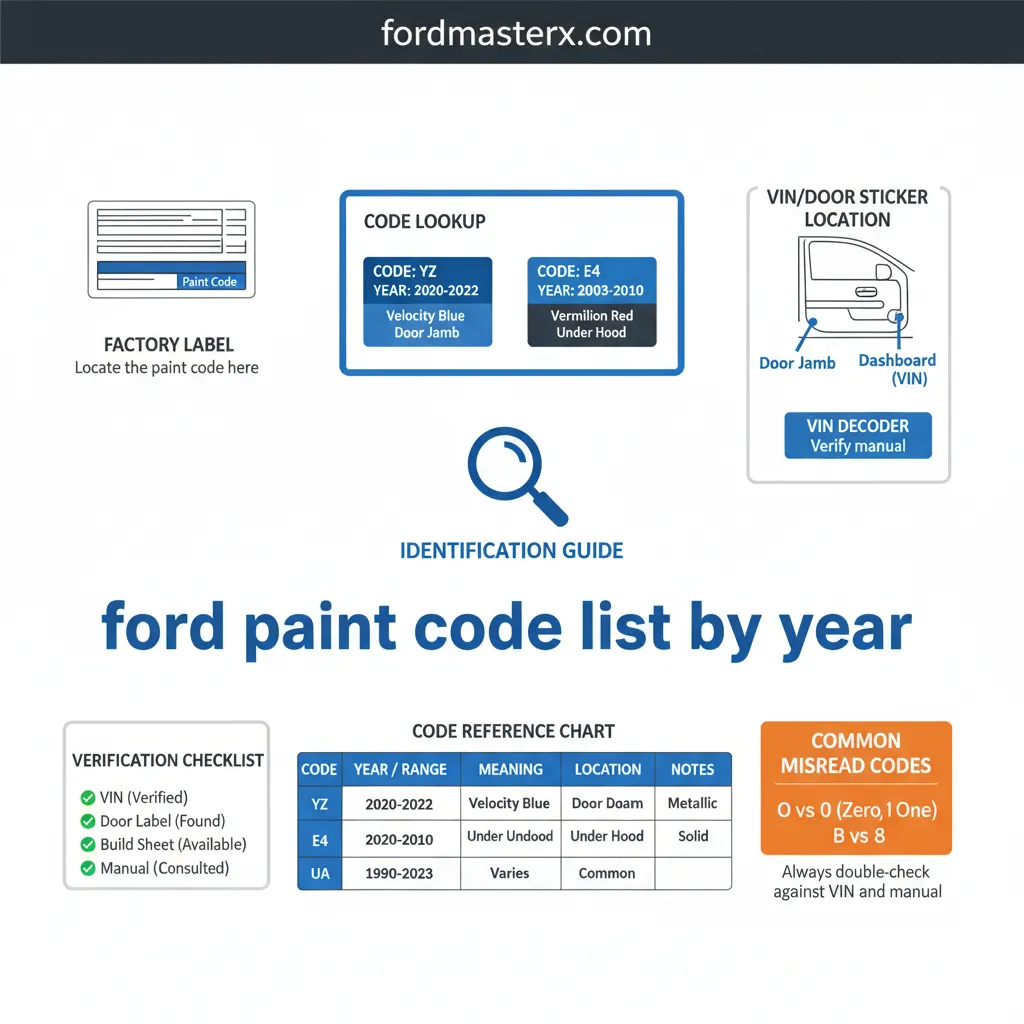
The following table provides a comprehensive listing of Ford paint codes, organized by their typical year of application, alongside their corresponding color names and common locations. This chart serves as your primary reference for identifying your vehicle’s original factory paint. Note that codes can be alphanumeric and sometimes a single code may represent multiple colors across different eras, making the ‘Year / Range’ column critical. While we strive for accuracy, always verify with your vehicle’s physical label.
| Code | Year / Range | Meaning | Location | Notes |
|---|---|---|---|---|
| A | 1965-1970 | Raven Black | Warranty Plate / Door Tag | Single character for early models. |
| M | 1967-1972 | Wimbledon White | Warranty Plate / Door Tag | Classic solid white. |
| YZ | 1994-2026 | Oxford White | Driver’s Door Jamb Sticker (EXT PNT) | Most common white, used across many models. |
| UA | 2000-2026 | Ebony / Shadow Black | Driver’s Door Jamb Sticker (EXT PNT) | Solid black, sometimes rebranded as ‘Shadow Black’. |
| L2 | 2007-2014 | Liquid Grey Metallic | Driver’s Door Jamb Sticker (EXT PNT) | Common metallic grey on various models. |
| JS | 2010-2018 | Ingot Silver Metallic | Driver’s Door Jamb Sticker (EXT PNT) | Popular silver finish. |
| FX | 2013-2020 | Ruby Red Metallic Tinted Clearcoat | Driver’s Door Jamb Sticker (EXT PNT) | Multi-stage paint, deep metallic red. |
| R3 | 2015-2026 | Race Red | Driver’s Door Jamb Sticker (EXT PNT) | Vibrant solid red, modern iteration. |
| E4 | 2018-2026 | Velocity Blue Metallic | Driver’s Door Jamb Sticker (EXT PNT) | Dynamic metallic blue, popular on trucks/SUVs. |
| RR | 2021-2026 | Rapid Red Metallic Tinted Clearcoat | Driver’s Door Jamb Sticker (EXT PNT) | Replaced Ruby Red, also multi-stage. |
| AZ | 2024-2026 (Est.) | Carbonized Gray Metallic | Driver’s Door Jamb Sticker (EXT PNT) | Newer metallic grey, appearing on current models. |
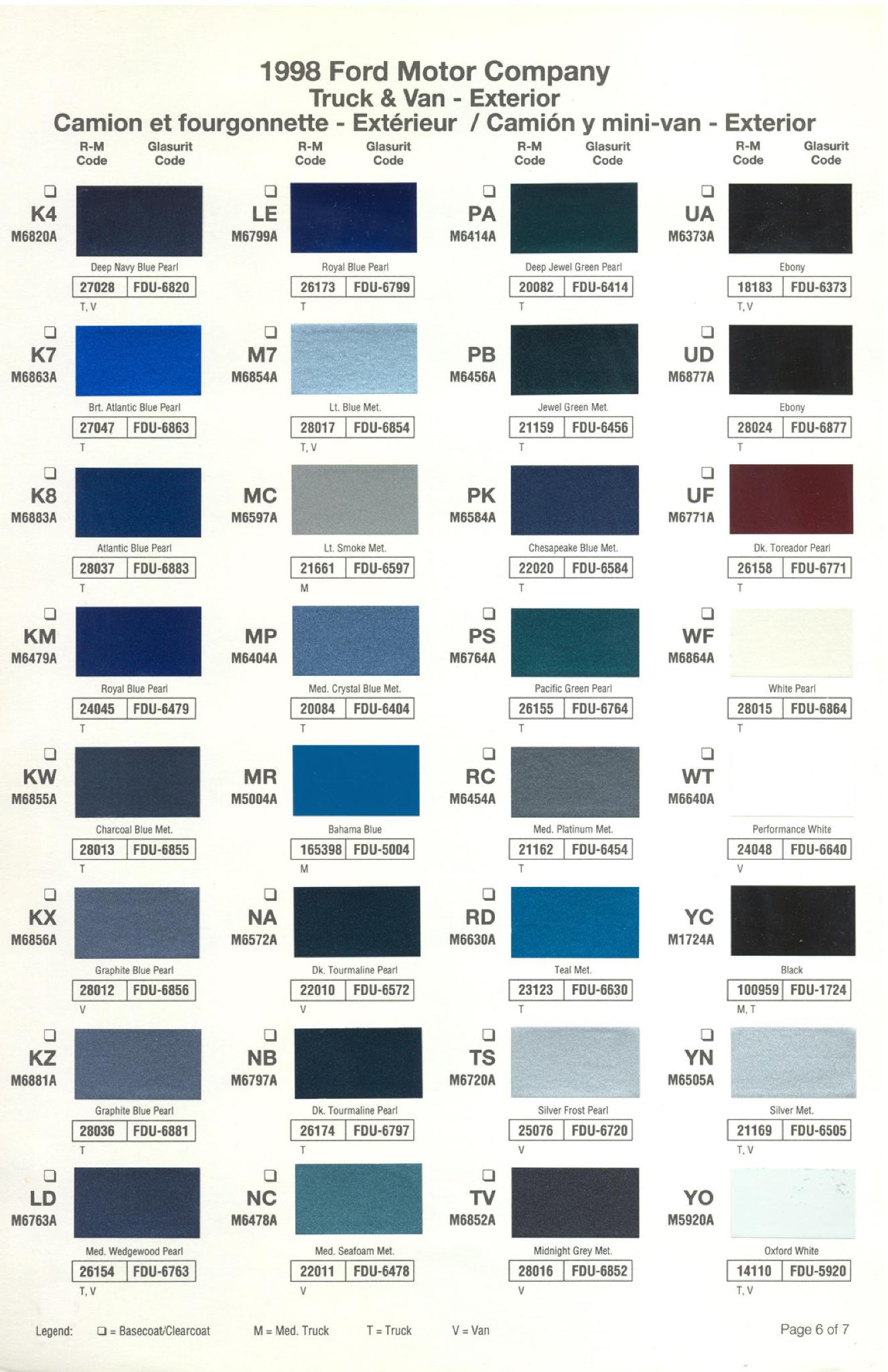
Locating Your Ford Paint Code: A Practical Guide
Accurately identifying your Ford’s paint code begins with knowing where to look. Ford, like most manufacturers, places this vital information in consistent locations. The most reliable primary source is almost always on the vehicle itself.
Primary Location: Driver’s Side Door Jamb
For most Ford vehicles from the 1980s onward, your paint code will be found on a sticker affixed to the driver’s side door jamb or the edge of the driver’s door itself (often referred to as the B-pillar sticker). This label is typically white or silver and contains a wealth of vehicle data, including the VIN, manufacturing date, GVWR, and tire pressure information. The paint code is usually identified by labels such as ‘EXT PNT’, ‘Paint’, or simply a two-character code directly under the vehicle information section. Prior to the 1980s, you might find a single character code on a Warranty Plate or Door Tag.
Alternative Verification Sources
While the door jamb sticker is paramount, other resources can corroborate or provide the code:
- Owner’s Manual: Many owner’s manuals include a specifications section or a dedicated page where the original paint code is listed. Always check the index or table of contents for “Paint Code” or “Color Information.”
- Original Build Sheet/Window Sticker: If you have access to the vehicle’s original build sheet, window sticker (Monroney Label), or sales invoice, the factory paint code is almost always present there.
- VIN Decoding (Limited): While a VIN decoder will provide extensive information about your vehicle, it less frequently offers a direct, explicit paint code. Some advanced dealer-level decoders might provide this, but it’s not a common public resource for direct paint code lookup.
It’s crucial to distinguish the paint code from other codes on the label, such as interior trim codes, manufacturing plant codes, or accessory codes, which can look similar in format.
Check the driver’s side door jamb or door edge. Look for ‘EXT PNT’ or a two-character code.
Consult the specifications section or index for “Paint Code” information.
Locate the original build sheet or window sticker for factory-listed paint codes.
If all else fails, a Ford dealership can often retrieve the code using your VIN.

Understanding Ford Paint Code Variations Through the Years
Ford’s paint coding system has evolved significantly over its long history, reflecting changes in manufacturing processes, color trends, and technological advancements in paint formulations. Understanding these year-by-year changes is crucial for accurate interpretation.
Evolution of the Coding System
In earlier Ford models, particularly from the 1960s and 1970s, paint codes were often simpler, consisting of a single letter or number (e.g., ‘A’ for Raven Black, ‘M’ for Wimbledon White). As automotive paint technology advanced and color palettes expanded, Ford transitioned to a more standardized two-character alphanumeric system, which became prevalent from the 1980s onwards. This system, which often combines letters and numbers (e.g., ‘YZ’ for Oxford White, ‘UA’ for Ebony), provides greater specificity for the myriad of colors and finishes.
Code Reuse and Color Evolution
A common challenge in deciphering Ford paint codes is the occasional reuse of a code for an entirely different color across different model years or vehicle lines. For instance, a code used for a specific blue in the 1970s might reappear for a beige in the 2000s. This underscores the critical importance of associating the paint code with the correct model year. Furthermore, even for consistently named colors like “Black” or “White,” the underlying paint formulation and finish characteristics have changed. The introduction of clear coats, metallic flakes, and pearl finishes means an ‘Oxford White’ from 1995 might have a slightly different hue or depth than an ‘Oxford White’ from 2015, despite sharing the same code. This is due to evolving pigment technologies and multi-stage application processes.
Special Editions and Unique Finishes
Certain special edition vehicles, performance trims (e.g., Mustang SVT Cobra, Shelby GT500), or specific trim levels (e.g., Raptor, King Ranch) have historically featured unique or limited-run paint codes. These colors might not be found on standard production models and can sometimes be complex multi-stage paints. Iconic colors like “Grabber Blue” or “Candy Apple Red” have had various iterations and corresponding codes over the decades, often associated with specific performance models, further highlighting the need for year-by-year context.
By The Numbers: Ford Paint Code Evolution
Years of 2-Char Codes (est.)
Older Labels Illegible (est.)
Shift to Alphanumeric Codes
Complex Finishes (e.g. Ruby Red)
(Illustrative data based on industry observations and historical trends)
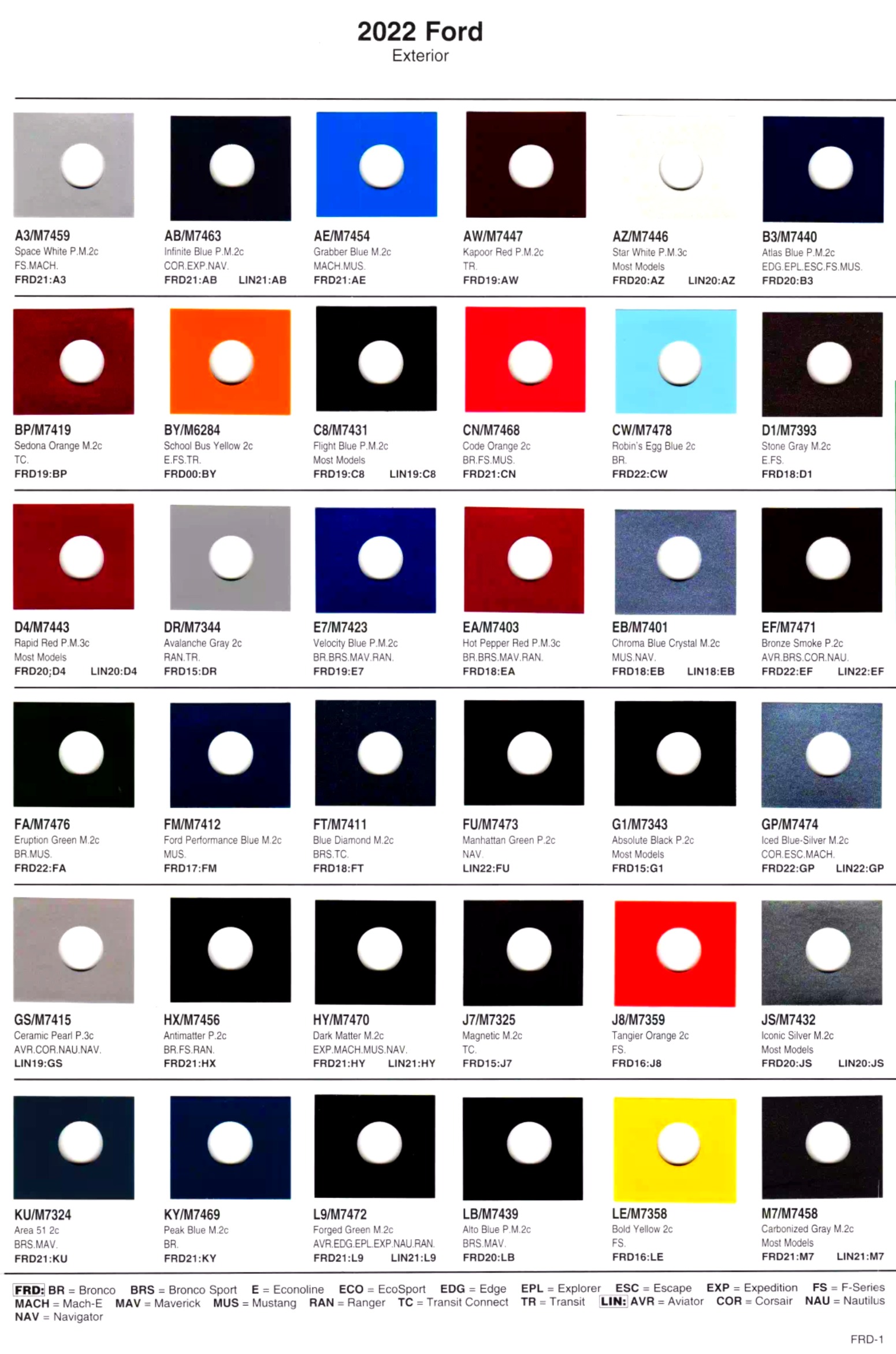
Verifying Your Ford Paint Code for Accuracy
Once you’ve located a potential paint code, a critical step is to verify its accuracy. Misinterpreting a code or relying on incorrect information can lead to costly and visually disappointing paint matching errors. A systematic verification process is highly recommended.
The Verification Checklist
To ensure you have the correct code, cross-reference information from multiple reliable sources:
Always start with the physical label on your vehicle. This is the most direct factory specification.
Cross-reference the code with your specific model year’s owner’s manual for confirmation.
If available, the original factory documentation provides definitive proof of the paint code.
Ford dealerships can use your VIN to access official service manuals and confirm codes.
Dealing with Discrepancies and Illegible Labels
If you encounter conflicting information between sources, or if your door jamb label is missing, damaged, or illegible (a common issue for approximately 5-10% of older vehicles due to wear or previous repairs), professional assistance is advisable. A Ford dealership can often retrieve the original build data using your VIN. For the most accurate color matching, especially for older or aged paints, a professional automotive paint supplier or body shop can use spectrophotometers – specialized tools that analyze the existing paint’s exact color composition – to create a custom match.
Be wary of similar-looking alphanumeric codes. For example, ‘I’ can be mistaken for ‘1’, ‘O’ for ‘0’, or ‘Z’ for ‘2’. Always double-check characters carefully. Relying solely on general online databases without physical verification can lead to errors, as these might not account for year-specific nuances or regional differences. Non-factory repaints will also render the original code irrelevant for matching the current finish.
Factors Influencing Ford Paint Code Application and Interpretation
Beyond the literal code, several external and internal factors can subtly influence how a Ford vehicle’s paint appears and how its code should be interpreted for repair or restoration.
Factory Options and Trim Packages
While the primary exterior color typically carries a single paint code, certain factory options and special trim packages can introduce unique paint schemes or accents. For instance, specific two-tone paint options on older F-Series trucks would have separate codes for the upper and lower colors. Modern vehicles might feature exclusive colors tied to performance models, like Ford Performance Blue often seen on ST or RS models, which may not be available on base models. These unique configurations require careful attention to detail.
Regional Market Differences and Production Variations
Ford is a global manufacturer, and subtle variations can exist due to regional market requirements or differences between production facilities. Although rare for primary colors, a paint code in Europe might have a slightly different formulation or associated shade compared to the same code produced for the North American market, influenced by local regulations or supplier availability. Even within the same production line, minor batch-to-batch differences in paint mixture can result in microscopic shade variances that are not reflected in the single paint code but can be noticeable to a trained eye.
The Impact of Paint Aging and Environmental Factors
Automotive paint is not static; it ages. Exposure to UV radiation, environmental pollutants, harsh weather, and even washing practices can cause the original factory color to fade, oxidize, or shift over time. This phenomenon means that even a perfectly matched paint from the original code might not blend seamlessly with an aged panel on an older vehicle. This is particularly true for colors with metallic or pearl finishes, which are also prone to metamerism – appearing differently under various lighting conditions (e.g., sunlight vs. fluorescent light). For these reasons, professional body shops often ‘blend’ new paint into adjacent panels to achieve an undetectable repair, rather than aiming for a perfect edge-to-edge match based solely on the code.
For older vehicles or complex metallic/pearl finishes, even with the correct paint code, a direct panel-to-panel match can be difficult due to paint aging and metamerism. Always discuss ‘paint blending’ with your body shop. This technique involves extending the repair paint onto adjacent panels, gradually fading it out to create an invisible transition and ensure a seamless repair.
Frequently Asked Questions About Ford Paint Codes
Can I use a VIN decoder to find my Ford paint code?
While a VIN (Vehicle Identification Number) decoder provides extensive vehicle information, it typically does not directly yield the specific paint code. The VIN confirms details like model year, engine, and trim level, but the paint code is usually found on a separate label or documentation. For the most accurate paint code, always refer to the door jamb sticker or the owner’s manual.
What if my door jamb sticker is missing or unreadable?
If your door jamb label is missing or illegible, your next best steps are to check your owner’s manual, original build sheet, or window sticker. If these are unavailable, a Ford dealership can often retrieve the original paint code using your VIN through their internal service systems. For very old vehicles or those with custom paint, a professional paint shop can use color-matching technology to identify the closest match.
Do special edition Fords have different paint codes?
Yes, often. Special edition Fords, performance models (like Shelby Mustangs or F-150 Raptors), or specific trim levels sometimes feature unique colors or multi-stage paint processes that are not found on standard models. These will typically have their own distinct paint codes listed on the vehicle’s identification label, separate from common production colors.
Why does my Ford’s paint look different from the freshly mixed paint, even with the correct code?
This is a common issue primarily due to paint aging. Over time, UV exposure, environmental elements, and even cleaning can cause your vehicle’s original paint to fade or shift slightly. Modern metallic and pearl paints are also susceptible to metamerism, meaning they can appear different under varying light sources. A professional body shop will often use techniques like paint blending to ensure a seamless color transition.
Can a single paint code represent two different colors in different years?
Yes, this can occur, especially with older codes or across significant model year gaps. Ford has, at times, reused specific alphanumeric codes for entirely different colors. This is why the ‘Year / Range’ column in any paint code chart is crucial; always ensure the code you find matches the correct model year of your vehicle.
Ford paint codes are essential for accurate color matching, identifiable primarily via door jamb labels or owner’s manuals. The presented chart offers a detailed year-by-year reference of factory paint codes through 2026, including their meanings and common applications. Verification through multiple sources, including VIN decoding and professional consultation, is critical to ensure precise code identification, especially for older or custom-painted vehicles. Utilize this comprehensive Ford paint code guide to confidently identify your vehicle’s exact color specification, and always perform a final physical verification for optimal repair and restoration outcomes.
Frequently Asked Questions
Where is the paint code located on my Ford?
The primary location for your Ford’s paint code is typically on the driver’s side door jamb or door edge sticker, often labeled ‘EXT PNT’ or ‘Paint’. This sticker, usually white or silver, also contains the VIN and other crucial vehicle information. For some models, it might also be referenced in the owner’s manual under the vehicle specifications section.
Can Ford paint codes be reused for different colors?
Yes, Ford has historically reused certain paint codes for entirely different colors across different model years or vehicle lines. For instance, a code used for a specific blue in the 1970s might later be assigned to a beige in the 2000s. Therefore, knowing the exact model year is crucial when cross-referencing paint codes.
What if my Ford’s paint code sticker is missing or unreadable?
If your Ford’s paint code sticker is missing or illegible, first check the owner’s manual or the original build sheet/window sticker. You can also contact a Ford dealership with your VIN; they often have access to factory build data. For older vehicles, a professional automotive paint supplier can use color-matching technology to identify the shade.
Do special edition Ford models have unique paint codes?
Yes, special edition Ford models, such as certain Mustang Shelby variants or F-150 Raptor editions, can feature unique or limited-run paint codes that are not available on standard models. These exclusive colors are typically documented in their respective model’s specifications or through specialized Ford performance literature, distinct from common production paints.
How do I ensure the paint color matches perfectly even with the correct code?
Even with the correct paint code, achieving a perfect match requires careful blending due to factors like paint fade, clear coat variations, and production batch differences. Always use a reputable paint supplier, test the color on a discrete area, and consider professional blending techniques if painting adjacent panels. Modern spectrophotometers can also help fine-tune the color formula.