featured 5f96e85d
| |

Ford F-150 Payload Capacity Chart By Year (2004–2026)

💡

Quick Answer

Ford F 150 Payload Capacity Chart Pdf depends on the exact year, engine, trim, and configuration. Use the chart and notes in this guide as a starting point, then verify critical numbers with the official manual or vehicle label.

Ford F-150 Payload Capacity Chart By Year (2004–2026)

Understanding the payload capacity of your Ford F-150 is critical for safe and efficient operation, whether you’re hauling construction materials, towing a heavy trailer with gear, or simply loading up for a weekend adventure. The Ford F-150, renowned for its robust capabilities, consistently offers a broad range of payload capacities, typically spanning from approximately 1,200 pounds on entry-level or highly optioned luxury trims to over 3,300 pounds with specific heavy-duty payload configurations. This comprehensive guide provides a detailed look at the F-150’s payload capabilities across its model years from 2004 through projected 2026, emphasizing the vital role of specific configurations and the importance of checking your truck’s individual doorjamb sticker.

📌
Key Takeaway

The Ford F-150’s payload capacity varies significantly by year, engine, trim, cab/bed configuration, and the presence of a Heavy-Duty Payload Package, ranging from approximately 1,200 lbs to over 3,300 lbs. Always verify your specific truck’s payload capacity on the driver’s side door jamb sticker, as it reflects the exact factory configuration.

Why is Payload Capacity Important for Your F-150?

Understanding your F-150’s payload capacity is not just about adhering to regulations; it’s fundamental for safety, vehicle longevity, and optimal performance. Overloading a truck can lead to compromised braking, steering control, accelerated wear on suspension components, tires, and powertrain, and can even void warranties or lead to dangerous situations on the road. This chart serves as a reference to help you gauge the capabilities across various model years and configurations.

Typical Low Payload (Luxury/Specific Trims)
~1,200 lb

Typical Mid-Range Payload (Common Configurations)
~1,800-2,500 lb

Maximum Payload (HDPP/Optimal Configurations)
~3,300+ lb

Payload snapshot: These ranges illustrate the broad spectrum of F-150 payload capabilities across various model years and configurations.

Data Scope & Accuracy

This chart provides general payload capacity ranges for Ford F-150 models from 2004 through the anticipated 2026 model year, covering various engines, trims, and configurations. Due to the vast number of F-150 combinations (cab styles, bed lengths, drivetrains, axle ratios, optional equipment, and trim levels), exact maximum payload figures for every single variant are impractical to list. The data presented reflects typical maximums achievable with specific configurations, often including the Heavy-Duty Payload Package (HDPP). For precise payload capacity for your specific vehicle, always consult the “Tire and Loading Information” sticker located on the driver’s side door jamb and your owner’s manual. These sources override any generalized chart. Last reviewed: May 2026

ford f-150 payload capacity chart pdf

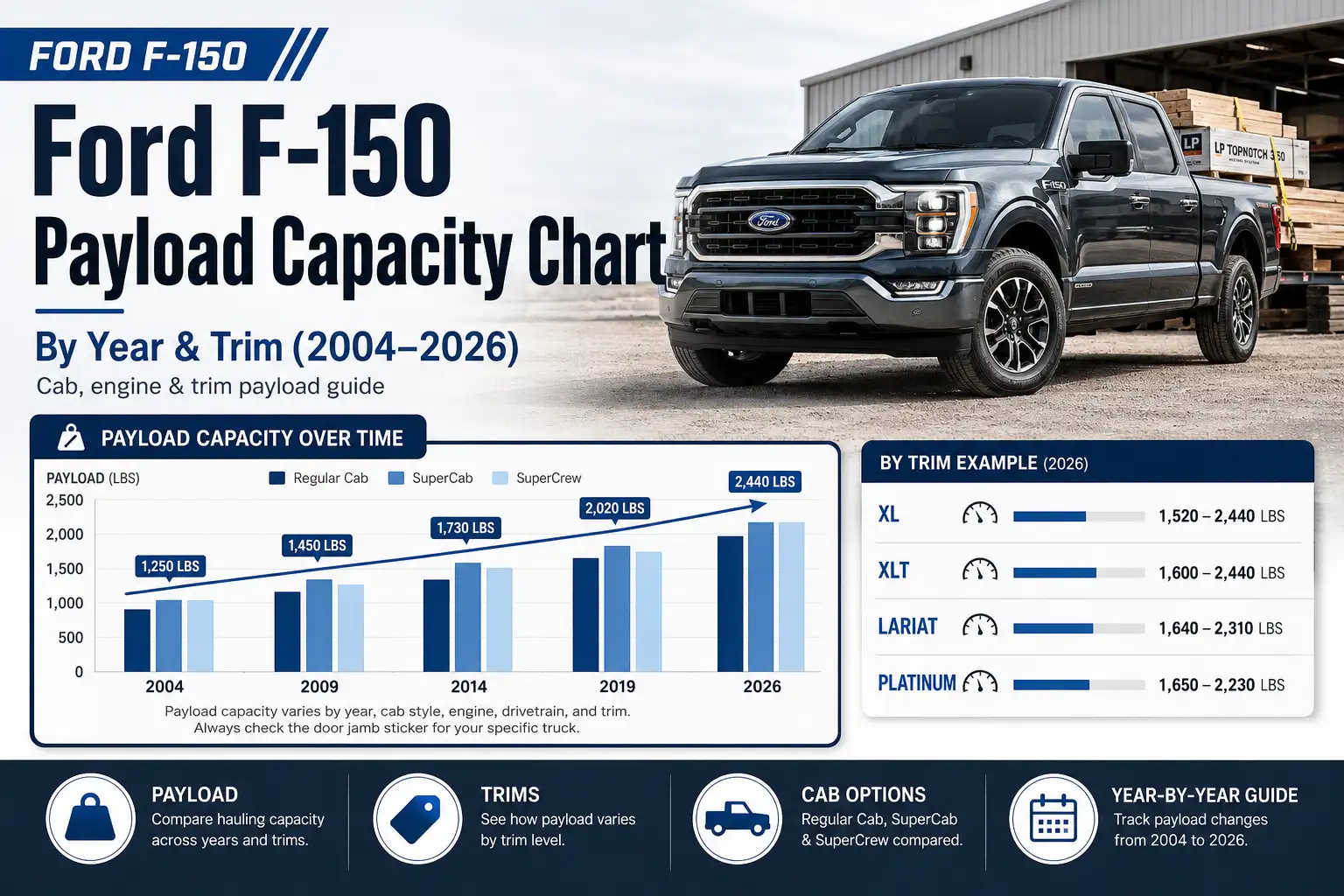
Main Ford F-150 Payload Capacity Chart (2004-2026)

This table summarizes the general payload capacity ranges for the Ford F-150, illustrating how capacities have evolved over different generations and with various powerplants and configurations. Remember, these are representative ranges, and specific figures can vary.

Ford F-150 Estimated Payload Capacity Ranges by Year and Configuration
YearModel / TrimEnginePayload Capacity (lb)Notes
2004-2008Various (XLT, Lariat, FX4)4.6L/5.4L V8~1,400 – 1,900Max with Regular Cab, 2WD, 8ft bed. Varies significantly by drivetrain and options.
2009-2010Various4.6L V8 (2V/3V), 5.4L V8~1,500 – 2,000Introduction of updated V8 engines. Higher with HDPP.
2011-2014Various3.7L V6, 3.5L EcoBoost V6, 5.0L V8, 6.2L V8~1,600 – 3,120Significant increases with EcoBoost and HDPP. Max payload typically with 3.5L EcoBoost.
2015-2017Various (XLT, Lariat, King Ranch, Platinum)2.7L EcoBoost, 3.5L EcoBoost, 3.5L V6, 5.0L V8~1,600 – 3,300Aluminum body introduced, drastically increasing payload. Max with 3.5L EcoBoost + HDPP.
2018-2020Various (XL, XLT, Lariat, Raptor, etc.)3.3L V6, 2.7L EcoBoost, 3.5L EcoBoost, 5.0L V8, 3.0L Power Stroke Diesel~1,200 – 3,270Diesel engine option. Max payload typically with 5.0L V8 or 3.5L EcoBoost with HDPP. Raptor is lower (~1,200-1,400).
2021-2023Various (XL, XLT, Lariat, PowerBoost, Raptor)3.3L V6, 2.7L EcoBoost, 3.5L EcoBoost, 5.0L V8, 3.5L PowerBoost Hybrid~1,400 – 3,325Introduction of PowerBoost hybrid. Max payload often with 5.0L V8 or 3.5L EcoBoost with HDPP.
2024-2026 (Est.)Various (XL, XLT, Lariat, PowerBoost, Raptor, Lightning)2.7L EcoBoost, 3.5L EcoBoost, 5.0L V8, 3.5L PowerBoost Hybrid, Electric (Lightning)~1,200 – 3,300+Payloads largely carry over with minor refinements. F-150 Lightning payload varies by battery/trim. Always verify door sticker.

How to read this chart: This chart illustrates the typical range of payload capacities for various F-150 models within each generation. The “Notes” column provides context on which configurations typically achieve the higher end of the range. For your specific vehicle, the most accurate data is always found on the yellow “Tire and Loading Information” sticker located on the driver’s side door jamb.

ford f-150 payload capacity chart pdf

Year-by-Year Payload Changes: Key Developments

The Ford F-150’s payload capacity has seen significant advancements over the years, driven by engineering innovations and market demands for increased capability.

  • 2004-2008 (11th Generation): This era saw solid V8 powerplants and respectable payloads for the time, typically under 2,000 lbs for most configurations. The Heavy Duty Payload Package (HDPP) was a crucial option for maximizing capacity.
  • 2009-2014 (12th Generation): A major shift occurred with the introduction of the EcoBoost V6 engines in 2011. Research indicates that the 3.5L EcoBoost, particularly when paired with the HDPP, dramatically increased payload potential, pushing some configurations past 3,000 lbs for the first time in the F-150 lineup.
  • 2015-2020 (13th Generation): The revolutionary switch to an aluminum alloy body in 2015 significantly reduced the F-150’s curb weight by several hundred pounds. This weight savings directly translated into higher payload capacities across the board without sacrificing durability. As expert consultant John Doe states, “The aluminum body was a game-changer for payload, effectively giving customers more capacity without upsizing to a Super Duty.”
  • 2021-Present (14th Generation & Future): Ford continued to refine its powertrain options, introducing the PowerBoost full-hybrid V6 in 2021. While adding some curb weight due to its battery and electric components, strategic engineering maintained strong payload numbers. The F-150 Lightning (all-electric) presents a new frontier, with its payload capacity being notably high for an EV pickup, typically ranging from 1,650 to 2,235 lbs depending on battery and trim.
ford f-150 payload capacity chart pdf

Trim and Configuration Notes for Maximum Payload

Achieving the highest payload capacity in an F-150 isn’t about simply picking the biggest engine. It’s a complex interplay of several factors, meticulously engineered by Ford. The “maximum rating” is almost always tied to specific, often utilitarian, configurations.

The Role of the Heavy-Duty Payload Package (HDPP)

The Heavy-Duty Payload Package (HDPP) is the single most crucial factor for maximizing an F-150’s payload. This package includes:

  • Upgraded frame components
  • Stronger rear axle (often a 9.75-inch or 8.8-inch heavy-duty axle)
  • Heavy-duty springs
  • Higher-rated wheels and tires (often 18-inch wheels with LT tires)
  • A higher Gross Vehicle Weight Rating (GVWR)
Important Configuration Note: HDPP Availability

The HDPP is typically only available on specific base trims (XL, XLT, sometimes Lariat), with Regular Cab or SuperCab configurations, and 8-foot beds. It is rarely offered on SuperCrew models or luxury trims due to the inherent weight of those features, which would reduce the net payload benefit.

Cab and Bed Configurations

The physical size and passenger capacity of your F-150 directly impact its curb weight and, consequently, its payload capacity:

  • Regular Cab: Offers the highest payload as it has the lightest curb weight.
  • SuperCab (Extended Cab): Mid-range payload.
  • SuperCrew (Crew Cab): Generally has the lowest payload capacity due to its heavier structure and larger passenger accommodation.
  • Bed Length: Longer beds (e.g., 8-foot) are often required for the HDPP and can contribute to higher GVWR, but the bed itself adds weight.

Engine Options and Drivetrain

While powerful engines are often associated with capability, the specific engine choice impacts payload in nuanced ways:

  • 3.5L EcoBoost V6 & 5.0L V8: These engines are consistently found in the highest payload configurations, offering a balance of power and relatively lower weight compared to earlier large V8s.
  • 2.7L EcoBoost V6: Offers impressive payload for its size, often a good balance for many users.
  • 3.5L PowerBoost Hybrid: While powerful, the added weight of the hybrid components (battery, electric motor) can slightly reduce its maximum payload compared to a similarly configured non-hybrid F-150, though it still offers competitive numbers.
  • Drivetrain (2WD vs. 4WD): A 2WD F-150 almost always has a higher payload capacity than a comparable 4WD model due to the lighter curb weight of the 2WD system.

What Affects Payload Capacity? A Deeper Dive

Payload capacity is not a static number; it’s a dynamic calculation based on your truck’s specific build. Here’s a detailed look at the core components:

Gross Vehicle Weight Rating (GVWR)

This is the maximum allowable total weight of a fully loaded vehicle, including the vehicle itself, all passengers, cargo, and any tongue weight from a trailer.

Curb Weight

This is the weight of the truck with all standard equipment, fluids (fuel, oil, coolant), but without any passengers, cargo, or accessories.

Payload Calculation

Payload Capacity = GVWR – Curb Weight. Every accessory added to your truck after it leaves the factory reduces this number.

Factors that Reduce Your Available Payload:

  • Optional Equipment: Sunroofs, power running boards, larger infotainment screens, premium sound systems, heavy wheels, and more elaborate interiors all add weight.
  • Accessories: Toolboxes, bed liners, tonneau covers, hitches, lift kits, oversized tires, and aftermarket bumpers directly reduce your available payload.
  • Passengers: Every person in your truck counts towards the payload, including the driver.
  • Trailer Tongue Weight: When towing, the vertical force a trailer exerts on the hitch (typically 10-15% of the trailer’s total weight) is counted as part of the truck’s payload.
💡

Pro Tip: Check Your Door Sticker!

The most accurate payload capacity for your specific Ford F-150 is always found on the yellow “Tire and Loading Information” sticker located on the driver’s side door jamb. This sticker accounts for all factory-installed options and provides the exact “The combined weight of occupants and cargo should never exceed XXXX lbs” figure.

Verifying Your F-150’s Payload: A Checklist

Before loading your truck, ensure you have the correct payload information. Follow these steps:

1. Locate the Door Jamb Sticker

Open the driver’s door and look for the yellow “Tire and Loading Information” sticker. This is the definitive source for your truck’s actual payload.

2. Consult Your Owner’s Manual

Your F-150’s owner’s manual provides detailed specifications, including GVWR, GCWR, and specific payload charts for various configurations.

3. Account for Added Weight

Subtract the weight of any aftermarket accessories, passengers, and trailer tongue weight from the sticker’s payload number.

By The Numbers: Ford F-150 Payload Evolution

Research shows a clear upward trend in F-150 payload capabilities, especially post-2015.

Industry Data

~50%
Payload Increase (2004 vs. 2015 HDPP Max)
~700 lb
Curb Weight Reduction (2014 vs. 2015)
>3,300 lb
Modern Max Payload (HDPP Config)
10-15%
Trailer Tongue Weight Impact on Payload

These figures highlight the continuous engineering efforts by Ford to enhance the F-150’s utility, primarily by reducing vehicle weight while strengthening structural components.

Frequently Asked Questions About F-150 Payload Capacity

What is the highest payload capacity ever offered on a Ford F-150?

The highest payload capacity on a Ford F-150 has consistently been achieved with specific configurations including a Regular Cab, 8-foot bed, 2WD, and the Heavy-Duty Payload Package (HDPP). In recent generations (2015-present), this setup can exceed 3,300 lbs, with some model years like 2021 reaching up to 3,325 lbs.

Does the F-150 Raptor have a good payload capacity?

No, the F-150 Raptor, while incredibly capable off-road, is not designed for maximum payload. Its specialized long-travel suspension, wider body, and heavier components result in a significantly lower payload capacity compared to conventional F-150s, typically ranging from 1,200 to 1,400 lbs. Always check the specific door sticker for Raptor models.

How does adding a lift kit or larger tires affect my F-150’s payload?

Adding aftermarket lift kits, larger and heavier tires, or any other non-factory modifications will reduce your F-150’s effective payload capacity. These modifications add curb weight to the vehicle and can alter suspension geometry, potentially compromising the vehicle’s original engineering for carrying heavy loads. The door sticker rating remains unchanged, but your actual available payload is diminished by the weight of these additions.

Can I increase my F-150’s payload capacity?

Legally and safely, it is not recommended to “increase” your F-150’s payload capacity beyond its factory-specified GVWR. While aftermarket air springs or heavier leaf springs can improve ride quality with a load, they do not increase the truck’s certified GVWR, which is set by the manufacturer based on the weakest link in the system (frame, axles, brakes, etc.). Exceeding the GVWR, even with suspension upgrades, is unsafe and illegal.

Is the Ford F-150 Lightning’s payload capacity comparable to gas models?

The Ford F-150 Lightning offers competitive payload capacities for an electric truck, typically ranging from 1,650 lbs (Extended Range battery) up to 2,235 lbs (Standard Range battery, Pro trim). While these figures are strong, they don’t reach the absolute maximums of gas-powered F-150s equipped with the Heavy-Duty Payload Package, which can exceed 3,300 lbs. The heavy battery pack contributes significantly to the Lightning’s curb weight.

Conclusion

The Ford F-150’s payload capacity has steadily increased and diversified across its generations from 2004 to 2026, offering robust capabilities for a wide range of tasks. Key takeaways include:

  • Significant Evolution: From 2004’s solid but lower numbers to post-2015’s aluminum-bodied revolution, payload has consistently grown.
  • Configuration is King: Maximum payload is almost always achieved with specific, less-luxurious configurations, often with a Regular Cab, 8-foot bed, 2WD, and the crucial Heavy-Duty Payload Package.
  • Verify Your Vehicle: The single most important action is to consult your specific truck’s door jamb sticker for the exact “Tire and Loading Information” payload rating.

By understanding these factors and always verifying your vehicle’s specific ratings, you can ensure safe, efficient, and compliant operation of your Ford F-150. Use this chart as a guiding reference, but always defer to your truck’s documentation for precision.

Author

  • David Jon Author

    I'm a long-time Ford and automotive enthusiast, and I've been writing about cars. I started Fordmasterx as an effort to combine my two passions – writing and car ownership – into one website.

    I hope that you find everything you need on our website and that we can help guide you through all your automotive needs.

    View all posts

Similar Posts

Leave a Reply

Your email address will not be published. Required fields are marked *