2013 F150 5.0 Oil Capacity: Exact Specs & Filter Guide in 2026

The introduction of the 5.0L “Coyote” V8 engine in the twelfth-generation Ford F-150 marked a significant departure from the modular V8s of the past. Featuring Twin Independent Variable Camshaft Timing (Ti-VCT) and an all-aluminum construction, the engine’s overall performance, timing chain longevity, and acoustic signature are inextricably linked to the health, pressure, and volume of its engine oil.
Maintaining this system requires strict adherence to precise fluid capacities, torque specifications, and maintenance intervals. The analysis provided herein systematically details the OEM specifications for the 2013 Ford F-150 5.0L V8, explores the electro-mechanical dependencies of the engine on its oil, and provides actionable, data-driven guidelines for long-term maintenance.
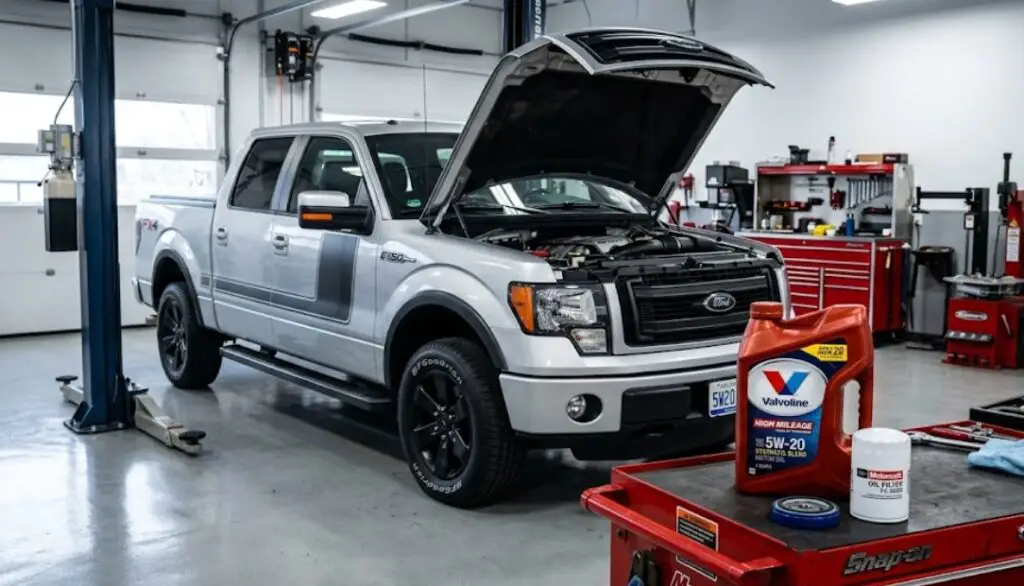
How Many Quarts of Oil Does a 2013 Ford F150 5.0 Take?
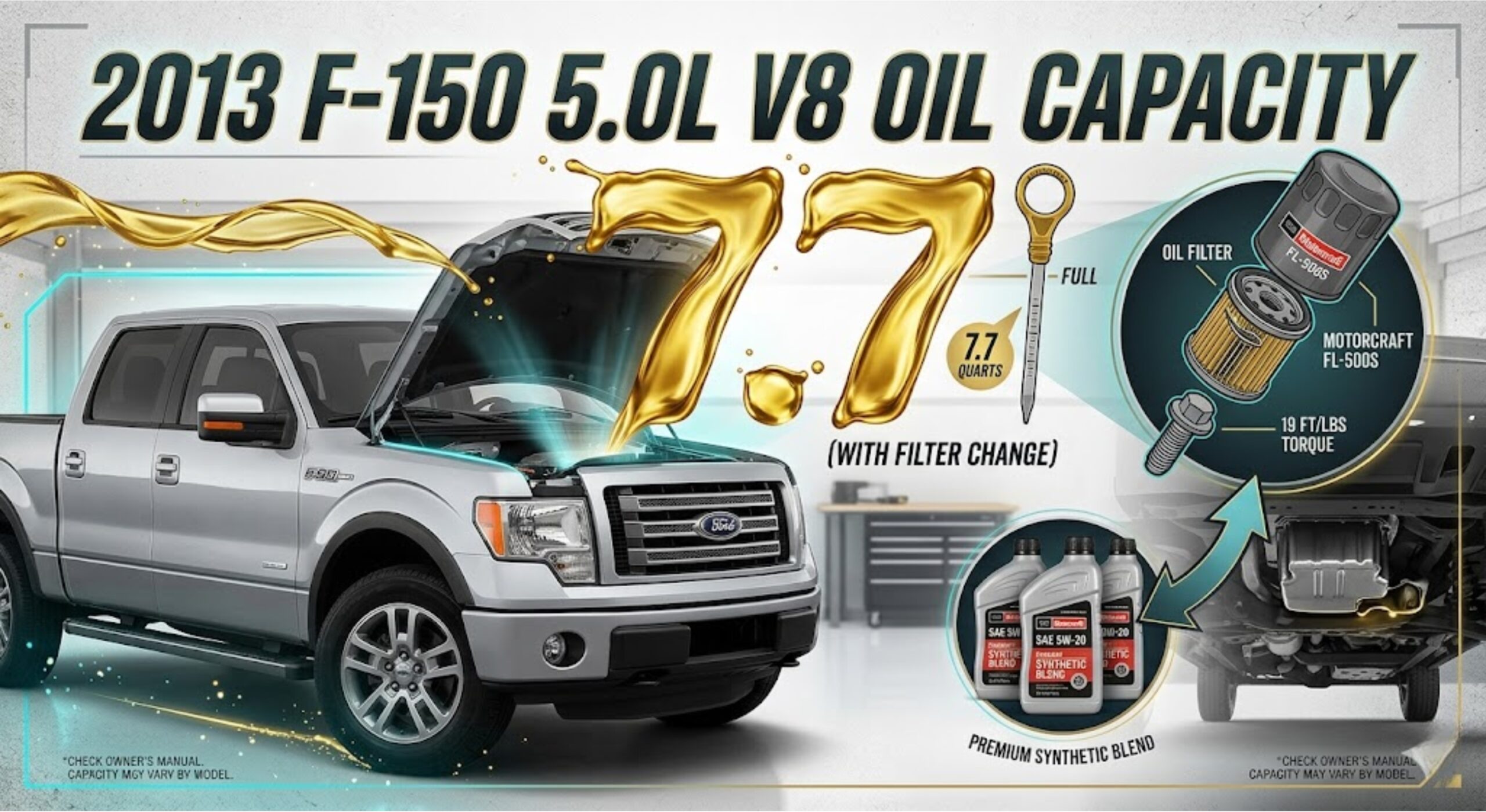
For the 2013 Ford F-150 equipped with the 5.0L V8 engine, the factory-mandated engine oil capacity is exactly 7.7 quarts, or 7.3 liters, when performing a comprehensive fluid change that includes an oil filter replacement. This specification remained static for the first generation of the Coyote truck engine, spanning model years 2011 through 2017.
It is a common point of diagnostic confusion for owners and technicians to assume that the drivetrain configuration alters the engine oil sump capacity. Extensive review of the manufacturer service manuals confirms that there is absolutely no deviation in engine oil capacity between two-wheel-drive (2WD) and four-wheel-drive (4WD) models. Both drivetrain setups require exactly 7.7 quarts of engine oil.
While a 4WD vehicle possesses additional independent lubrication subsystems, such as the front differential housing which takes 3.5 pints of axle fluid, and the transfer case which requires 1.5 quarts of dedicated transfer case fluid, the primary engine sump remains geometrically identical and unaffected.
Furthermore, it is critical to distinguish the 2013 specification from later iterations of the Coyote platform. In 2018, Ford introduced the third-generation Coyote 5.0L, which featured a transition to plasma wire arc-transfer cylinder liners and a significantly redesigned oil pan. Consequently, the oil capacity for 2018 through 2020 models increased substantially to 8.8 quarts. By the 2021 model year, the capacity was adjusted once again to 7.75 quarts.
Applying the later 8.8-quart metric to a 2013 engine will result in severe overfilling. Overfilling a crankcase is disastrous, as it allows the rotating crankshaft counterweights to submerge into the oil pool, causing aeration and foaming. Aerated oil cannot be properly pressurized by the oil pump, leading to a catastrophic loss of hydraulic pressure to the Ti-VCT phasers and potential failure of the engine’s internal hydrodynamic bearings.
Ford 5.0L Coyote Oil Specifications and Viscosity Standards
The 2013 F-150 5.0L is engineered to operate optimally on SAE 5W-20 motor oil. The 5W-20 weight is required across all standard temperature ranges, as it provides the necessary flow characteristics at startup while maintaining adequate film strength at operating temperatures.
The lubricant must meet Ford’s proprietary specification standards, which have evolved significantly over the past decade. Historically, the 2013 owner’s manual called for a synthetic blend oil meeting the WSS-M2C945-A specification. However, automotive lubrication standards are evolutionary, designed to meet the demands of modern engine tribology. The WSS-M2C945-A standard has since been superseded by the more rigorous WSS-M2C960-A1 specification.
The newer specification introduces enhanced protections against Low-Speed Pre-Ignition (LSPI) and improved timing chain wear mitigation, both of which are critical factors for the Coyote’s sophisticated and sensitive valvetrain architecture. While the factory fill utilizes Motorcraft Premium Synthetic Blend Motor Oil , independent diagnostic technicians strongly recommend utilizing full synthetic formulations offering the same WSS-M2C960-A1 and API SP/ILSAC GF-6A certifications.
Full synthetic oil provides superior thermal stability for applications involving severe duty, heavy towing, or extreme temperature fluctuations.
For geographical regions experiencing extreme cold, the manufacturer permits a highly specific deviation in fluid viscosity. In ambient temperatures that consistently drop to -22.0 degrees Fahrenheit (-30 degrees Celsius) or below, an alternative 0W-20 or 0W-30 engine oil meeting the WSS-M2C963-A1 specification may be utilized.
This adaptation significantly improves cold-start fluidity, reducing the parasitic drag on the engine internal components and ensuring the oil pump can instantly deliver fluid to the uppermost camshaft journals during sub-zero ignitions.
Essential Hardware: Oil Filters, Drain Plugs, and Torque Specifications
The filtration and fluid retention components of the 2013 F-150’s oil system are strictly standardized. Failure to adhere to these precise hardware specifications frequently results in systemic pressure losses, localized dry-starts, or weeping oil pan seals.
The Motorcraft FL-500S Oil Filter Mechanics
The OEM-specified oil filter for the 2013 5.0L is the Motorcraft FL-500S. The internal design of the FL-500S includes a highly specific, temperature-resistant silicone anti-drain back valve. Because the Coyote’s oil filter is mounted horizontally on the lower driver’s side of the engine block, directly beneath the alternator , an inferior anti-drain back valve made from standard nitrile rubber will degrade over time and allow oil to empty from the filter housing while the engine is turned off.
This phenomenon results in “dry starts,” a condition where the valvetrain and the primary hydraulic timing chain tensioners are momentarily starved of lubrication upon ignition. Frequent dry starts are a primary catalyst for premature timing component failure, making the specialized silicone valve in the FL-500S an absolute requirement.
Drain Plug Thread Specifications and Alterations
The factory oil pan drain plug features an M12-1.75 thread pitch and requires a standard 15mm socket for removal and installation. Due to the propensity for the factory 15mm hex head to round off after years of service and repeated torque cycles, the automotive aftermarket frequently offers reinforced replacement plugs featuring a larger 16mm hex head to provide a more secure gripping surface. Regardless of the exterior head size utilized, the underlying M12-1.75 coarse thread pitch remains constant and must be respected to prevent cross-threading the oil pan.
Fastener Torque Specifications
Overtightening the oil drain plug is a remarkably common procedural error that inevitably strips the delicate internal threads of the aluminum oil pan, leading to costly pan replacement. The authoritative torque specification for the 2013 5.0L oil drain plug is exactly 19 foot-pounds, or 26 Newton-meters.
For the oil filter, traditional industry guidance of tightening “hand-tight plus a quarter-turn” is the generally accepted standard for routine maintenance. However, specialized builder documentation indicates a highly specific two-stage torque process for the oil filter housing adapter if it is removed during engine rebuilding procedures: Stage 1 requires tightening to 44 pound-inches,
followed by Stage 2 which dictates a 180-degree physical rotation. For standard oil change maintenance, generously lubricating the rubber O-ring of the new FL-500S filter with fresh oil and tightening until snug by hand is sufficient to create a proper seal.Component Part Number / Specification Required Tool Fastener Torque Specification Engine Oil SAE 5W-20 (WSS-M2C960-A1) Standard Funnel N/A (System Capacity: 7.7 Quarts) Oil Filter Motorcraft FL-500S 74mm Filter Wrench / Hand Snug (Hand Tight + 1/4 Turn) Drain Plug M12-1.75 Coarse Thread 15mm Socket (OEM Standard) 19 ft-lbs (26 Nm)
The 5.0L Oil Change Procedure and the “Drip Tray” Anomaly
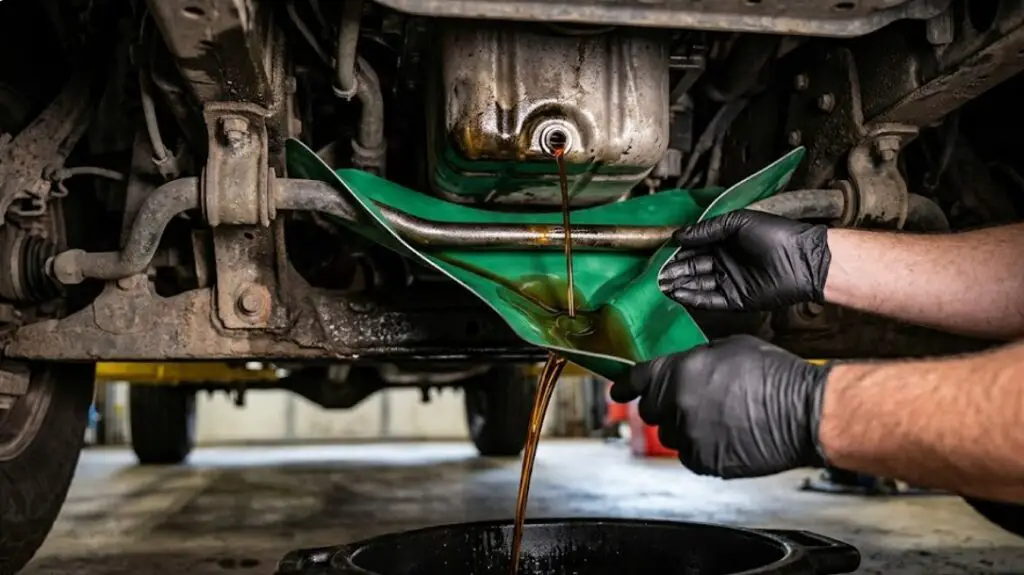
Performing an oil change on the 2013 F-150 5.0L involves relatively standard mechanical processes, but the physical layout of the vehicle introduces highly specific ergonomic and cleanup challenges that routinely frustrate technicians.
The procedure begins with proper preparation and access. The vehicle must be positioned on a perfectly level surface to ensure accurate fluid draining and subsequent dipstick readings. If the vehicle’s suspension is too low to facilitate unhindered access to the undercarriage, safety stands must be deployed utilizing the manufacturer-approved jacking points.
The technician should open the hood and remove the top oil filler cap immediately. Removing this cap serves a critical physical function: it breaks the vacuum seal within the crankcase, relieving internal pressure and promoting an uninterrupted, laminar flow of draining oil out of the bottom of the pan.
With the catch pan positioned beneath the rear-sloping oil pan, the 15mm drain plug is carefully removed. The oil should be permitted to drain for a minimum of ten minutes to ensure the sump is fully evacuated of contaminated fluid. Once the flow is reduced to a negligible drip, the drain plug is reinstalled and carefully torqued to the specified 19 foot-pounds.
The most notoriously problematic step involves the removal of the oil filter. Ford engineered a small plastic drip tray directly beneath the filter mounting boss, which was theoretically designed to channel the runoff oil safely downward into a waiting catch pan. In practical application, this engineering design exhibits a significant flaw.
When the FL-500S filter is breached and unthreaded, the pressurized oil frequently shoots horizontally or entirely overruns the shallow confines of the factory drip tray. This runaway fluid rapidly coats the vehicle’s electronic power assist steering (EPAS) housing and the front stabilizer sway bar, creating an extensive environmental mess on the shop floor or driveway.
To mitigate this architectural oversight, seasoned automotive technicians strongly recommend fabricating a secondary deflector shield out of flexible cardboard, or utilizing a commercially available, moldable “Form-A-Funnel” constructed of nitrile-coated high-tensile aluminum. By securing the deflector directly to the sway bar with a zip-tie before loosening the filter, the horizontal oil flow is physically forced downward into the drain pan, completely circumventing the associated mess.
A secondary procedural debate involves pre-filling the oil filter. Because the FL-500S oil filter mounts horizontally on the Coyote engine block , pre-filling the filter with fresh oil prior to installation is physically challenging and almost universally results in excessive spillage during the threading process. While pre-filling vertically oriented filters is an industry best practice to mitigate dry starts, the horizontal orientation on the 2013 F-150 renders this action largely impractical.
The standard operating procedure dictates lubricating the rubber gasket with fresh oil, installing the filter dry, and relying on the engine’s high-volume, gear-driven oil pump to rapidly saturate the filter media during the initial 30-second post-maintenance engine idle. Following this initial idle period, the vehicle is turned off, the fluid is allowed to settle, and the final oil level is rigorously verified via the engine dipstick, adjusting the 7.7-quart capacity precisely to the upper hash marks.
Resetting the Intelligent Oil-Life Monitor (IOLM) Algorithms
The 2013 F-150 powertrain management system does not rely on static, archaic mileage markers for maintenance intervals. Instead, it utilizes an advanced Intelligent Oil-Life Monitor (IOLM) system. The vehicle’s Powertrain Control Module (PCM) calculates oil degradation dynamically based on a proprietary algorithm that constantly tracks engine operating temperatures, the frequency of cold starts, total idle hours, and varying engine load parameters.
Once the engine oil is replaced, the IOLM must be manually reset to 100 percent. Failing to perform this critical administrative step will result in the dashboard persistently displaying premature “Engine Oil Change Soon” or “Oil Change Required” warnings, rendering the monitoring system entirely inaccurate for the subsequent maintenance cycle. Ford engineered two distinct methodologies to accomplish this reset, depending entirely on the type of instrument cluster optioned in the specific 2013 truck.
The first approach is the Dashboard Interface Method, utilized in trucks equipped with the advanced digital productivity screen. The technician must turn the ignition to the “On” position without actually cranking the engine to life. Using the directional control pad located on the steering wheel, the operator navigates through the main dashboard menu to the “Settings” tab, proceeds to the “Vehicle” sub-menu, and selects the “Oil Life Reset” function. By pressing and holding the “OK” button located in the center of the directional pad, a progress bar will initiate. Pressure must be maintained until the bar completes and the digital display confirms that the “Oil Life Set To 100%”.
The second approach is colloquially known as the “Pedal Dance,” which is the mandatory procedure for trucks featuring the base instrument cluster without steering wheel directional controls, or as a manual override for advanced clusters. The technician switches the ignition to the “On” position, ensuring the engine remains off. The operator must then fully depress both the accelerator and the brake pedals simultaneously, pinning them firmly to the floorboard.
After holding both pedals for approximately three seconds, a message will illuminate on the dash stating “Service: Oil reset in prog.”. The operator must maintain continuous pressure on both pedals for a duration of roughly 20 to 25 seconds until the display seamlessly transitions to a secondary message confirming the reset is fully complete. Only then may the pedals be released and the ignition switched off.
Tribology and Maintenance Intervals: The 5,000-Mile Consensus
While the Intelligent Oil-Life Monitor is undeniably a highly advanced piece of software, empirical engine data and exhaustive tribology analyses suggest that strict reliance on the system’s maximum theoretical thresholds can be detrimental to the Coyote engine. The official owner’s manual explicitly notes that under highly optimal, continuous highway driving conditions, the intervals prompted by the IOLM can reach up to 10,000 miles or one full calendar year. However, the mechanical realities and tight tolerances of the Coyote V8 dictate a significantly more conservative approach in practice.
For naturally aspirated engines like the 5.0L Coyote, independent diagnostic technicians and specialized engine builders overwhelmingly recommend adopting a severe-duty cycle interval of strictly 5,000 miles or 6 months, regardless of what the dashboard IOLM dictates.
This aggressive maintenance stance is deeply rooted in the engine’s physical architecture. The 5.0L engine utilizes exceptionally long, hydraulically tensioned timing chains to synchronize the four overhead camshafts. As the motor oil degrades over thousands of miles, it inevitably loses its shear stability. Simultaneously, microscopic particulate matter and carbon blow-by begin to accumulate within the fluid.
These suspended particulates act as a micro-abrasive compound on the delicate timing chain pins and links. Over an extended 10,000-mile interval, this abrasive action leads to permanent “timing chain stretch,” disrupting engine timing and ultimately requiring a massive engine teardown to rectify.
Furthermore, the Twin Independent Variable Cam Timing (Ti-VCT) phasers rely entirely on precise, uninterrupted fluid pressures to continuously advance and retard the camshaft timing. As oil ages, it oxidizes and forms sludge. This sludge can easily clog the microscopic mesh filter screens located within the VCT control solenoids. A restriction in flow to the VCT solenoids leads to incredibly sluggish engine response, erratic idling, mechanical misfires, and ultimately, costly phaser replacements.
Finally, modern driving habits frequently involve short, stop-and-go trips in urban environments. During these brief excursions, the engine rarely reaches the sustained 212-degree Fahrenheit operating temperatures required to effectively boil off internal condensation and evaporate combustion blow-by gases.
This phenomenon allows unburnt gasoline and moisture to dilute the crankcase oil, significantly reducing its kinematic viscosity and entirely compromising its protective film strength. Therefore, changing the 7.7 quarts of high-quality synthetic oil and the FL-500S filter every 5,000 miles represents the premier, data-backed strategy for ensuring the Coyote engine exceeds 200,000 miles without requiring devastating internal timing system overhauls.
Advanced Diagnostics: The Coyote Tick and Oil Consumption Myths
Properly maintaining and diagnosing the 2013 F-150’s oil system requires a nuanced understanding of the engine’s known acoustic characteristics and historical consumption anomalies. Diagnosing these issues correctly prevents owners from authorizing unnecessary, highly invasive engine repairs.
Deciphering the “Coyote Tick” Phenomenon
A pervasive acoustic anomaly deeply associated with the 5.0L V8 is colloquially known throughout the automotive industry as the “Coyote Tick” or the “Typewriter Tick.” This manifests as an irregular, metallic tapping sound that perfectly matches the engine RPM, becoming most prominent at idle only after the engine has reached normal, hot operating temperature.
Extensive teardowns and engineering analyses indicate that this specific tick is rarely a precursor to catastrophic engine failure. It is generally attributed to a combination of internal valvetrain acoustics, minor piston skirt friction within the aluminum cylinders, or the rapid cycling of the Ti-VCT solenoids as the engine oil naturally thins out at higher temperatures. Interestingly, the tick often becomes dramatically more pronounced immediately following a fresh oil change.
This counterintuitive reality occurs because brand-new engine oil is highly detergent and entirely lacks the minor suspended carbon particulates that naturally accumulate in older oil. These microscopic particulates serve to temporarily “cushion” the microscopic clearances between metal components. Once the old oil is flushed, the acoustic dampening effect is lost. Owners have reported measurable success in dampening the acoustic signature by transitioning to a slightly more robust oil base stock, or by utilizing advanced, molybdenum-based friction modifiers like Ceratec.
However, as long as the mechanical oil pressure remains stable, and wear metals analyzed via a specialized used-oil analysis laboratory remain within average parameters, the tick is largely considered a harmless operational characteristic of the engine platform rather than a mechanical defect.
Clarifying Technical Service Bulletin 19-2365 Regarding Oil Consumption
When researching the F-150 5.0L engine architecture, an investigator will inevitably encounter vast amounts of literature detailing excessive oil consumption issues. It is absolutely vital to clarify the strict chronological scope of this issue to avoid misdiagnosing a 2013 vehicle.
In December of 2019, Ford officially issued Technical Service Bulletin (TSB) 19-2365—which was later superseded by various updates—directly addressing excessive oil consumption, which the manufacturer defined as burning greater than one quart of oil per 3,000 miles of travel. Engineering analysis identified the root cause as abnormally high intake manifold vacuum occurring specifically during Deceleration Fuel Shut-Off (DFSO) events.
This excessive vacuum force was physically pulling liquid oil vapor directly through the Positive Crankcase Ventilation (PCV) system and the valve guides, depositing it into the combustion chambers where it was burned and expelled through the exhaust. The authorized repair involved reprogramming the PCM to alter the vacuum curve, changing the oil, and installing a newly calibrated, longer engine dipstick to mask the visual drop in fluid.
Crucially, this specific TSB applies exclusively to the 2018 through 2020 (Generation 3) Coyote engines. The 2013 (Generation 1) 5.0L engines utilize an entirely different PCM calibration, traditional heavy iron cylinder liners rather than arc-sprayed bores, and a different PCV routing architecture. Therefore, the 2013 F-150 5.0L is functionally exempt from the systemic, vacuum-induced oil consumption issues that plagued the later iterations.
If a 2013 model exhibits significant oil loss between intervals, the diagnostic path should immediately focus on standard mechanical wear items, such as degraded valve stem seals, worn piston rings, or obvious external gasket leaks, rather than relying on software calibrations.
Comparative Powertrain Lubrication Matrix
To properly contextualize the 5.0L V8’s fluid requirements, it is highly useful to map its lubrication specifications against the other powerplants available in the 2013 Ford F-150 lineup. The 5.0L requires the highest fluid volume among the standard, widely adopted engines, surpassed only by the heavy-duty, niche 6.2L V8 utilized primarily in the SVT Raptor and premium trims.
| Engine Configuration | Oil Capacity (w/ Filter) | Specified Oil Viscosity | OEM Filter Part Number |
| 3.5L EcoBoost V6 | 6.0 Quarts (5.7 Liters) | SAE 5W-30 | Motorcraft FL-500S |
| 3.7L Ti-VCT V6 | 6.0 Quarts (5.7 Liters) | SAE 5W-20 | Motorcraft FL-500S |
| 5.0L Coyote V8 | 7.7 Quarts (7.3 Liters) | SAE 5W-20 | Motorcraft FL-500S |
| 6.2L Boss V8 | 7.0 Quarts (6.6 Liters) | SAE 5W-20 | Motorcraft FL-820S |
Questions and Answer (People Also Ask)
What are the mechanical ramifications of utilizing 5W-30 instead of the factory 5W-20 in a 2013 5.0L?
While the 2013 factory specification strictly dictates 5W-20 , a significant contingent of lubrication engineers and mechanics advocate for 5W-30, particularly in high-mileage scenarios or exceedingly hot climates. Ford’s engineers originally specified 5W-20 primarily to meet stringent Corporate Average Fuel Economy (CAFE) standards. Thinner oil creates demonstrably less hydrodynamic drag on the rotating crankshaft and complex valvetrain, which marginally improves overall vehicle fuel efficiency.
Furthermore, it guarantees rapid pressurization of the highly sensitive Ti-VCT solenoids during cold morning starts. Conversely, at operating temperature (212°F / 100°C), 5W-30 retains a noticeably higher kinematic viscosity, resulting in a thicker, more robust protective boundary layer between high-stress metal surfaces. In 2021, Ford retroactively shifted the factory recommendation for the newest generation of 5.0L engines back to 5W-30.
While 5W-20 remains the official baseline for the 2013 model, stepping up to a high-quality 5W-30 full synthetic will absolutely not harm the engine and will likely offer vastly superior protection against thermal breakdown during heavy payload hauling or continuous trailer towing operations.
Why does the oil life monitor reset to 100% when the oil looks visibly dirty immediately after a change?
The Intelligent Oil-Life Monitor (IOLM) operates entirely on algorithmic calculation, not optical sensors. The system has zero physical capability to evaluate the actual color, opacity, or chemical condition of the oil sitting in the pan. It resets to 100% simply because the operator manually executed the digital reset command, establishing a new baseline for the algorithm to begin counting down based on subsequent engine loads and temperatures.
If the oil appears dark brown or black immediately following a change, it is merely indicative of the new oil’s high detergency immediately suspending residual carbon deposits left behind in the engine block from the previous cycle.
Is the Coyote engine susceptible to catastrophic oil pump gear failure?
While not isolated exclusively to the 2013 model year, the powdered metal oil pump gears (OPG) utilized in the factory Coyote engine are a known weak point, particularly under extreme stress. In a naturally aspirated truck used for daily driving, the factory powdered metal gears are entirely adequate.
However, if the 5.0L engine is subjected to forced induction (supercharging), or repeatedly hits the rev limiter, the harmonic vibrations transferred through the crankshaft can shatter the brittle factory oil pump gears. When these gears shatter, the engine immediately loses all oil pressure, resulting in total engine destruction within seconds.
For high-performance builds or severe-duty applications, upgrading to billet steel oil pump gears is considered a mandatory preventative measure.
Conclusions and Strategic Maintenance Recommendations
The 2013 Ford F-150 5.0L V8 Coyote is an exceptionally durable powertrain, provided its complex lubrication ecosystem is meticulously maintained and thoroughly understood. The constant interplay between fluid volume, temperature-dependent viscosity, and absolute mechanical filtration forms the irreplaceable bedrock of its operational longevity.
Based on the exhaustive synthesis of OEM specifications, fluid dynamics, and thousands of hours of field data, the actionable recommendations are as follows:
- Strict Capacity Adherence: The engine requires exactly 7.7 quarts of fluid, regardless of the vehicle’s drivetrain. Technicians must actively resist the urge to apply the 8.8-quart specification belonging to the 2018+ models, as overfilling will induce devastating crankshaft aeration.
- Fluid and Hardware Selection: Utilize a fully synthetic SAE 5W-20 or 5W-30 motor oil meeting the updated WSS-M2C960-A1 specification. Pair this exclusively with a genuine Motorcraft FL-500S filter to ensure proper silicone anti-drain back valve functionality. The use of aftermarket filters with inferior valving will guarantee dry starts.
- Torque Discipline: The M12-1.75 coarse thread drain plug must be precisely torqued to 19 ft-lbs (26 Nm) to prevent thread galling and permanent damage to the expensive aluminum oil pan.
- Interval Management: Reject the 10,000-mile upper theoretical threshold programmed into the factory IOLM. Adopt a strict 5,000-mile or 6-month severe-duty fluid replacement interval to proactively preserve the hydraulic integrity of the delicate Ti-VCT system and delay the onset of timing chain elongation.
- Procedural Efficiency: Always deploy a Form-A-Funnel or custom cardboard deflector shield during the filter removal process to bypass the fundamentally flawed factory drip tray design. This will completely prevent the inevitable contamination of the steering rack and suspension sway bar components.